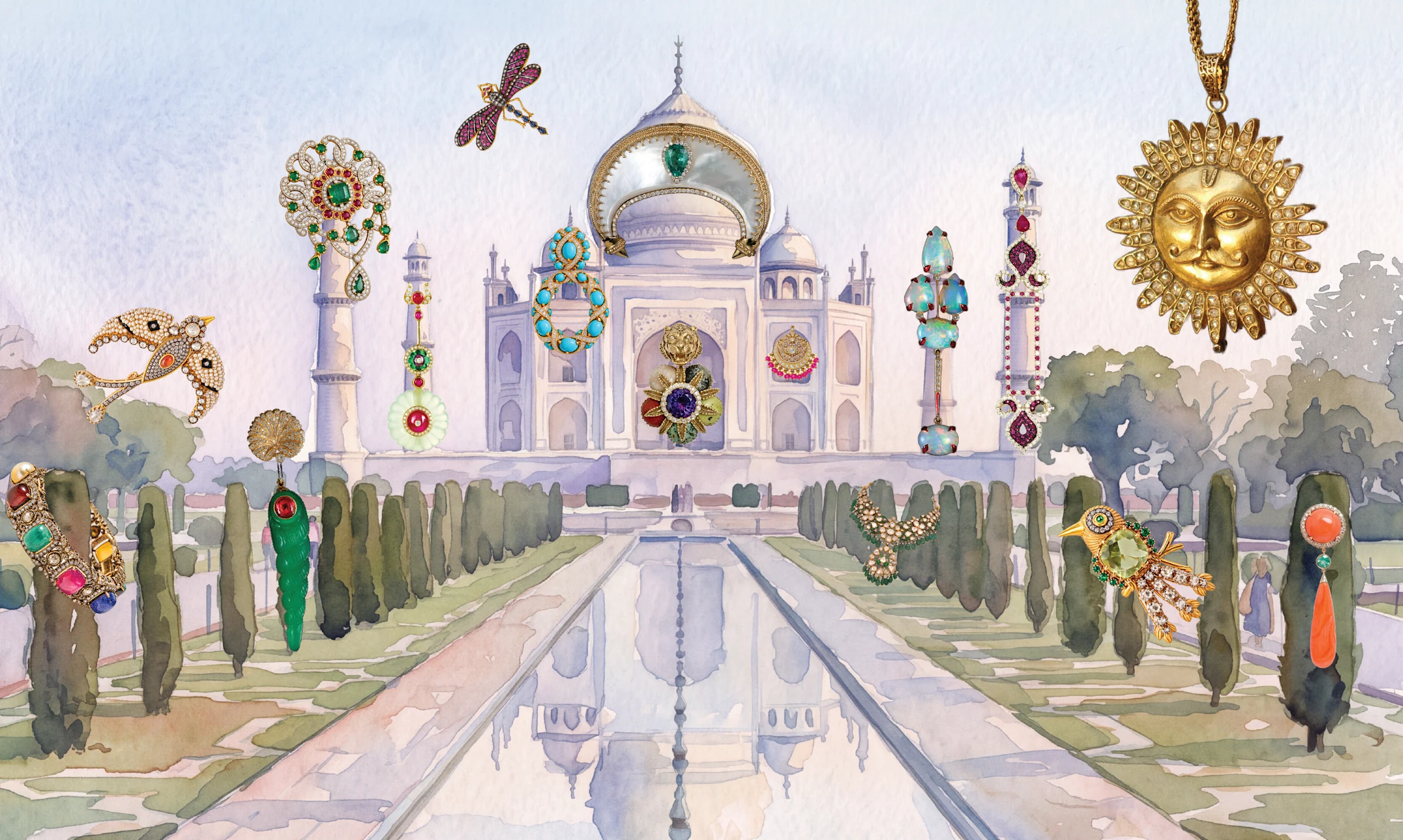
In a workshop in Kolkata’s Bowbazar jewelry district, framed images of deities hang above workbenches scattered with gold filings and glinting uncut gemstones. Torches hiss and hammers clang as artisans turn rough stones into some of India’s finest necklaces, rings, and bracelets.
At his bench, master artisan Mihir Swarnakar is focused on a single diamond, its facets flashing in the morning light. Beside it lies his work ahead: a mound of cloudy, irregular stones to be painstakingly polished. For days, he has coaxed high-karat gold into a bezel that traces the finished diamond’s contours. Now, with a few careful presses of his burnisher, he secures the gem in place. His movements seem instinctive, as though the generations of jewelers before him had passed down their muscle memory.
Unlike Swarnakar, Akshat Ghiya had no formal training in jewelry-making. When the founder of Jaipur-based label Tallin started sketching his pieces, his artisans would scoff at his drawings, insisting they couldn't be made. In his atelier, where goldsmiths, setters, and polishers work to the melodies of Kishori Amonkar and Ustad Amir Khan, he sets traditional polki diamonds without their customary gold-foil backing, allowing light to pass through the stones. Skepticism is part of the creative process. “We always try anyway,” he says. “Surprisingly often we find a way to make things work.”
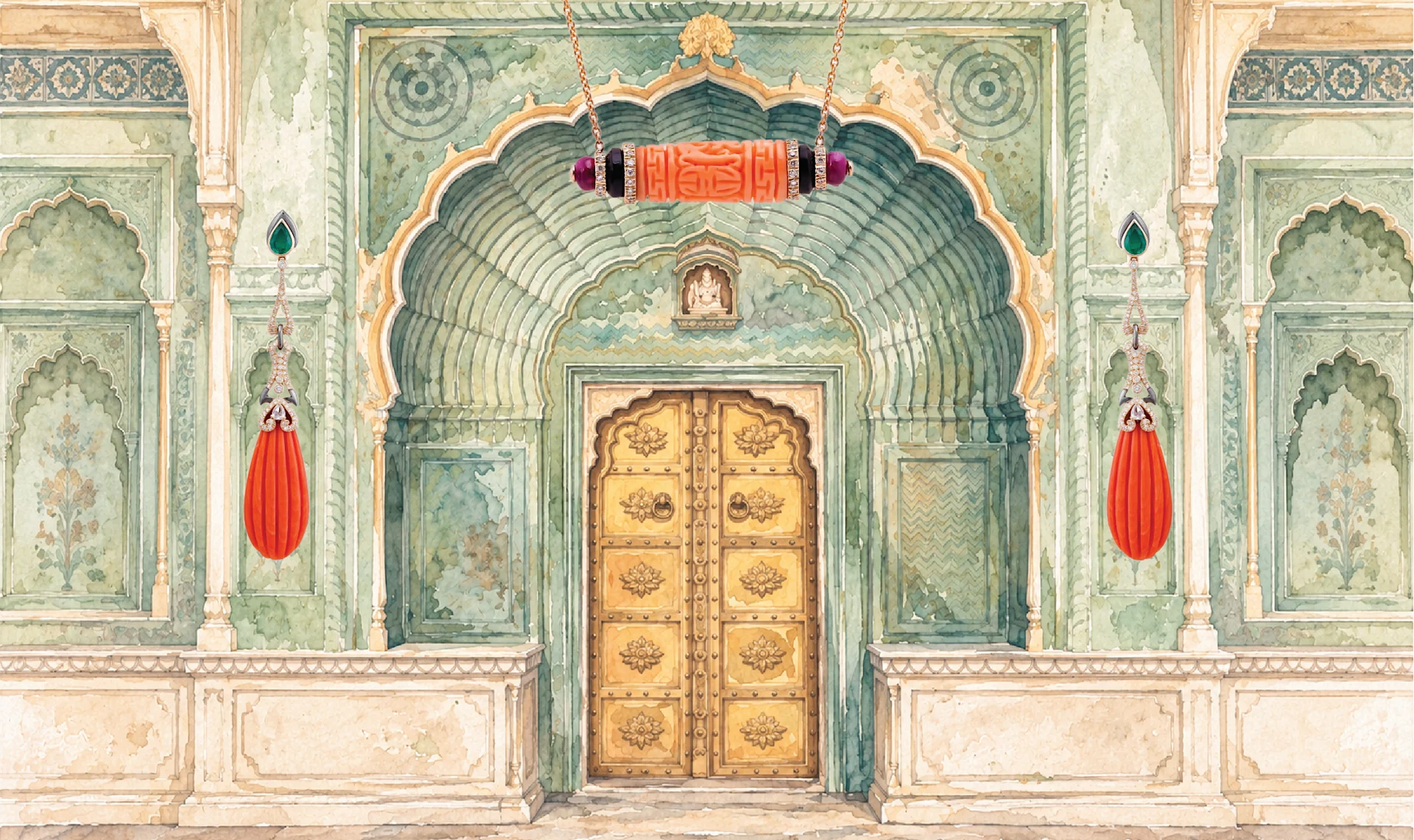
Swarnakar and Ghiya embody two approaches to Indian jewelry-making that increasingly intersect: one anchored in techniques passed down through generations, the other keen to test their limits. This dialogue has implications far beyond India: With Kolkata-born luxury house Sabyasachi collaborating with The Met and House of Masaba selling its pieces through Moda Operandi, Indian designers could help determine what the rest of the world wears next.
Ghiya’s approach may be unconventional, but he grew up steeped in the trade: His father traded gemstones in Italy, while his mother established the Jaipur atelier that’s now home to Tallin. Jaipur has been a center of the craft since its founding in 1727. Beyond the studio on weekday mornings, gemstone traders call out as rickshaws clatter by, and vendors hang strands of gems as nonchalantly as laundry.
Few people realize how much of European high jewelry owes its look to India. In 1911, Jacques Cartier, heir to the famed Parisian house, traveled to Delhi for George V’s durbar. There, he marveled at the sinuous goldwork and riotous combinations of emeralds, rubies, and sapphires worn by Indian royalty. Parisian tastes at the time were comparatively muted: Diamonds, typically in symmetrical settings, were de rigueur. Cartier would bring India's exuberant use of color back to Paris, helping popularize the style later nicknamed Tutti Frutti. In 1936, the house made one of its most famous examples, the Hindu Necklace, for the socialite Daisy Fellowes.
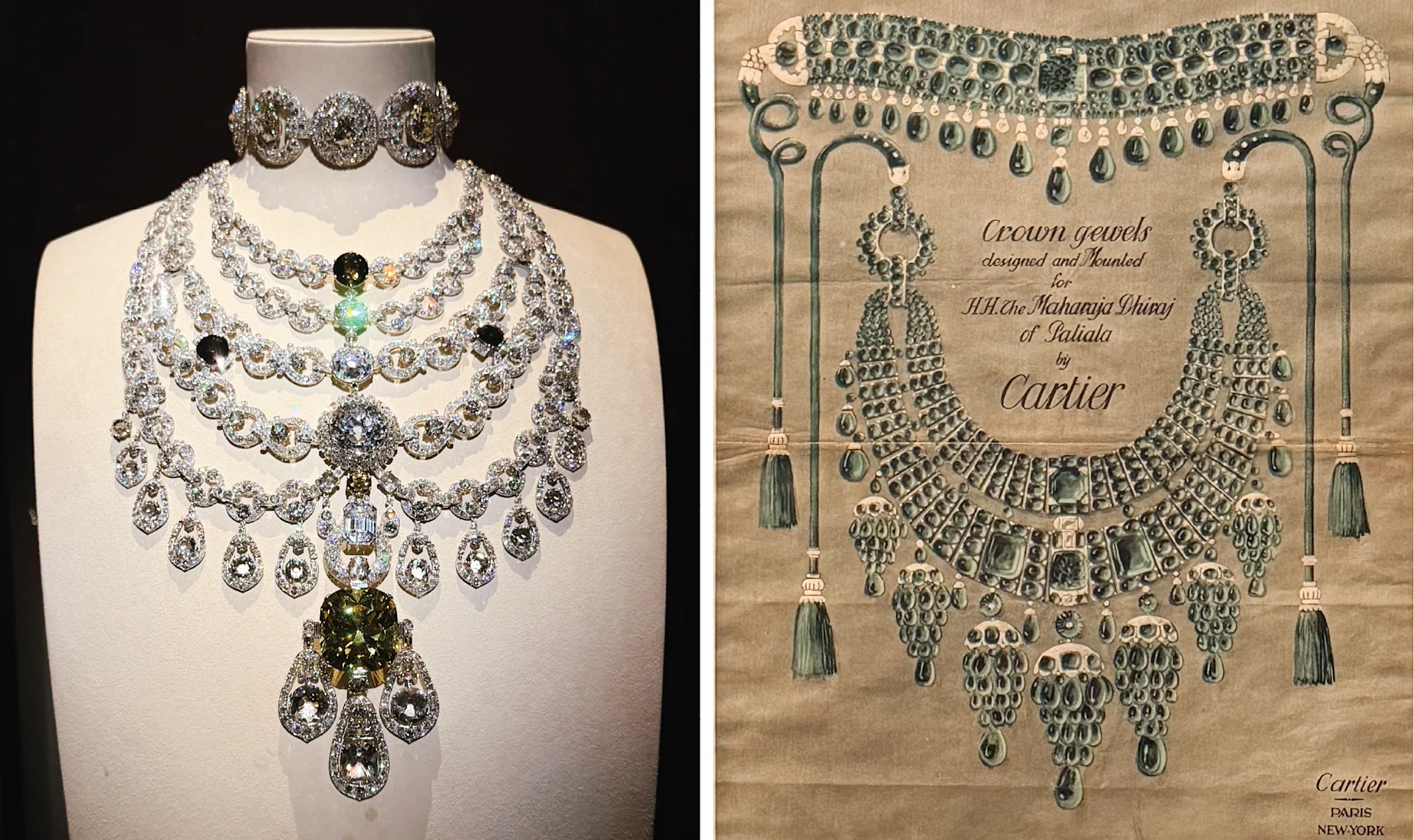
Patiala Necklace, commissioned by Maharaja Sir Bhupindra Singh of Patiala and created by Cartier Paris in 1928 (photo: Wojciech Rosiak)
Cartier’s 1928 advertisement for the crown jewels designed and mounted for Maharaja Sir Bhupindra Singh of Patiala (photo: Wojciech Rosiak)
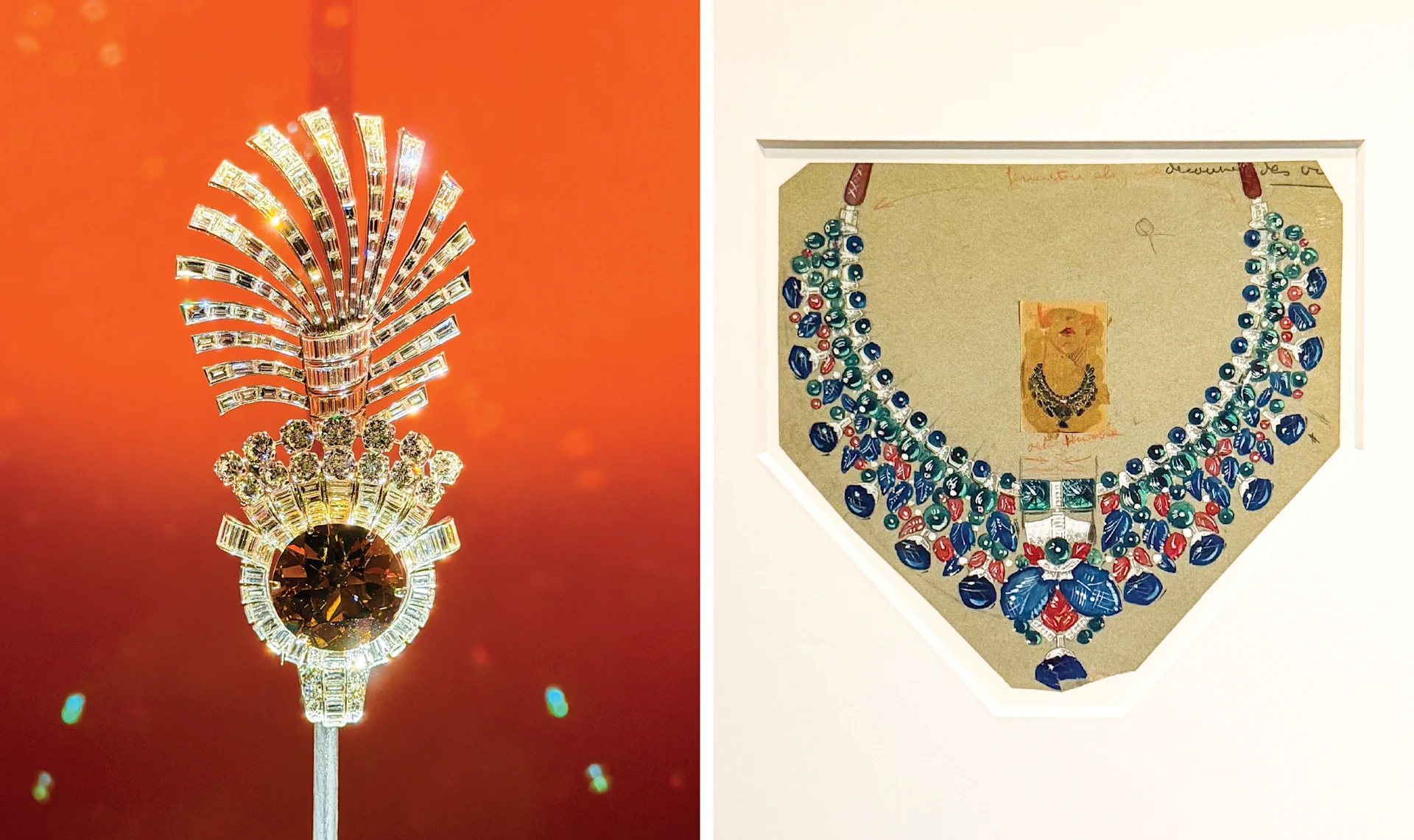
Tiger’s Eye Turban Ornament, created by Cartier London in 1937 and set with a 61.5-carat brownish-yellow diamond (photo: Wojciech Rosiak)
Archival design for a necklace illustrating Cartier’s use of colored stones and intricate compositions (photo: Wojciech Rosiak)
Patiala Necklace, commissioned by Maharaja Sir Bhupindra Singh of Patiala and created by Cartier Paris in 1928 (photo: Wojciech Rosiak)
Cartier’s 1928 advertisement for the crown jewels designed and mounted for Maharaja Sir Bhupindra Singh of Patiala (photo: Wojciech Rosiak)
Tiger’s Eye Turban Ornament, created by Cartier London in 1937 and set with a 61.5-carat brownish-yellow diamond (photo: Wojciech Rosiak)
Archival design for a necklace illustrating Cartier’s use of colored stones and intricate compositions (photo: Wojciech Rosiak)