
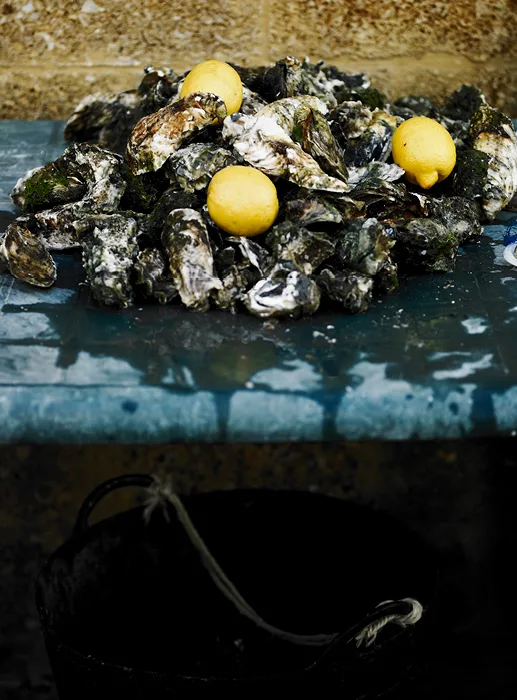
The most important thing I put in my suitcase before a trip to Cádiz, the Andalucian port city I’ve been to many times through the years, is my knife roll. This is because I go there to cook, which also explains why my iPad carries a variety of favorite Spanish cookbooks and a couple of recipes photocopied from books that pre-dated this cyber convenience—Janet Mendel’s irresistible Andalucian red-garlic and fish soup from her great 1996 collection Traditional Spanish Cooking, for example. Let me explain.
Built at the end of a long, narrow peninsula that sticks out into the limpid green waters of the Atlantic like a cooking spoon, Cádiz was founded by the Phoenicians around 1100 BC and claims to be the oldest continuously inhabited city in Europe.
This estimable historical pedigree to one side, Cádiz is also surely one of the happiest places in the Old World, because the primal brininess that hovers over this town is as comforting as it is invigorating. Even when it’s out of sight, the sea is always present. The sunlight reflected off its waters brightens the narrowest alleys in the Old Town and the mouth-watering smells of seafood-centered Gaditana cooking hone your hunger from dawn to dusk.
Everyone is welcome in this big-hearted place, which is always up for a good time and a story or two told over a coffee or a pour of xeres (sherry). There is a frank and friendly curiosity about new ideas and faces, which comes from the town’s ancient vocation for receiving strangers who arrive in boats from faraway places.
Aside from the occasional brief surge of visitors brought on by docking cruise ships, Cádiz is also one of those delectable European destinations where life has not been jarred by travelers. Instead, it remains a confidential place to be discovered on foot and savored as much for its atmosphere as its sights. The one time of the year the town gets busy is during its famous carnival, which runs from February 16th to the 26th in 2023; although the actual festivities begin three weeks before this official opening date.
Though carnival in Cádiz is a pageant of colors, floats, processions and fireworks, what makes it fascinating is that it has an important satirical side linked to contemporary events and expressed through song by the chirigotas, singing groups that work on their themes all year long and convey them via words set to simple melodies. This literary edge reflects the reputation of the Gaditanos as being the wittiest people in Spain, with a famously sharp sense of humor, and it also explains why carnival was banned by the Franco regime.

The first time I visited Cádiz, it was an accidental trip made in flight from a Spanish Mediterranean beach town where a love affair had gone off the rails. “Go to Cádiz,” a close friend in Madrid advised when I called her stricken from a phone booth. “Spend a few days there and let the hurt fade a bit before you go back to Paris.” So without asking her why, I did, and coming out of the train station on a quiet August morning, the cerulean skies and soft saline stink of the sea immediately unknotted my shoulders.
Walking to the seaside parador where I’d booked a room, I found myself in front of a beautiful café, the aptly named Café Royalty, an elegant 1912 spot I later learned is one of the swankiest watering holes in the city. So I stepped inside and sat at a gray marble-topped table. “Good morning, and welcome to Cádiz,” said the freshly-shaven waiter in English, eyeing my luggage, when he came to take my order. He smelled pleasantly of the cypress in Agua Brava cologne and also the strong Ducados cigarette he’d probably smoked while shaving in a hurry, late for work. All I wanted was a coffee and some cold sparkling water, but he insisted I try some picatostes, too. Covered with confectioner’s sugar, these golden lozenges of fried bread were delicious.