In December, Italian photographer Enrico Costantini found a way to visit Socotra, an island way out in the Arabian Sea that's owned by Yemen. Having traveled to many parts of the Middle East, Qatar, Oman, Saudi Arabia, it’s a trip Costantini has been planning and cancelling since 2014. Travel to Yemen is of course forbidden. The country has been in the center of not only horrific conflict between tribes, but conflict with neighboring Middle Eastern countries and the presence of Al Qaeda. The state of Yemen is so dire that the UN has called its humanitarian crisis “the worst in the world.” But Costantini found a path to Socotra, which he describes as a “different world” from mainland Yemen, with its own culture and biodiversity. True though that may be, we are not recommending anyone go on this journey, but rather see it through Costantini’s lens.
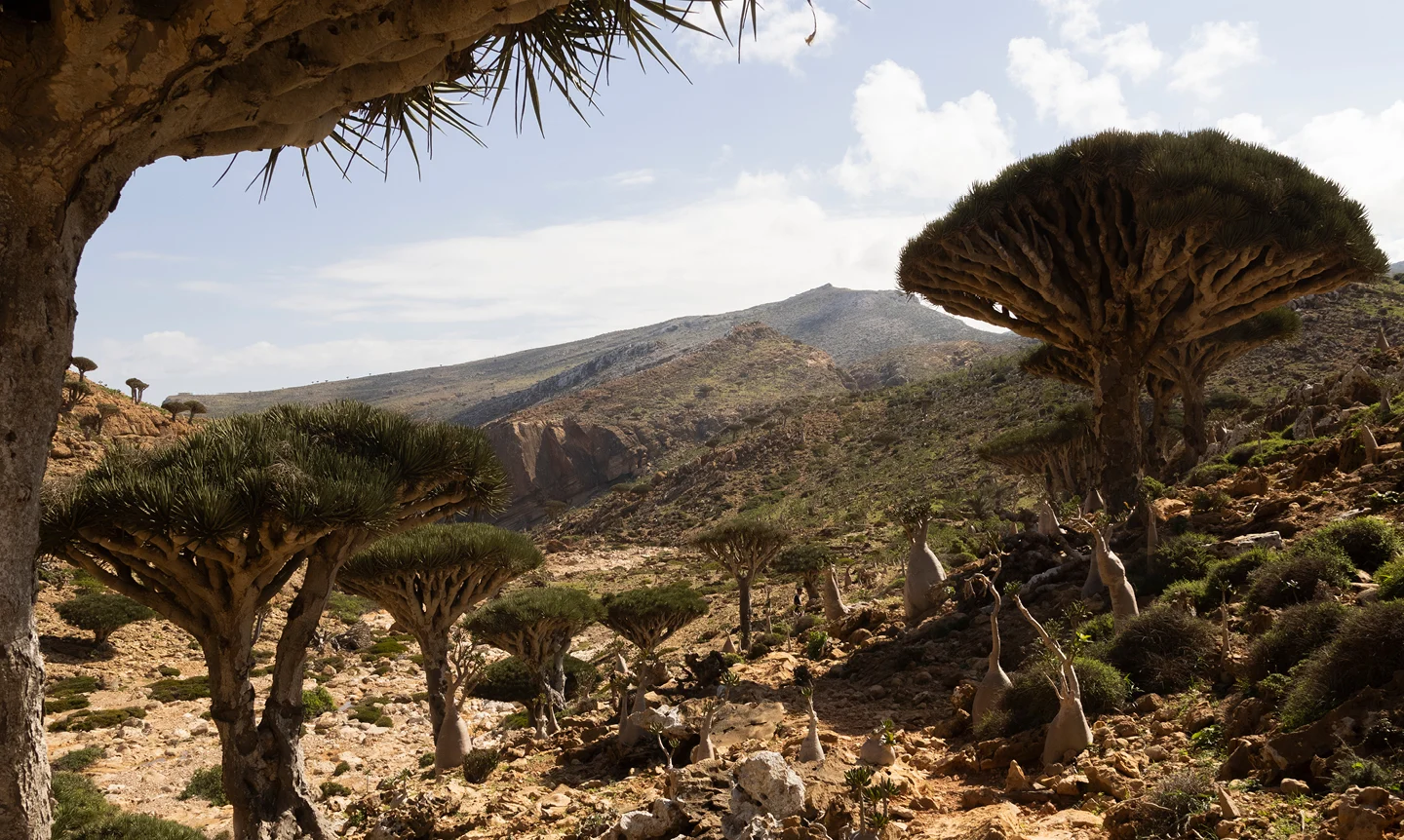
Socotra is often compared with the Galapagos islands, in that it is home to hundreds of plants and animals that are unique to the island. The hallmark of this is the Dragon’s Blood tree, enormous and old, with a mythical red sap. These giants are found in the mountainous core of the island, protected from the fierce winds that can stir up. (A cyclone in 2018 destroyed many of the largest, oldest ones.) Costantini divided his week there between the city of Hadiboh, camping in Diksam, where the Dragon’s Blood grow, and down along the white sand coastline of Qalansia and its teal-green Detwah Lagoon. Here, snapshots and notes from his explorations.

On our first morning we went very early to the crowded fish market in Hadiboh, the capital city, where a lot of people were coming and going on their motorbikes. In Socotra, most get around on motorbikes (or 4-by-4s)—all very charming, vintage enduro motorbikes—and often with two or three people on each one.

In front of the fish market, there’s a small vegetable market, with a few fruit stands down a side street. Fishing is the main industry here and fish, with rice and vegetables is primarily what everyone eats (occasionally goat meat, too). The island is lively and wild, but there aren’t many fruits and vegetables grown here, those are imported.

There are only a few restaurants, or little cafés, with just a few options, on this one street, where I ran into these men chatting, but that’s all. Same with shops. Everyone cooks at home. As a tourist I was traveling with a friend and guide, as well as a chef and his assistant, who cooked for us while we were camping.

I did see a few men meeting up for tea in this small shop.

This kid was baking these circular breads in an oven in the back of this bakery and came out to offer me a piece.

We left the city to go camp in the mountains, to see the biggest Dragon’s Blood trees. Dixam is a small village just near where we camped. This kid on the wall was playing with a football and then stopped to look at me. It’s so unusual for the kids to see tourists so they were very curious about what we were doing.