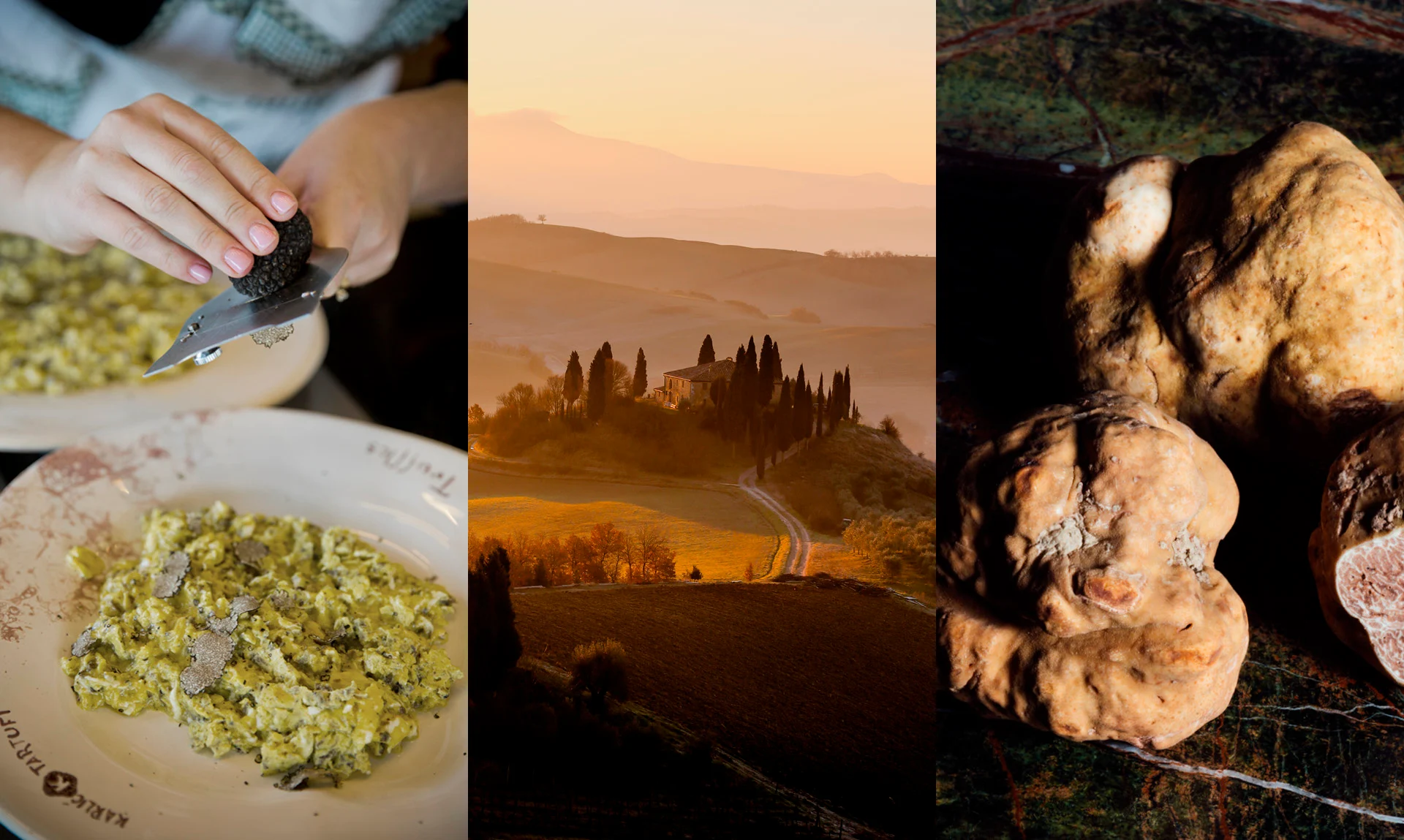
To get one (only seemingly) astonishing fact out of the way: There are not really truffles growing in Alba proper. It does make sense that the second largest town in Italy’s northern region of Piedmont—where some central streets are lined with stores like Gucci and Prada boutiques—does not in fact have hunters with rubber boots and sniffing truffle hunting dogs and pigs wandering through the pedestrian zones looking for treasure. The Albesi, turns out, have merely succeeded in branding the most sought-after and most expensive of the rare truffle varieties with the very name of their town, as the white truffle is often referred to globally as the “White Alba truffle”.
The white truffle does occur naturally in the surrounding hills around Alba, but what’s lesser known is that it can be found in many and large parts of western Piedmont, as well as in the Italian regions of Tuscany, Lombardy, Emilia-Romagna, Marche, and Umbria, too. Beyond Italy, truffles—rare, mushroom-like fungi which spring up wildly beneath the earth under certain temperate climates—also occur naturally in Europe in the soil of the Balkan Peninsula, parts of Spain, southern France, as well as the Istrian Peninsula.

There are almost one hundred different types of truffles, not all of which are edible. And among the edible varieties, only a few are of economic or grand culinary importance, and most remain shrouded in mystery even to those who harvest them. In addition to the aforementioned White “Alba” truffle or Piedmont truffle (Tuber magnatum Pico), that short list includes the Black Summer truffle (Tuber aestivum), Winter truffle (Tuber brumale), Black truffle or “Périgord” truffle (Tuber melanosporum); and the Bianchetto truffle (Tuber borchii).

While the summer truffle exists, it is the most common, least rare, and least expensive. It is frequently served in upscale restaurants, where it is often sliced raw atop elegantly plated dishes, positioned to impress—but this variety is relatively tasteless when unwarmed (as are all other truffle varieties, except the two white ones). It is Europe’s fall and winter truffle varietals, which can be found starting in September, which are higher in demand, more concentrated in flavor, and most prized.
The deepest in flavor (and consequently most expensive) of all of the black truffle varieties is the so-called Périgord truffle, which is not only deep black on the outside (like the Summer truffle and even the Winter black truffle), but also on the inside. This is in season from January until the spring, and—like its summer counterpart—tastes best when heated.
The truffles best eaten raw—i.e. Delicately shaved over the simplest possible dishes such as pasta or soft scrambled eggs—are exclusively the two white varieties. By name, these are the Bianchetto truffle, which grows from the end of January to mid-April, but is more yellowish in color and has a more garlicky flavor; as well as the noble, perfumey, and pricy White “Alba” truffle, available only from late September to December and reaching its flavor peak in November.
It is no surprise that the cuisines of the regions and countries where truffles grow nearest take a truffle-y turn come fall. Whichever of the varieties is your preference or your hopeful prize, here is a starting guide for where to find truffles and how to eat black truffles and white truffles close to their sources, and with respect to their regional cuisines.
ITALY
Thanks to decades of effective marketing, the town of Alba in the northern Italian region of Piedmont is considered the capital of the white truffle, or tartufo bianco. Every autumn, tourists storm the pretty little town to eat or buy (often at exorbitant prices) rare truffles, which in many cases may not even come directly from the region. Regardless, there are several restaurants here and in the surrounding area that have—after years of access—become among the best addresses at which to eat truffles in the world. In many, you choose your level of indulgence: The truffle is weighed at the table before it is grated until you say “stop”, then weighed again (you pay the difference in weight).