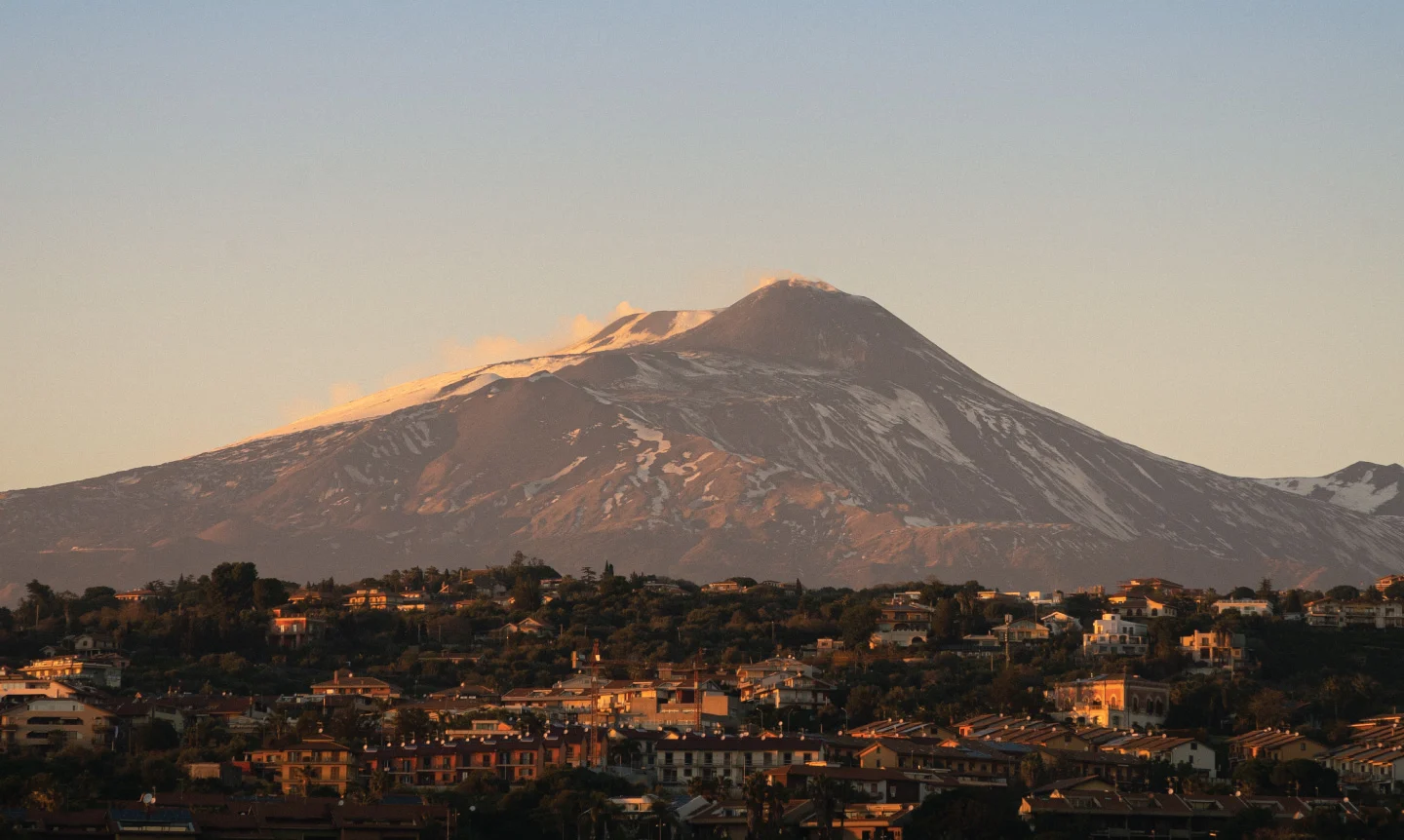
I arrived in Sicily in the wake of The White Lotus. Three weeks after four million Americans had watched Tanya McQuoid, the heiress played by Jennifer Coolidge, tumble to her death from a megayacht stationed only yards from the coastline of the Italian island. Three weeks after Google searches for “Sicily” doubled in the United States.
My plane touched down in Palermo just after 3 P.M. The moon had already wandered into the Bubble Yum-blue sky and the air smelled of wet earth. I walked from the landing strip, surrounded by hulking outcrops, to the terminal. A group of well-heeled men behind me spoke in the drawled consonants and clipped vowels of received pronunciation. I heard words like “villa” and “boat” and “exquisite.” I sprinted to a taxi and threw myself inside.
In the city, I rolled down my window. It no longer smelled like earth. It smelled of gasoline fumes wafting from the scooters negotiating Palermo’s tight medieval streets and of freshly-butchered meat from the open-air markets. Other corners smelled like they were drenched in cooking oil, thanks to the many friggitorie, shops that peddle fist-sized arancini stuffed with beef, potato crocche, and fried chickpea panelle.
Palermo has a reputation for chaos and cacophony. But as we pulled up to Casa Nostra in Il Capo, only a few vendors remained along a stretch that normally hosts a raucous daily food market. One person forlornly turned stigghiole, or skewered intestines, over smoldering charcoal, scrolling through TikTok with his other hand.
The driver of my minivan cab pulled over to the side of a cobblestoned street. She sighed and cracked her neck. Before we parted ways, I asked if she had seen White Lotus, the American television program.
“No,” she said, after a long pause. She cocked her head to one side, before asking in Italian, “What is that? Did you make it?”
Hollywood often dangles the promise of vacation before us. Occasionally, we bite.
This is, after all, a critical part of why we watch: to be transported. When a popular show’s carefully-curated portrait of a faraway destination puts the world’s attention in a chokehold, the place, as if by osmosis, begins to assume those attributes. Take what we made of rural Italy after Under the Tuscan Sun (unrelentingly balmy, and perfect for an American’s self-discovery journey). Or Bali after Eat Pray Love (peaceful, and perfect for an American’s self-discovery journey). Or the English countryside after The Holiday (gray, and perfect for an American’s self-discovery journey). Life begins to imitate art — art about a certain kind of traveler, at least.