Calling Piero Portaluppi just a recently rediscovered architect would be slightly misleading. While it’s true that without director Luca Guadagnino filming a great deal of 2009’s I Am Love in the magnificent Villa Necchi Campiglio, many international visitors may not have been able to pinpoint his work, the sheer quantity of buildings he realized in Milan has inevitably shaped the face of this northern Italian city — cementing the understated, muted elegance that still makes it both fascinating and somewhat impenetrable. However, the fact that Portaluppi’s career flourished in the 20s and 30s — at the height of Italy’s Fascist regime — makes him, in some respects, more of a rehabilitated designer. Some of the commissions he took from the party are hard to swallow politically today; but the pared-back, eminently modern looks of the era’s Rationalist style are captivating to those able to divorce ideology from aesthetics. More so than anything, Portaluppi was the architect of a flourishing, intellectual bourgeoisie who wanted new homes and offices in a fast-changing city. His approach straddled different eras: born in 1888, he carried the sweeping ornateness of Art Deco into his later, Rationalist projects, creating an eclectic style that dipped into neoclassicism but always with a sumptuous, subdued chicness. A satirical cartoonist and illustrator as well as a furniture designer, collector, and amateur filmmaker, Portaluppi called himself “a man of 25 careers,” who built power plants as well as villas and office blocks. Those wanting to explore his work beyond the (deservedly) revered Villa Necchi can start with this itinerary of ten highlights dotted around Milan.
Casa degli Atellani
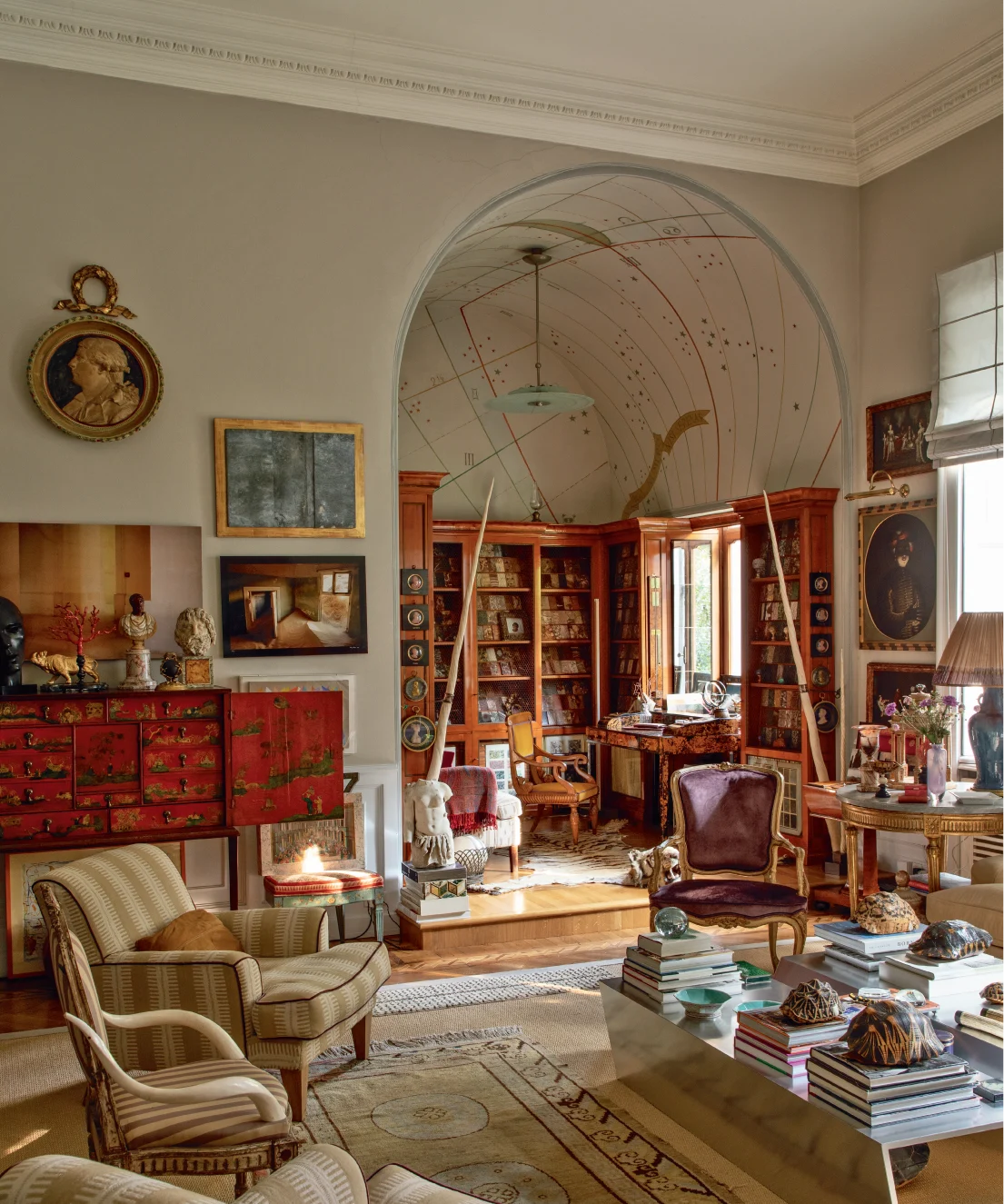
Hydroelectric-power magnate Ettore Conti (and Portaluppi’s own father-in-law) bought this residence in the early 20th century, after it had passed many hands — which obfuscated its original splendour as one of Milan’s grand renaissance villas. In the 15th century, the city’s ruler and arts patron Ludovico Sforza owned the house and famously donated its adjoining land to keen wine-grower Leonardo Da Vinci, so he could plant his own Malvasia vineyard. This hallowed history didn’t deter Portaluppi from bringing a modern sensibility to the works, which lasted from 1919 to 1921, for a strikingly cohesive result: his geometric mosaic floors, some of which reference zodiac signs and planets, harmonize with the restored frescos. A passion for sundials (which Portaluppi used to collect) led him to construct one inside a small internal dome; he also designed a host of bespoke modernist furniture — from a round walnut desk to a scalloped sofa, as well as tables and chairs. Portaluppi himself lived in one of the house’s apartments through the Second World War, despite the bombardments that damaged some of the structure, until his death in 1967. Though his descendants inhabited the flats for decades, the house also played host to many a fashion week event, so it’s perhaps no surprise that LVMH’s Bernard Arnault ended up acquiring it in 2022. For now, the residence remains close to the public — rumours have it might be turned into a hotel; but Arnault’s intentions remain under wraps.
Albergo Diurno Metropolitano Venezia
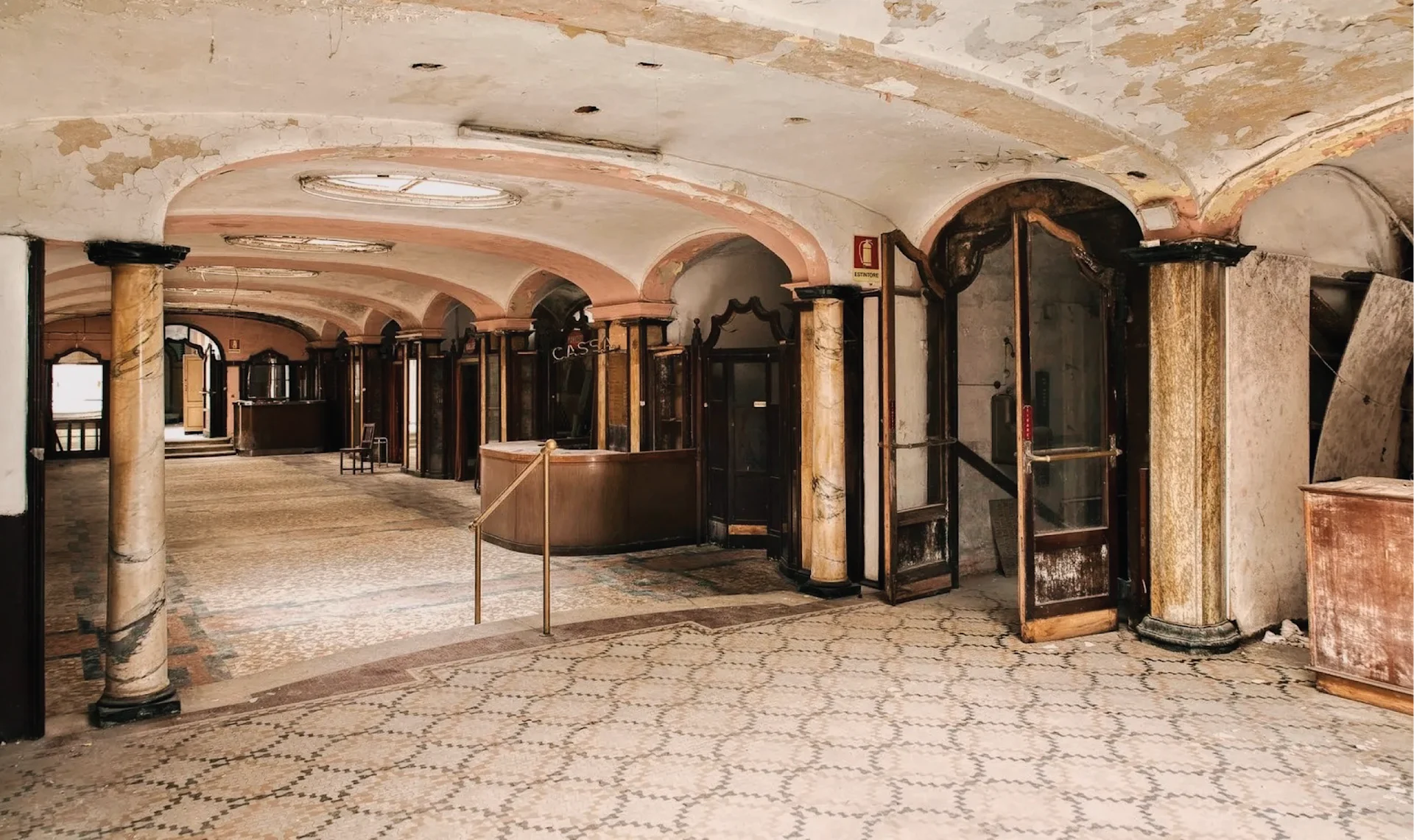
Despite its name — meaning “Metropolitan Daytime Hotel” in Italian — there were no beds at the Albergo Diurno Metropolitano. Set underneath today’s Piazza Oberdan, in the Porta Venezia neighbourhood, it was conceived in the 1920s as a place where those arriving at the city’s old train station could freshen up after a long journey, or those living in humble homes nearby could have access to warm water. Other than showers and thermal baths, the subterranean centre was home to services from hairdressers to barbers, a travel agency and a photography studio (as well as a manicure salon, an express laundry, and shoeshine stand) — each decorated in the most luxurious hallmarks of Art Deco. Portaluppi, building off a structure created by engineer Marcello Troiani, added intricate mosaics, fountains, statues, marble floors, brass details, and dark walnut wood furnishings — all of which have remained virtually untouched but severely damaged by the passage of time, ever since the site started being abandoned in the 1980s. Though the doors to this magnificent but haunting underground warren have been occasionally opened up by Italy’s non-profit national trust, the FAI, the site has been officially shuttered for years. However, there are plans to revive it and transform it into the National Museum of Digital Art, with an unconfirmed debut date.
Palazzo della società Buonarroti-Carpaccio-Giotto
Most people know this building on the edge of Indro Montanelli park as the “Casa con l’Arcone” — the “The House with the Big Arch.” The huge feature of its moniker wasn’t just intended as an architectural showoff. It had a specific purpose, which is what landed Portaluppi with the commission in the mid-1920s: the palazzo needed to provide a connection between the busy thoroughfare of Corso Venezia and the newly-built Excelsior neighbourhood just behind, acting as an entryway to this large-scale urban development. The imposing U-shaped structure stands out on a road that’s lined with impressive palazzi and was mainly made up of high-end apartments, though it also hosted shops and offices. Its symmetrical main façade is pleasingly orderly but features many of Portaluppi’s signature decorative touches — including Art Deco-inflected, circular reliefs, jagged framing, decorations, and the vault’s diamond-pattern ceiling.
Casa Radici di Stefano
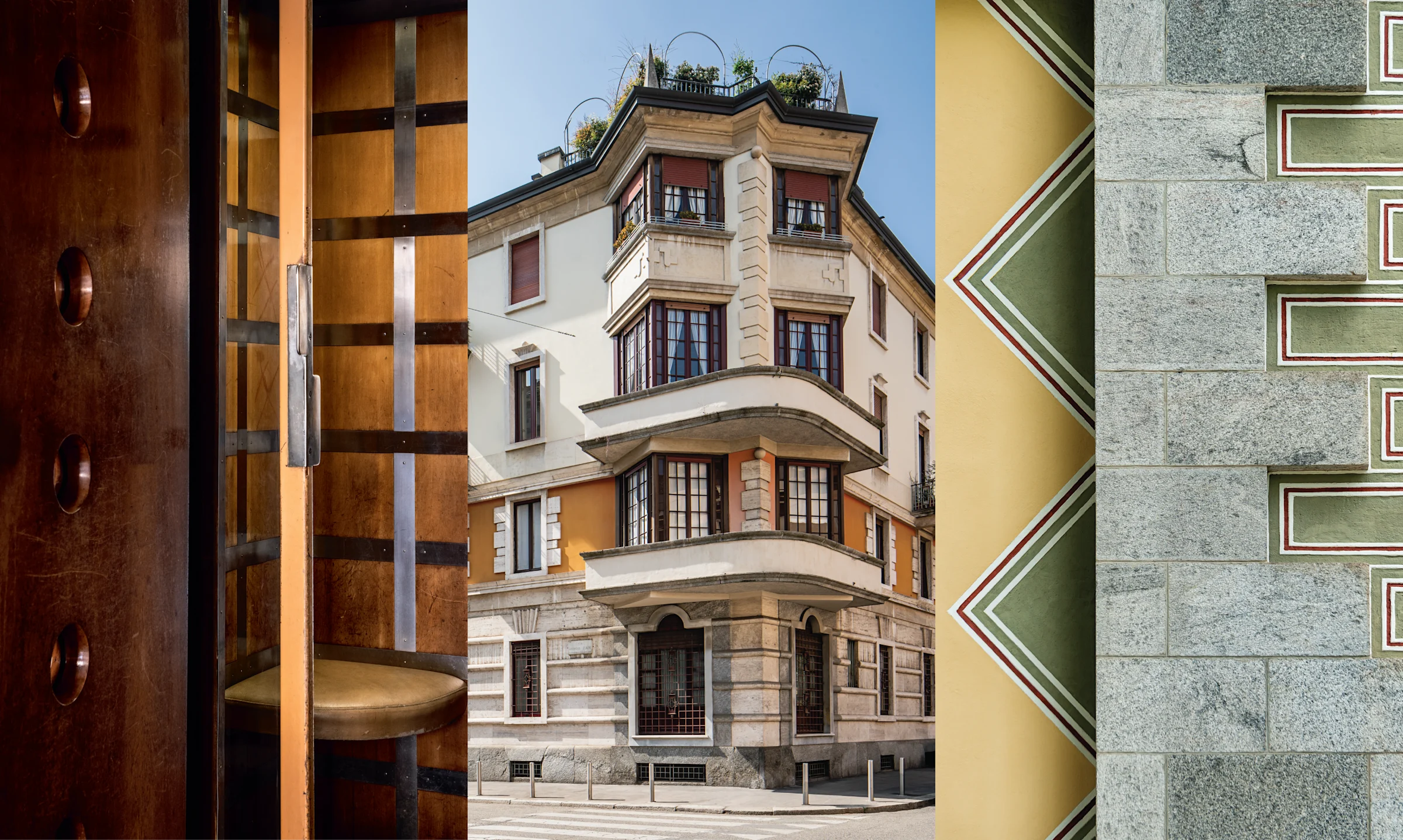
This house on Via Jan used to be frequented by Milan’s creative intelligentsia when it was home to prolific collectors, husband-and-wife Antonio Boschi and Marieda di Stefano. Today, their second-floor apartment has been turned into a museum showing some of the stand-out pieces they accumulated over five decades — with works by the likes of Lucio Fontana and Giorgio de Chirico displayed in the genteel domestic surroundings. The art is an obvious draw but the architecture, devised by Portaluppi between 1929 and 1931, is no less. Outside, the building’s exterior corner was cut out to create pointy, wrap-around balconies and luminous bay-windows; but it’s inside that you’ll find the house’s most fascinating feature: a staircase lined by elaborate wrought-iron balustrades, with landings covered in burnt orange and ochre triangle-pattern mosaics.
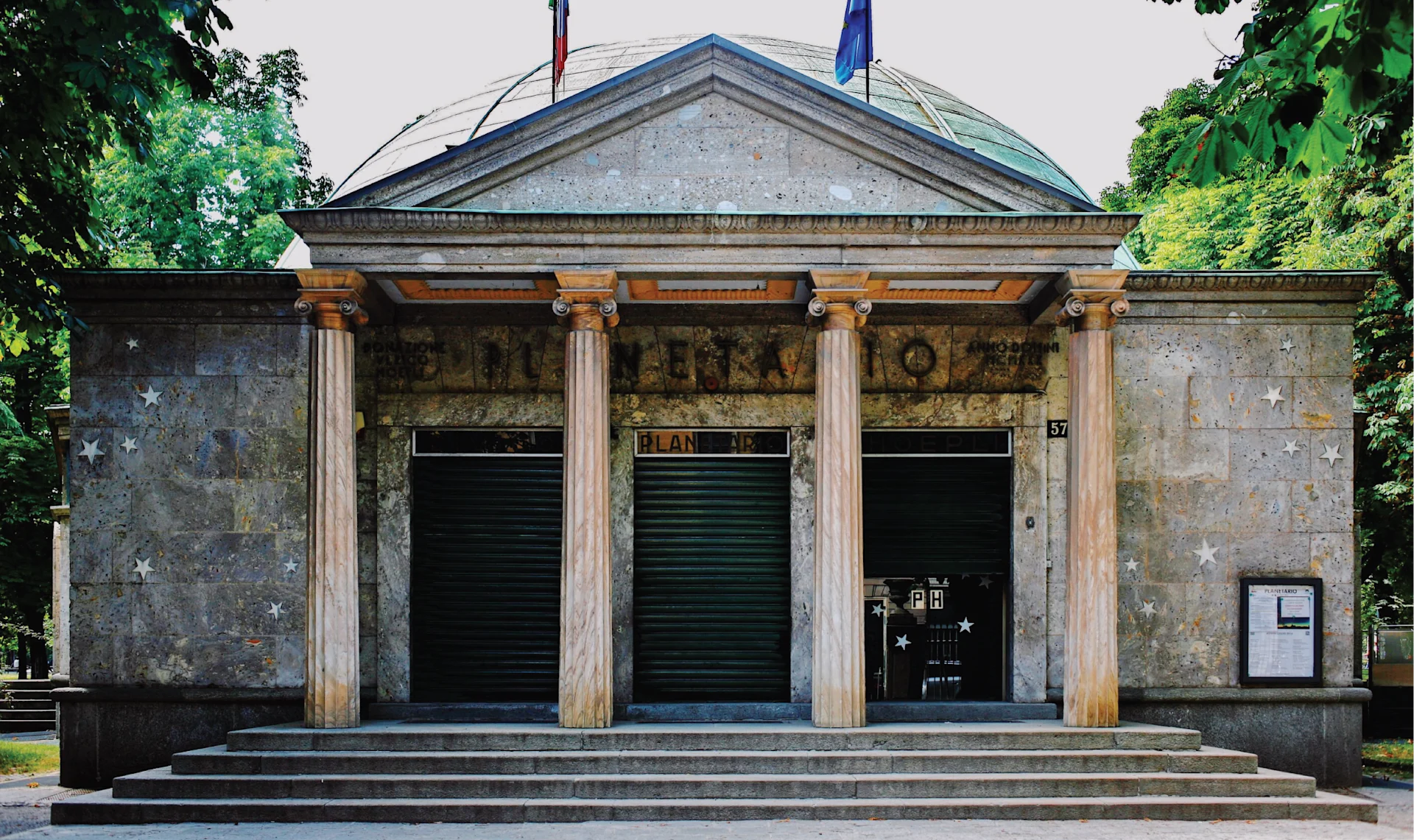
Planetario Ulrico Hoepli
Though this squat structure lies semi-hidden in a corner of Indro Montanelli park, this is, in fact, Italy’s biggest and oldest planetarium. Centered around a sizeable dome used for starry projections and displays, the building was designed by Portaluppi in an octagonal shape so the narrow façades outside could disappear into the foliage — or, as he put it, “sneak off between the old tree trunks.” Drawing from the traditional form of the renaissance baptistery, it was meant to combine scientific and religious references into a single, cosmically-minded, spiritually-leaning whole. The institution, which first opened in 1930, owes its name to Swiss-Italian publisher Ulrico Hoepli, who commissioned it as a gift to the city. Though its stone-and-marble neoclassical exteriors — modelled after an ancient Greek temple, complete with columns — are suitably minimalistic, Portaluppi’s signature flourishes are still scattered around the building, and include some silvery constellation-themed decorations in the interiors.
Sede per la Società Filatura Cascami Seta
Other than building homes for Milan’s thriving bourgeoisie, Portaluppi was often hired to dream up comely structures for the industry and commerce that underscored this area’s (and this social class’) economic success. Around the region, his embellished power plants are testament to a different vision of what industrial spaces could be like. Closer to home, in Milan, he also constructed an ornate chocolate factory and some sophisticated offices for textile businesses — including this headquarters for a silk-weaving company. This project, completed in the mid-1920s, has little of the boxy aesthetics that would become commonplace of industrial contexts later in the century: the rococo-inflected façade looks back to the 18th century with its stonework insignia and thin windows. Within, however, the floor mosaic and sweeping staircase are an expression of Portaluppi’s sleekest Art Deco tendencies.
Palazzo Crespi
Many of Portaluppi’s commissions sprung from personal connections with the tight-knit network of Milan’s high-society. Here, the Crespi of the palazzo’s name were an entrepreneurial clan who also co-owned the city’s main newspaper, the Corriere della Sera. Towering over the diminutive Piazza Meda, a stone’s throw from the Duomo and San Babila, the building was completed in 1932 as part of a radical rethinking of the urban layout of central Milan: the elegant, V-shaped structure, designed primarily to host offices, has a stately but understated grandeur. However, you don’t need to have business to attend to inside to get a glimpse of the structure’s most memorable attribute: the dark-marble portico at street level, with its moody coffered ceilings and lantern-like pendant lights.
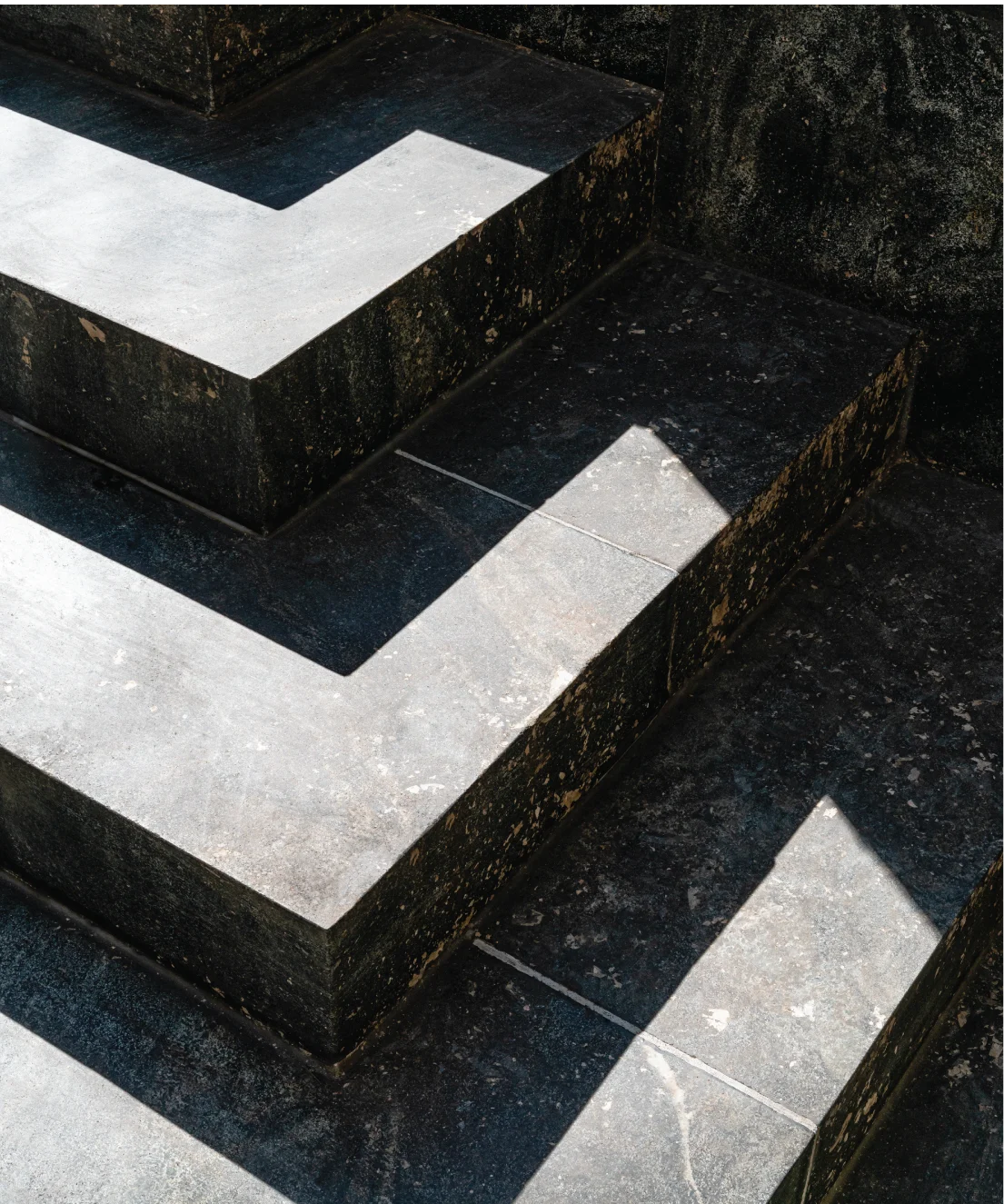
Casa Corbellini-Wassermann
Veteran art dealer Massimo de Carlo is an institution on Milan’s cultural scene so it’s only right he bagged himself an iconic, eminently Milanese location as the new headquarters of his long-established commercial gallery. Since 2019, he has been showing edgy contemporary works inside a splendid two-floor apartment in this house designed by Portaluppi in the 1930s. As the flat had been abandoned for over a decade, it was in need of a thorough spruce up — entrusted to Studio Binocle with the oversight of renowned designer Antonio Citterio. The works stayed as close as possible to Portaluppi’s original, polishing up the coloured marble of his design — with the striking, striped pink, green, and white floors running like highway lines through the space. While the oft-photographed external spiral staircase was originally conceived by Portaluppi for a temporary pavilion as part of the 1933 Milan Triennale, its lithe marble structure (later transported and attached here) suits the Rationalist façade just-so.
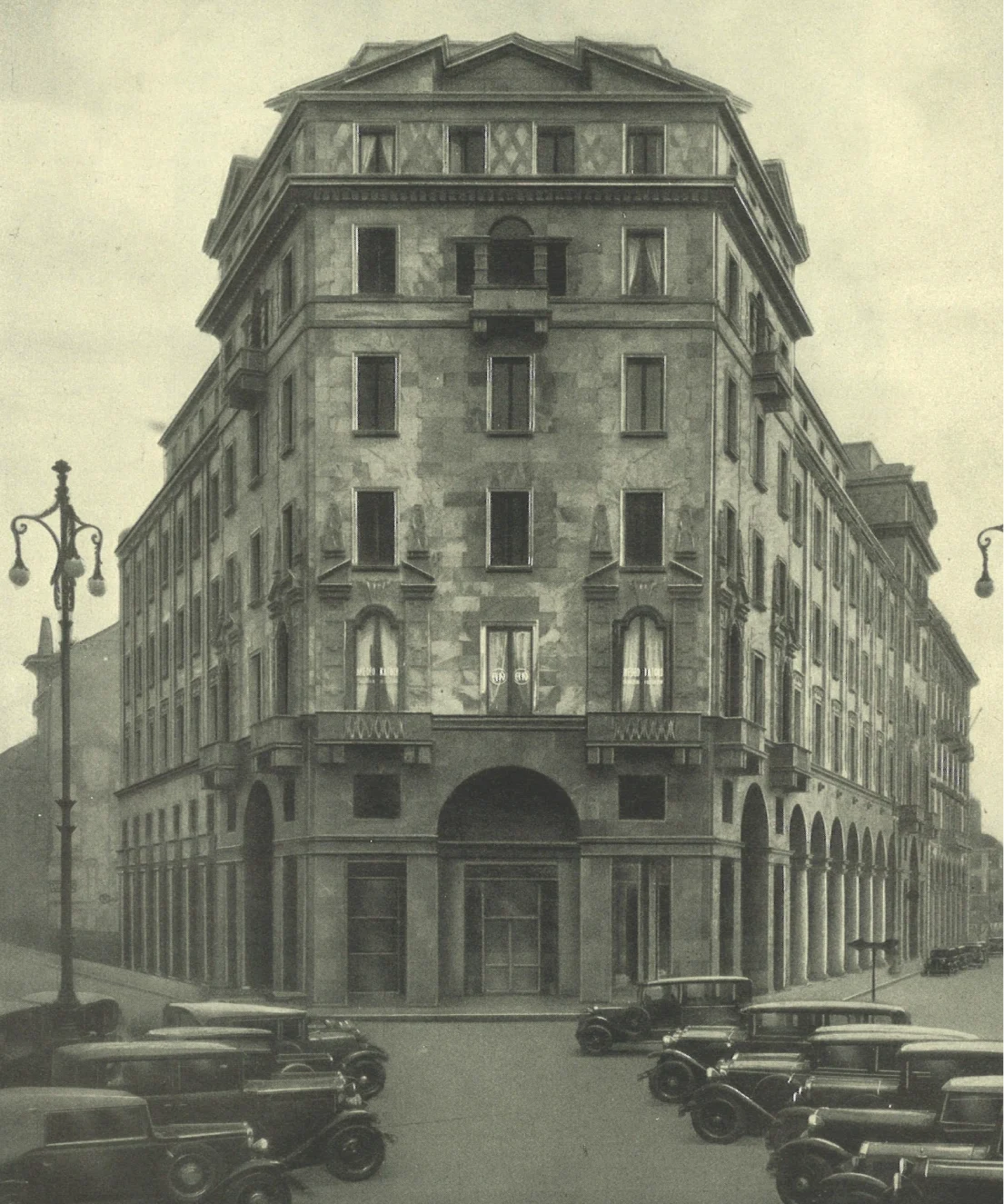
Palazzo dell’Istituto Nazionale delle Assicurazioni
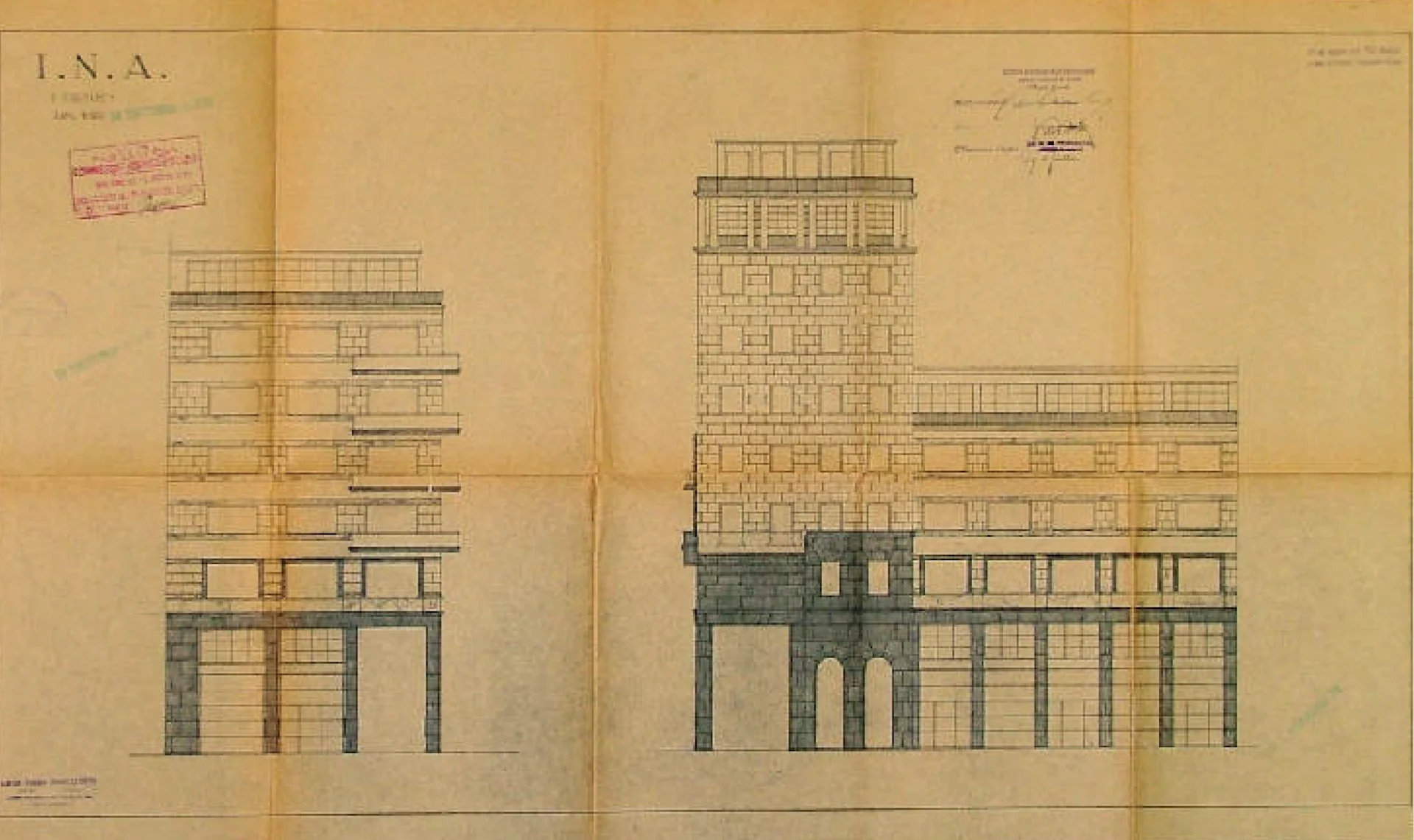
This monumental, stocky building in central Milan, not far from the Duomo, is one of Portaluppi’s projects that most closely toes the line of the 1930s’ prevailing (and state-sanctioned) Rationalist style — particularly in its monolithic side tower, that most virile of Fascist architectural tropes. The stark, regimented building, named after the National Insurance Institute, leaves less room than usual for his Art Deco touches. Wide, horizontal windows lend the main block of flats and offices an elongated appearance — and give it a stacked, multi-layered feel thanks to alternating panels in pink marble, framed by a delicate white marble edge. A dramatic dark granite archway on its side gives the whole structure a whiff of the metaphysical, another aesthetic favoured by the dictatorship.
Palazzo dell’Arengario
Though it was group-designed by Portaluppi alongside three of Milan’s most famous architects at the time (Giovanni Muzio, Pier Giulio Magistretti and Enrico Agostino Griffini), this is possibly Portaluppi’s most prominent building, sitting right next to the city’s Duomo. Construction began in the 1930s to provide a monumental, mirror-like counterpart to the ornate Galleria Vittorio Emanuele on the opposite side of the square, and act as a local seat for the Fascist government. However, the project wasn’t actually completed until the 1950s, by which point its political connotations had made it unpalatable to post-war Italian society. Still, the complex was restored in the noughties and today plays host to the Museo del Novecento, an institution dedicated to twentieth-century art with a solid collection of Futurist paintings. The two symmetrical buildings — made out of the same Candoglia marble as the Duomo — feel like otherworldly, minimalist portals to the new city beyond. Construction of a footbridge between the two structures has been proposed and received with much controversy.