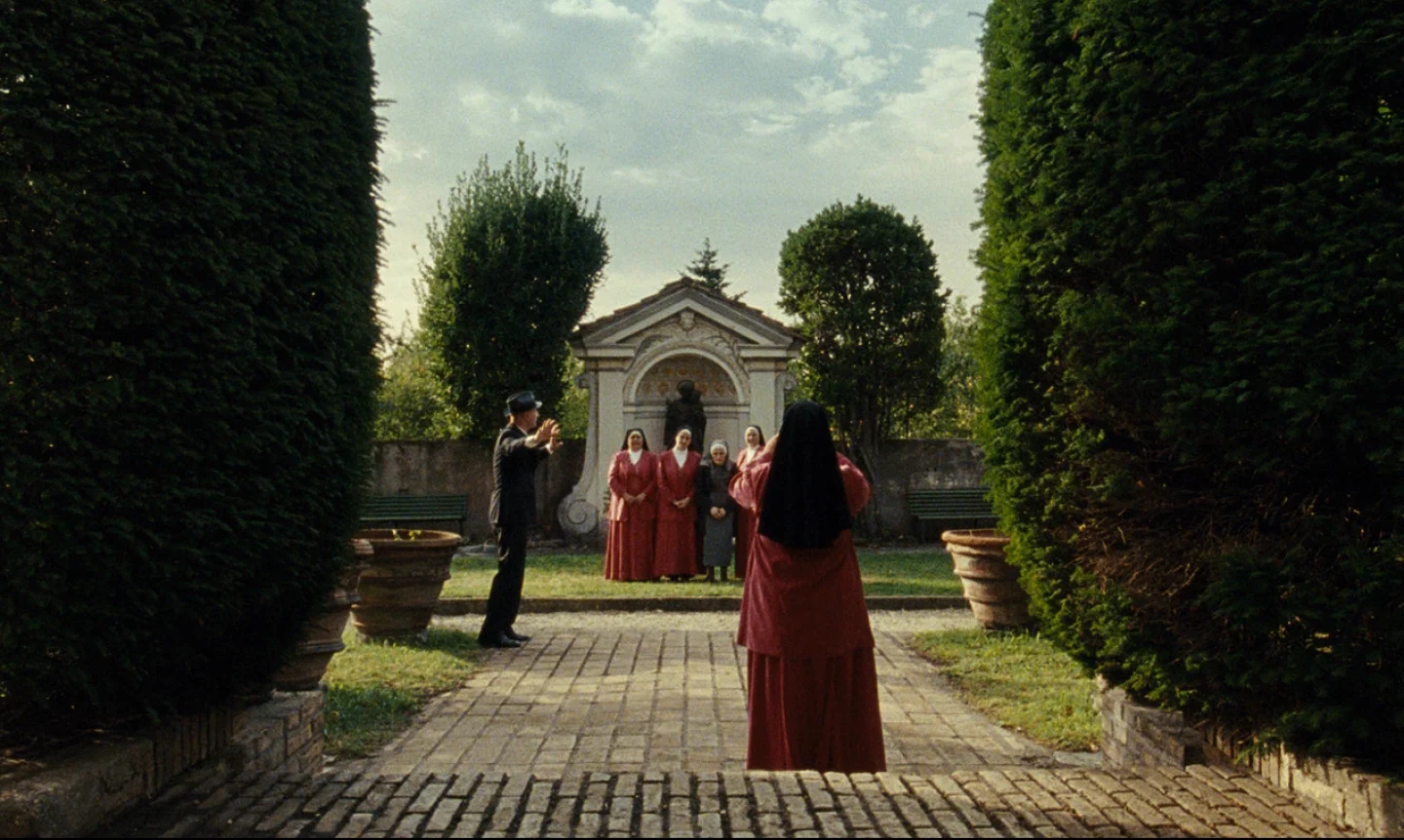
Wildflowers sprouting between roof tiles, stains darkening marble fountains, and everywhere the sooty, uneven cobblestones: this is Rome, and the wonderful patina of a place that has chosen to age proudly. The beautiful details and landmarks of The Eternal City has most certainly been captured in film over the decades. But in some cases, film has imparted style onto Rome, as much as the other way around.
Many now-legendary Italian directors—Fellini, Antonioni, Pasolini, De Sica, Bertolucci, and Sorrentino—were first lured to Rome as young men: Each could easily see the drama and understated beauty that everyday Romans ran the risk of overlooking, the potential for new in the old, the elegance and the vulgarity, the classical symmetries and the chaos.
In 1960, Federico Fellini’s La Dolce Vita notably spread Rome’s cinematic glamour worldwide, largely by way of a now immortalized scene in which Anita Ekberg (Silvia) waltzed into the Trevi Fountain by moonlight in a black strapless evening gown, luring Marcello Mastroianni in after her. The film introduced the world to a very particular Italian style—slim suits and dark Persol sunglasses (worn indoors and at night—Fellini practically invented that) and actress Anouk Aimée in her little black dresses and cat-eye, which quickly became the epitome of understated chic.

The places in which this and other recognizable scenes were filmed became a character in and of themselves, and each location has since been pulling back visitors to relive the magic. Watching them again—or for the first time—can add yet another layer of lovable history onto the way we view the city, and especially these six memorable areas.
The Spot: The EUR Neighborhood
The Films: La Dolce Vita, The Eclipse
In the early 1930s, on the occasion of the World Expo, Mussolini envisioned the creation of EUR, a new district that was to rise on the edge of the city in order to launch Rome into the future. The Expo never happened because of World War II, but EUR stands as a reminder of this ambition. Its plain lines and white marbles are reminiscent of Imperial Rome with a Deco twist, and thanks to its abstract—almost dystopian—atmosphere, it has served as an unusual and fascinating backdrop for a number of films.
Most of The Eclipse (1962) by Antonioni was shot in the modern residential part of EUR, built in the sixties, where Monica Vitti’s character lives. The surreal and enduring silence of this starkly designed neighborhood enhances the sense of alienation that became Antonioni’s signature.
You could begin your wanderings in front of The Palazzo dei Congressi in Piazza John Kennedy 1. The stark design of its interiors also appears in Fellini’s La Dolce Vita (1960) as the emergency room where Mastroianni takes his girlfriend after her attempted suicide. In The Conformist, Bernardo Bertolucci uses the De Chirico-like atmosphere of the roof terrace as the setting for the psychiatric ward where Trintignant visits his father. Once in the area, have lunch at Il Fungo in Piazza Pakistan 1, the tall, mushroom-shaped tower built in 1960 as a water tank, now a vaguely futuristic looking high-end restaurant. Its UFO-like shape looms from the window in the scene of the opening sequence when Monica Vitti breaks up with her lover and appears as a ghostly presence in several subsequent scenes. Walk down Viale dell’Umanesimo until you reach the artificial lake on Passeggiata del Giappone, where Monica Vitti and Alan Delon watch his sports car being recovered and lifted with cables from underwater.

The Spot: Ancient Park of the Aqueducts
The Film: La Grande Bellezza, La Dolce Vita
One of Rome’s lesser trafficked outdoor attractions is Parco degli Acquedotti, a reminder of the ancient empire’s famous aqueducts. Built to deliver fresh water from the mountains into the city, the immense structures still stand at the edge of Rome as a testament to the imperial architects’ engineering skills. In La Grande Bellezza (2013) by Paolo Sorrentino, protagonist Jep Gambardella watches a “conceptual” performance by a completely naked female artist who keeps running into a wall next to the aqueduct (an allusion, according to some critics, to Marina Abramovic). The opening scene of La Dolce Vita depicts a helicopter flying right over the one named the Aqua Claudia carrying the statue of Jesus suspended by cables. Today the park, which comprises the remains of seven ancient aqueducts, is considered one of the largest “green lungs” of the city of Rome. It sprawls nearly 600 acres and is a perfect spot for a picnic, bike ride, or just exploring the ruins. The entrance is on Via Lemonia.
The Spot: The Coppedè District
The Films: The Bird with the Crystal Plumage, Inferno
Tucked behind the main streets of Quartiere Trieste is one of the most bizarre and little-known neighborhoods of Rome, the Quartiere Coppedè. Built from 1913 to 1927, it is named after its creator, Florentine architect Gino Coppedè, and its few buildings are a mix of historic styles—Art Nouveau meets Fortuny and Orientalism. The atmosphere, however, is pure gothic and eclectic, the perfect location for Dario Argento’s horror films, The Bird with the Crystal Plumage (1970)—Argento’s debut—and Inferno (1980), both set largely in and around Piazza Mincio, the district’s main square and the home of the Fontana delle Rane (the frog’s fountain). Each of the buildings has a uniquely detailed facade, decorated with spiders, she-wolves, and mythological figures, and surrounded by towers, loggias, and painted walls.