Man and microbe alike are elementally drawn to milk—and for the same reasons: Containing protein, fat, sugar, water, it’s fortifying and life giving to them both. Long before the principles of pasteurization were known, the activities of microbes were accidentally at first, and then intentionally, harnessed and manipulated for turning milk into cheese. The benefits proved to be that, in the form of cheese, milk and its nutrients were more stable, hearty, and longer lasting.
While much has progressed and changed since the genesis of rudimentary cheesemaking, many cultures still hold on to fundamentals and techniques that have served them well over time. These hyper-regional production methods and traditions turn out some of the most uniquely flavored cheeses on the map—some, an acquired taste.
Brânză de Burduf, Romania
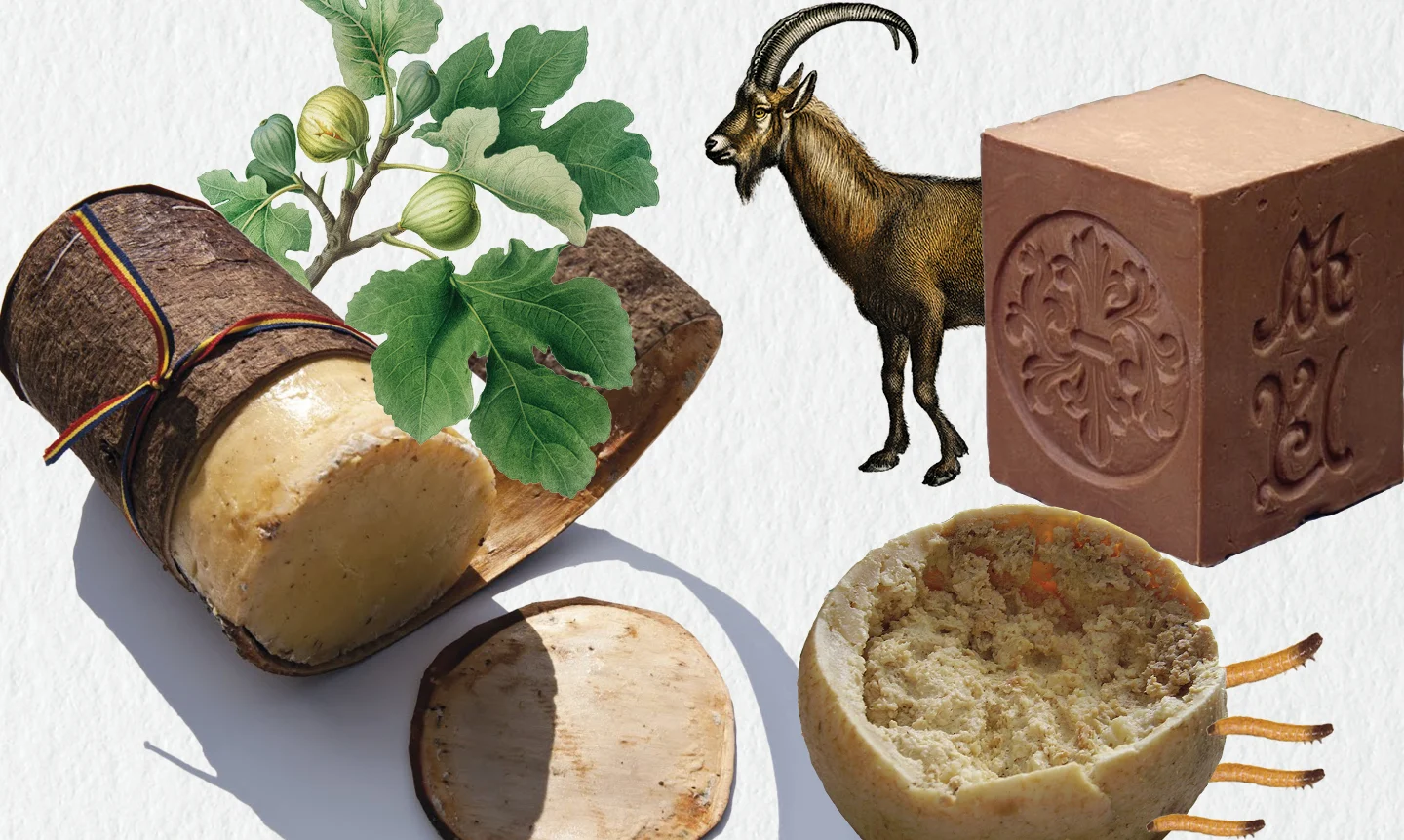
From the mountain pastures of the Romanian Carpathians, this rindless sheep or sometimes buffalo milk cheese is aged inside the fresh bark of a fir tree. The use of the wood as a vessel helps facilitate transport over the narrow and stony mountain paths, and is also used to impart a resinous note into the cheese. Locals prepare pieces of bark by soaking them in hot whey to help them form it into a cylinder, then sewing it closed around the cheese with thread. Brânză can only be produced from May to July, when the fir trees are full of their aromatic resin.
Zeleno Sirene, Bulgaria
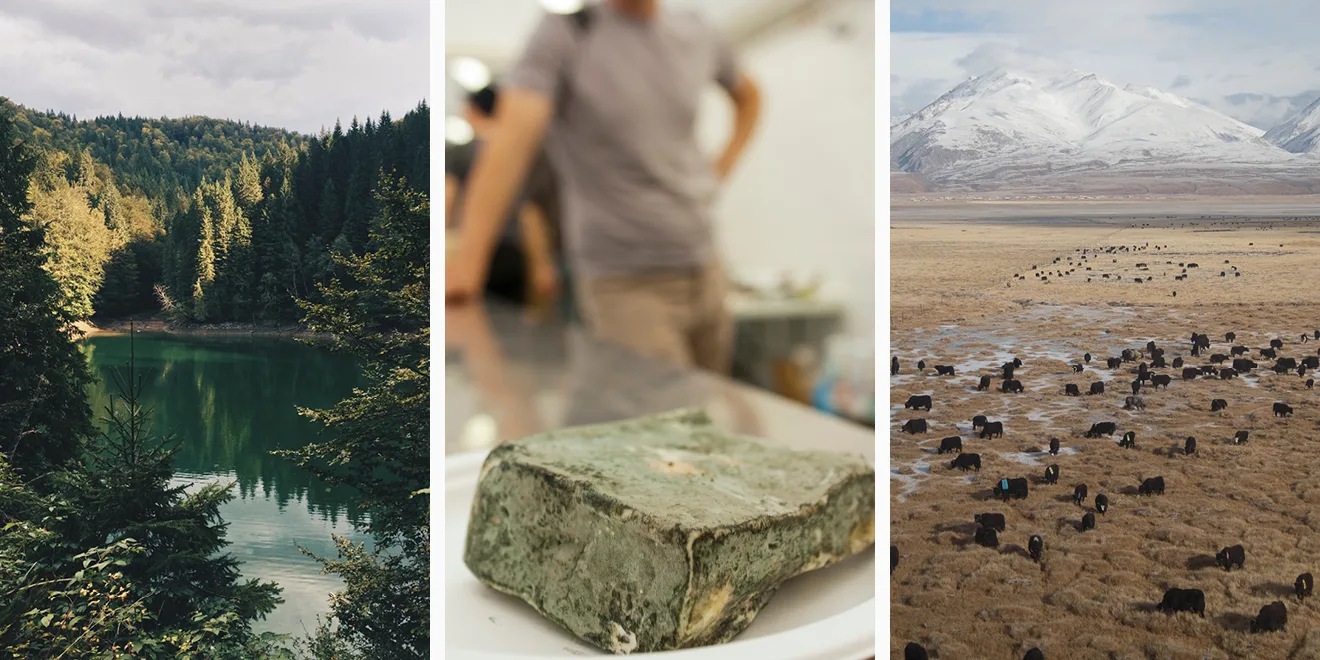
For centuries, this soft cheese has been produced the same way on the pastures of the Bulgarian Balkan Mountains. The hand-extracted sheep’s milk is stored in brine and in vessels made of lime wood until the end of summer, when the cattle are driven down the mountains and back into the valley. The open vessels are stored in cellars over autumn, allowing the liquid brine to evaporate over time and the humid autumn air to draw a thick layer of green mold around the white cheese. The process makes zeleno sirene (literally: green brine cheese) one of the few cheeses that obtains mold naturally, without inoculation with fungal cultures. The resulting sharpness in flavor can easily compete with its distant and better known relatives Roquefort and Stilton.
Chhurpi (Yak Cheese), Tibet
It is said that some areas of the Tibetan highlands are so flat, that the shaggy yaks grazing on them can be seen from several kilometres away. The fur of the animals serves the nomadic people as wool for their tents, and their meat and milk as food for the whole year. Yaks give little, but very rich milk, which can contain up to seven percent fat (in comparison: cow's milk has about four percent). The milk’s taste is characterized by the mountain herbs and flowers on which it feeds, and used to make chhurpi or durkha, a hard yak’s milk cheese also found in Nepal and other Himalayan regions. The curds are separated in cauldrons (which are traditionally fired with yak patties as fuel), then dried and cured until the flavor is matured, hearty, and intense, like an aged, spicy sheep cheese.

Milbenkäse, Germany
From the state of Saxony-Anhalt in Germany comes one of the most intriguing cheeses in the world—milbenkäse or mite cheese, which has been produced for centuries only in the village of Würchwitz. Instead of the typical bacteria or fungi culture used to ripen cheese, in this case specially bred (tyrophagus casei) mites take care of the job. During production, fresh soft cheese is placed in a wooden box together with caraway seeds and sea salt for three to six months, upon which the tiny arachnids are set to feast. Their eating produces digestive enzymes which kickstart fermentation and turn the cheese sour, zesty, lightly bitter, and ready for eating. (The mites are said not to pose a health risk.)
Casu Marzu, Sardinia
The Sardinian term casu marzu, literally means “rotten cheese,” refers to a sheep’s milk fiore sardo, the local pecorino, that’s gone through a rare—and controversial—transformation. Traditionally, the rind of a wheel of pecorino is removed to permit a so-called “cheese fly” (Piophila casei) to lay its eggs inside. These eggs later hatch into small white larvae that will munch their way through the cheese. The metabolism of proteins provides a creamy consistency and an aromatic sharpness to the cheese. The larvae “may, but do not have to be eaten”, according to one of the producers. Due to safety concerns, the cheese is forbidden from commercial sale, but some Sardinians continue to eat and love its strong, long-lasting flavors.
Sognefjord Geitost, Norway
From the shores of the longest and deepest of Norway's fjords comes a 500-year-old cheesemaking method. Whey leftover from making a fresh white goat’s milk cheese is mixed with cow's milk rennet and boiled down for 8 to 10 hours until the lactose turns brown and crystallizes. The mixture is then drained, cooled, and pressed into a cube in a wooden vessel for a day. The resulting brown cheese, a category called brimost locally but known far and wide as geitost, is eaten cut into wafer-thin slices and preferably on toasted bread, and carries the lingering taste of caramel. Since Norwegian authorities prohibit the use of raw, unpasteurized milk, the artisanal production of the cheese is currently endangered.