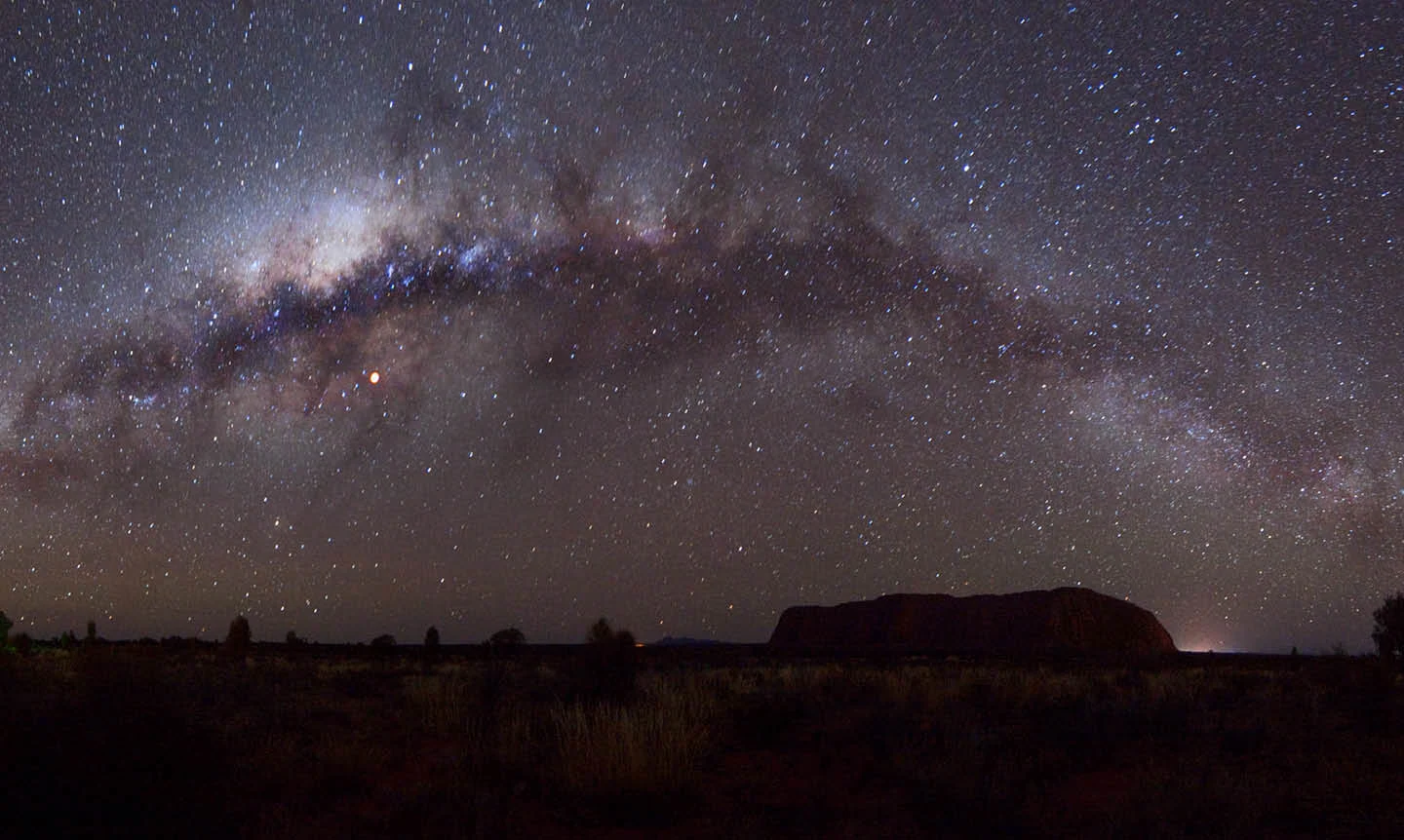
For the First Nations people of Australia the night sky is a map, a calendar, and an illuminated text of stories and lore—songlines—passed down through countless generations. A timeless library of wisdom and wonder.
To anyone it is a source of infinite awe. In Australia, the light show is made more dazzling and magnificent by the continent’s lack of people, pollution and peaks. The mostly flat terrain has the effect of seemingly magnifying the vast skies and everything in them.
The Milky Way, our home galaxy, unfurls above the South Pole in a way that allows Australia and its islands to have prime positioning for some of the best astral viewing on Earth. There are more stars visible here than in the northern hemisphere—from the full, cinematic expanse of the Milky Way to lesser familiar sights such as Alpha and Beta Centauri (the closest stars to our solar system) and the four-pointed Southern Cross (the constellation featured on the national flag).
Viewing conditions are best on either side of the new moon, when skies are darkest, as well as from these vantage points.
Murray River Dark Sky Reserve, South Australia
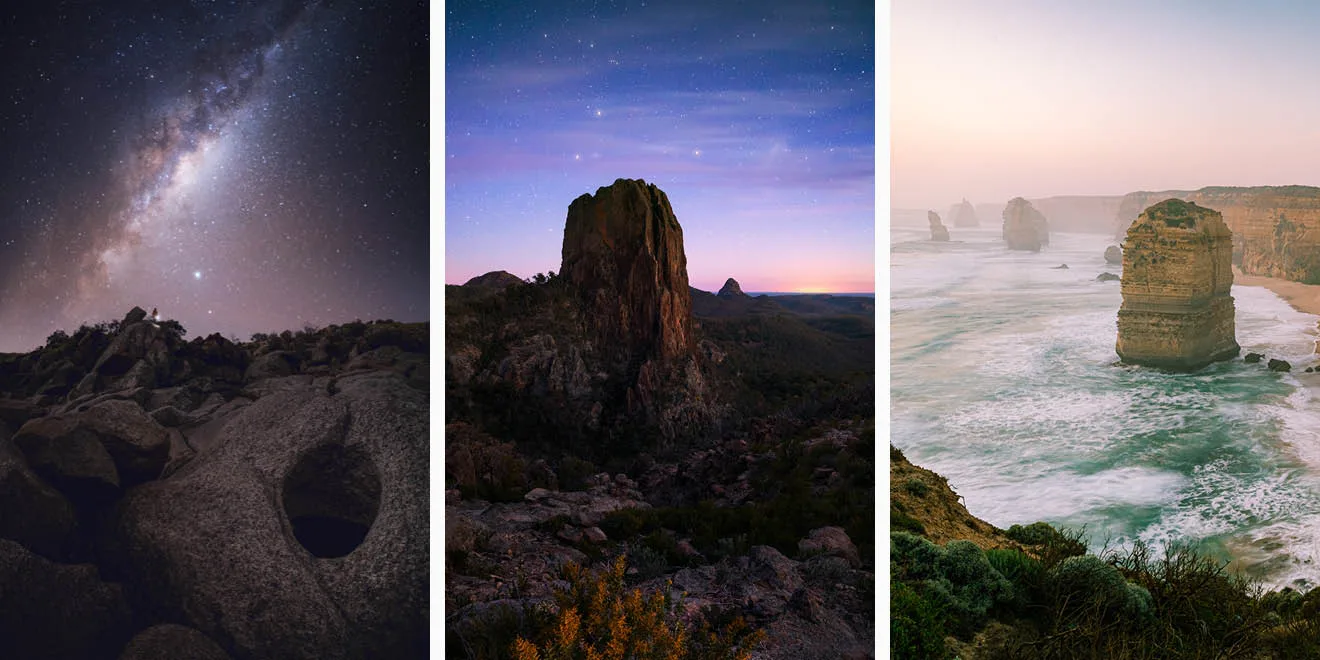
The Swan Reach Conservation Park, a 1200 square mile region of wildlife reserves, wetlands and quaint country towns barely an hour west of the South Australian capital Adelaide, is Australia’s only so-called “Dark Sky Reserve” and one of just 15 of them across the world. Out here beside the mighty Murray, the continent’s longest river, the nights are jet-black and the stars shine bright. With minimum darkness levels measured around 21.8 (where 22 is total darkness), it’s an exceptional spot to get acquainted with the cosmos. The night sky is best viewed from a houseboat on the Murray or lookouts along the river such as Big Bend, where 200-million-year-old sandstone cliffs soar above the waters. murrayriver.com
Warrumbungle National Park, New South Wales
The massed peaks of the Warrumbungle (‘Crooked Mountain’) National Park in central New South Wales combine high altitude, low humidity, and zero population for excellent night-sky action. Hence the many telescopes sited here, including Australia’s largest observatory at Siding Springs. Amateur astronomers make the pilgrimage to this park 250 miles northwest of Sydney for the chance to see more than 6,000 stars with their own eyes and, in summer, the Magellanic clouds, two dwarf galaxies that orbit the Milky Way and are perfectly visible.
Great Ocean Road, Victoria
Despite being one of Australia’s most popular tourist attractions, except for the main townships of Anglesea, Lorne and Apollo Bay this heroic coastal drive is largely deserted. Dense rainforests, some dating from Gondwanaland times, crowd a serpentine shoreline where dramatic cliffs meet the Southern Ocean and a star-packed sky. The headline—the 12 Apostles, a picturesque arrangement of limestone stacks anchored in the ocean—is most spectacular seen beneath the light of the moon and the Milky Way.
Southwestern Tasmania
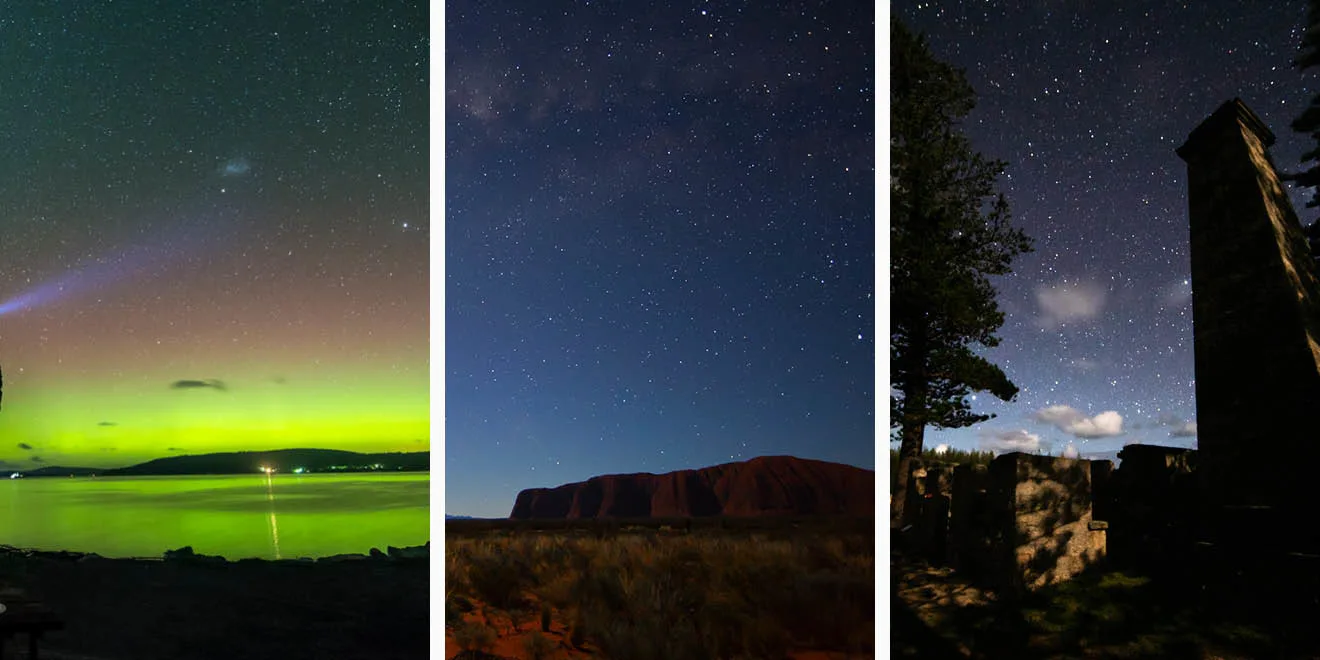
Being an island at the end of the Earth and the gateway to Antarctica, Tasmania has even brighter, starrier skies than the mainland. It also has the aurora australis, the southern equivalent of the Northern Lights, which appears year-round but is most brilliant during the long, dark winters. The kaleidoscopic lights are visible throughout the island but the further south the better. In the capital Hobart, vantage points include Mount Nelson and Kunanyi/Mount Wellington. Head to South Arm Peninsula for the chance to see the lights reflected in bioluminescent seas, or fly to tiny Melaleuca and camp overnight in the World Heritage southwest wilderness.