Every language contains certain words that reflect the collective value system of its people– words that carry emotional meaning and don’t have explicit translations when defined in another language, often because the essence of the word in its original language embodies a certain feeling and experience that is distinct to the culture of its people.
In many cultures, dining is a central theme for some of these untranslatable words– but it’s the feeling associated with the dining experience, rather than the food itself. As scent and taste are directly connected to the hippocampus and thus have a significant effect on spatial memory, it’s well-proven that food stimulates a deep emotional connection to a place or moment in time. These words capture the magic of a moment.

Words like tavolàta (Italian), sobremesa (Spanish) or mazmez (slang, Arabic), for example, reflect the traditions of each culture’s innate values that are characterized by the intimacy of a community within its dining culture. These words emphasize the conveniality and traditions that unfurl around a table; while other words reflect a more general sensibility of hospitality, like Philoxenia (Greek) which isn’t associated with dining by definition, but stipulates the culture’s inherent warmth and hospitality towards strangers, which is commonly extended through food or in shared moments around a table.
Within these cultures, the table is a beacon for community. Today, you can find special places around the world creating experiences that center around these ideals, where the table forms the heart of the experience, creating an intimacy and warmth intrinsic to its culture. They are places for discerning travelers, who value intimacy, community and spontaneity, to connect to these cultures in a more meaningful way. In many of these places, immersing yourself means having a seat at the table– and if you’re lucky, lingering there all night.
Casa Lawa, Sicily, Italy
Tavolàta, Italian, friends sitting around a table
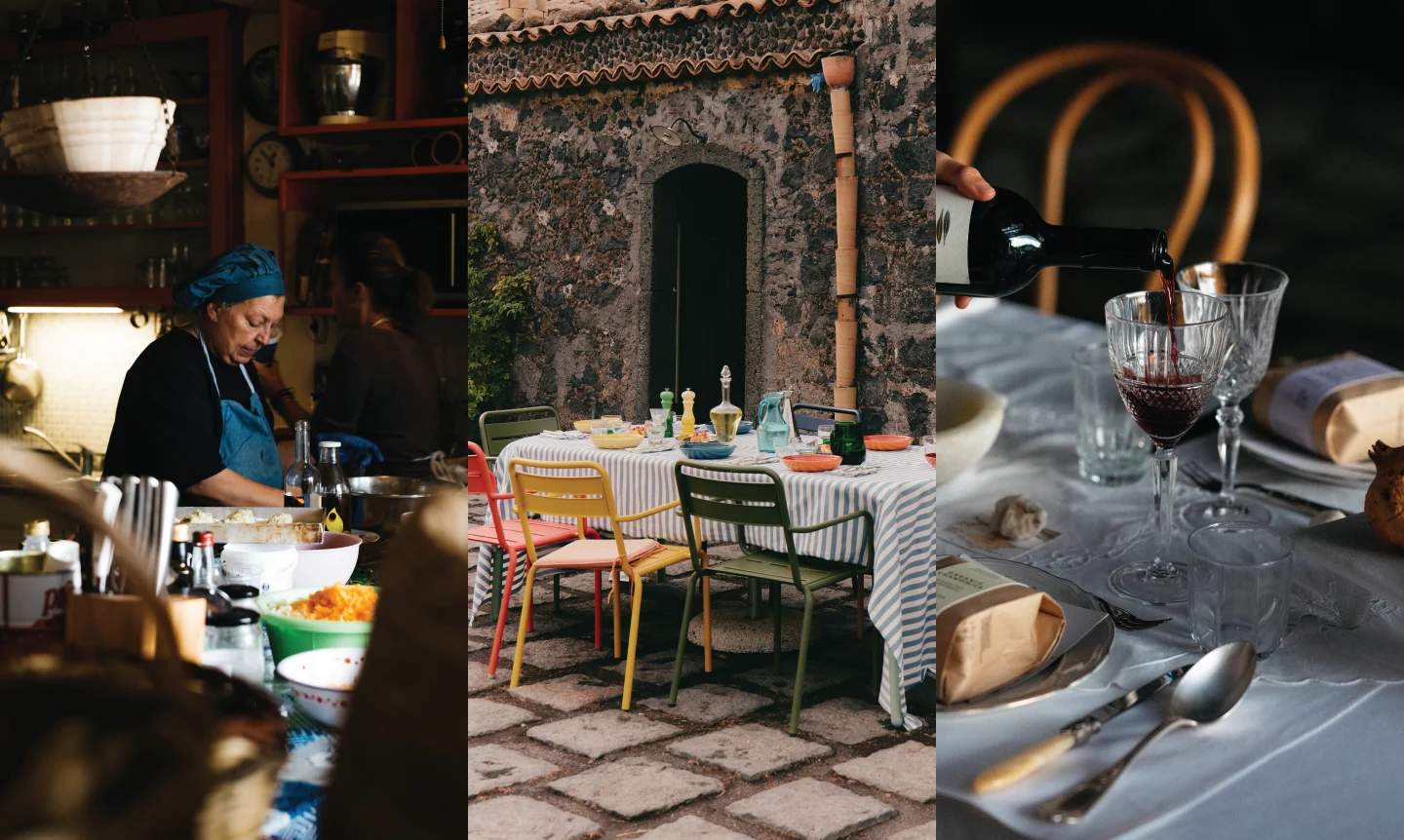
The word tavolàta indicates more than just a table, but rather a table full of people, a table with a built-in community already there waiting for you. Nowhere is a tavolàta more perfectly presented than at Casa Lawa, a four-room guesthouse located on the slopes of Mount Etna, where owner Lukas Lewandowski has created a community-forward experience centered around its food programming and chef residencies. Inviting chefs from around the world to come and cook for the other guests staying at the guesthouse, Lukas has cultivated a community through warm, intimate moments that form around the table– masterfully elevating the experience with his whimsical tablescapes and colorful decor.

“At Casa Lawa, ‘tavolata’ embodies more than just sharing a meal,” he explains. “It's about creating moments of connection. Our dining experiences are designed to foster meaningful interactions among guests, where they can feel at home, savor delicious food and engage in lively conversations.” At Casa Lawa, Lukas has created a community for artists and guests by providing a dynamic stay shaped by the people who visit. Every experience at Casa Lawa is centered around the kitchen. The house’s head chef oversees the chefs in residency and leads the kitchen program, which consists of collaboratively crafting menus, conducting cooking classes and creating other unique food-centric experiences for guests, always beginning the day with what Lukas calls “breakfast bliss”, featuring a colorful, abundant table with sizzling eggs, vibrant fruit plates, their legendary granola, local coffee and “lot’s of love,” he adds. “I like to call breakfast a big hug to kick off the day, the best way to say buongiorno!” Beyond that, Casa Lawa hosts farm-to-table lunches, afternoon snacks by the pool and by evening, everyone gathers for a communal feast featuring multi-course meal. “It’s like a family dinner, but with fewer awkward conversations,” he says. Every Friday and Saturday, the kitchen hosts their big family style dinner with the chef-in-residence, bringing everyone together again for a communal feast. “Casa Lawa is not just the guesthouse we opened two years ago,” Lukas says. “It is an enclave of community living and rural simplicity, a distinctive experience that combines the richness of Sicilian culture with modern hospitality.”

Beit Douma, Douma, Lebanon
Mazmez, Arabic (slang), the act of savoring a meal; eating slowly and for a long time in good company.
In Lebanon and many Arab countries, meals are characterized by the tradition of slow dining, long lunches and lingering conversation. This is precisely the vision at Beit Douma, a guesthouse situated in a restored 19th-century villa in the mountains about one-hour-and-a-half from Beirut, developed as an extension of Souk El Tayeb, a farmer’s kitchen and weekly farmers’ market in Beirut that brings rural produce to the city, uniting communities and supporting small-scale agriculture helmed by Lebanon’s leading culinary activist Kamal Mouzawak. “With mazmez, the first element is time,” Kamal explains. “The second is calm.” Mazmez is about savoring food and engaging in long conversations. “It’s a concept that’s more about the experience than the food. It isn’t rushed like a work lunch,” he says. “It’s a social act, not an eating act.”

The Beit Douma experience is centered around this concept of long lingering meals, where the house cooks (of which there are about eight working at Beit Douma) are not internationally-acclaimed chefs, but simple home cooks from Douma and other nearby villages. They use ingredients from local producers to create the feeling of being at home (beit means home) by replicating familiar family meals, like big sunday lunches and light dinners at home meant to be savored. The stay at Beit Douma revolves around the food as if you’re being welcomed into a family home, integrating guests into the local community through regional and seasonal home cooking served family-style. “Breakfast is very important at Beit Douma,” Kamal says. “It’s not just coffee and a croissant. You’re meant to spend a long time at breakfast and the setting matters. From gathering inside together at the long veranda table or outside in the garden, there’s never any rush.”