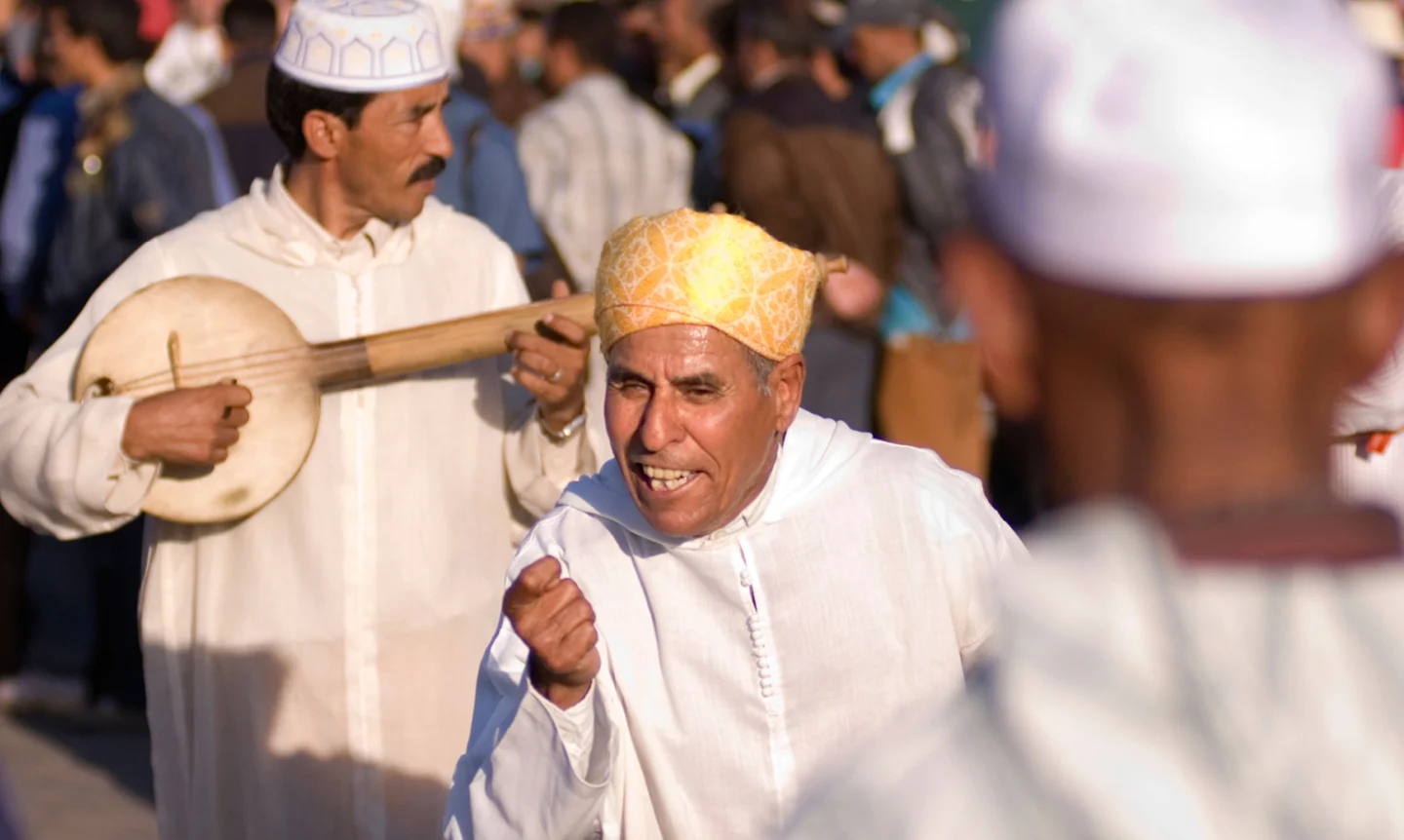
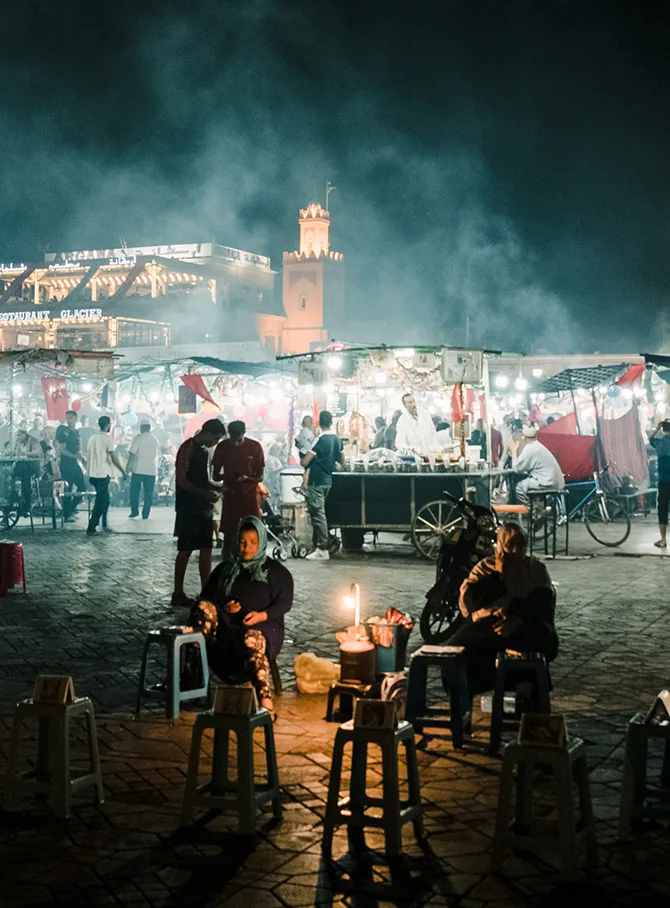
Arriving late one afternoon twenty years ago in Marrakech, in air that crackled in the heat, I was met by a riad owner at the Djemaa el Fna, Marrakech’s main square, and strolled towards the dusky pink maze of the ancient medina. He stopped us where a small crowd had gathered in a circle—the halqa—and nudged me toward the front. There, leaning against a staff and holding court in white robes, a storyteller had his audience enraptured. I couldn’t understand what exactly was being said, but I could easily sense the importance of the ritual.
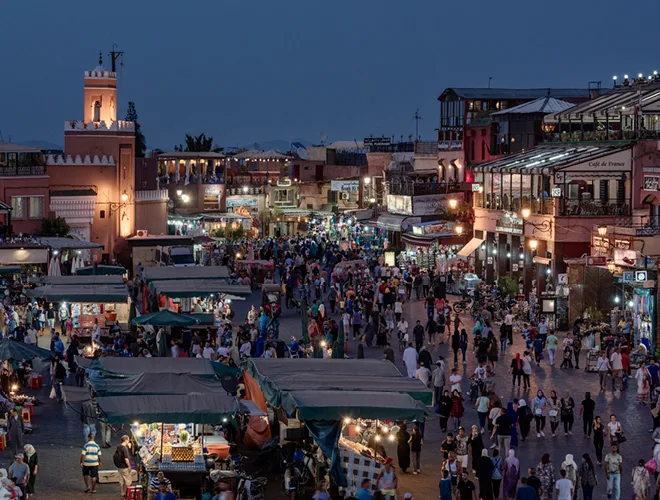
As the Moroccan proverb goes, “When a storyteller dies, a library burns.” The tradition of storytelling on the Djemaa dates back to the 11th century, and even several hundreds of years earlier around rural Morocco. Traditionally male, storytellers long travelled from village to village publicly telling their tales in exchange for a few coins, and the stories they shared were then repeated in the homes by and among women. Like many parables and fables of the West, the stories they passed on were fashioned to entertain, but also to impart some kind of moral code or lesson on the human condition. The origin tale of the Sahara Desert, for example, poignantly suggests that each grain of sand represents a lie told by us human beings.
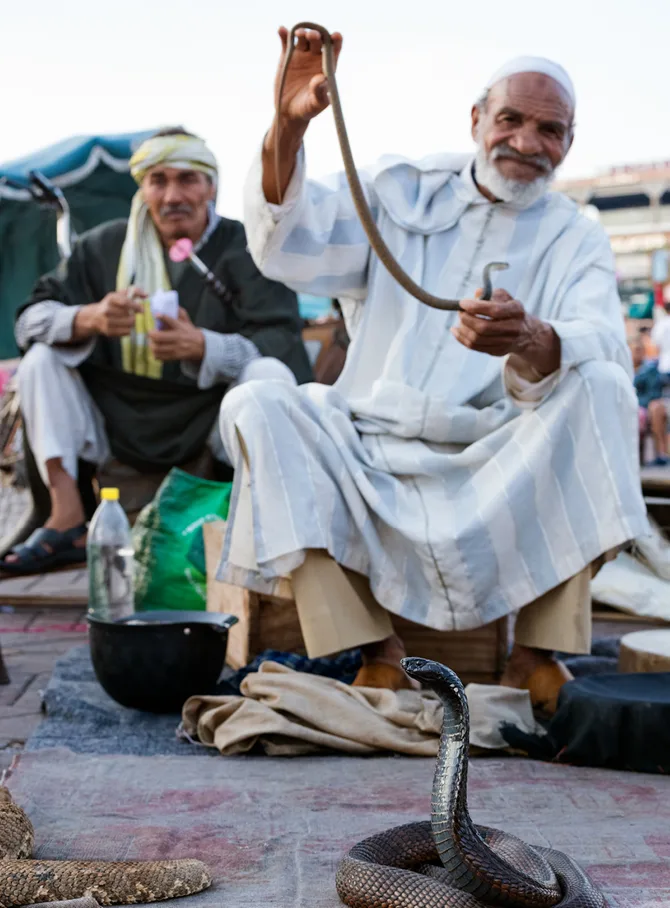
As it turned out, I was lucky to have seen that small gathering at all. In 2006, Richard Hamilton, author of The Last Storytellers and founder of the website The House of Stories, was producing a segment for BBC Radio. “I was blown away by the fact you could still pay someone to tell you a story,” he said, “that a tradition hundreds of years old was still going on in the 20th century.” But his subject, 72-year-old storyteller Moulay Mohammed El Jabri, was by then one of very few remaining. El Jabri believed that there had been a gradual decline in interest since the 1960s when people first started to own televisions. Combined with an influx of tourism that had pushed the storytellers to the fringes of the square to make way for the seemingly more exotic snake charmers, monkey-handlers, and henna artists, their space had diminished considerably. Then, nearly a decade later, something extraordinary happened.
British expat Mike Richardson was just gearing up to open his second cultural café, Café Clock Marrakech, when he met a young Peace Corps worker, Sarah Quinn, whose future father-in-law was Hajj Ahmed Ezzarghani, the master storyteller on the Djemaa el Fna. “Haj was living through the experience whereby the sheer volume of life on the square was making it almost impossible to perform,” Richardson told me. “So we hit upon the plan of bringing storytellers to Café Clock.” Haj was delighted and began recruiting young apprentices—including women—who could both perform and translate his stories into English. “If you come from an outside culture with an open mind, storytelling will show you an absolute and proper Morocco,” Richardson explains.
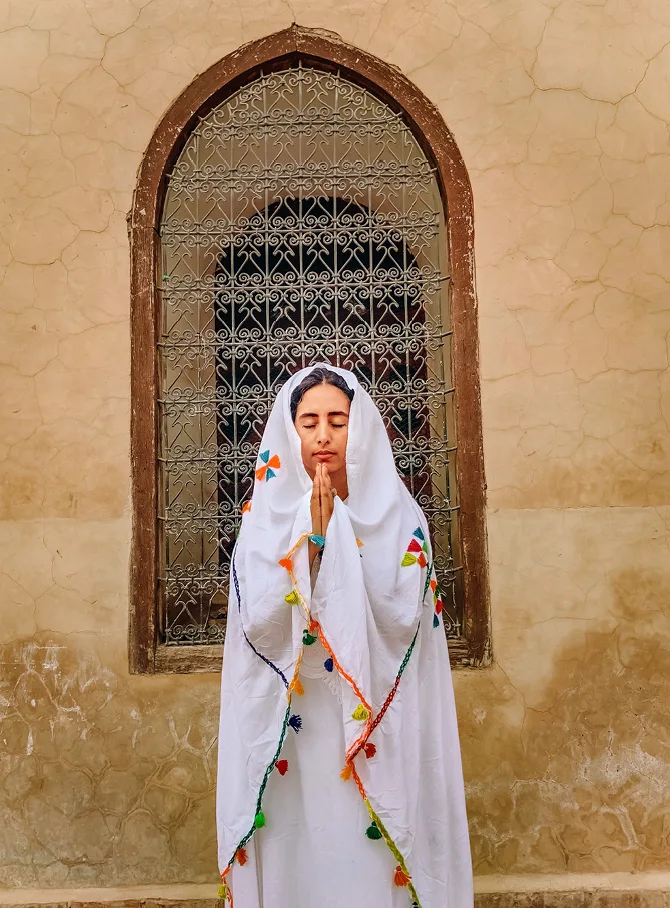
Young women very quickly started to seize their opportunity to find their voice. Among Haj’s apprentices was Bochra Laghssais, who has gone on to become much celebrated in her own right. “I felt empowered to perform such an ancient art in public knowing that a long line of women fought for this to happen, for me to have that right, to take it from what is considered private to the public sphere,” she explains. “I feel blessed and grateful for my grandmother who instilled and sparked my curiosity and imagination [at] an early age, and to my master Hajj Ezzarghani who taught me and trained me to perform this art in public. Storytelling for me is a space for learning, I feel free and alive in that moment. It’s my space to let out my creativity.”
Before the pandemic, the Clock storytellers were still somewhat legendary, a cultural spectacle worth seeking out for anyone who came to Marrakech, but when Covid-19 swept through the country, the square became as dusty and desolate as the desert itself, and the cafés closed their doors. It could have been the undoing of an already fragile tradition. But—as it was becoming apparent that young people were thirsty for stories, interested in what their elders had to say, and feeling an urgency to ensure their heritage survived—some recognized it as an opportunity to pivot in a direction that the next generation of storytellers could embrace.
In March of 2020, another initiative was launched: curated by celebrated British storyteller John Row, the World Storytelling Café invited 200 storytellers to perform online, resulting in a growing community that reached the farthest corners of the globe. “Storytellers were coming together not just in Morocco, but from all around the world,” Row told me. “We have an African American in Washington DC talking to a storyteller in India. And kids from Gaza talking to kids in the Punjab. After the pandemic, everything will be a hybrid of live and online, and [the stories] will be accessible to everybody.”
A sense of urgency to preserve the tradition is gaining pace, led by the next generation of storytellers like Laghssais, who believe that platforms like youtube and Instagram and initiatives like the World Storytelling Café are crucial to preserving and documenting the oral heritages of Morocco and North Africa. “I want people to be learning from the Marrakech storytellers, because it’s part of a continuous tradition that was lost in the west,” says Row, who will curate Marrakech’s first annual storytelling festival. “This sense of lineage is very special, and what we are seeing today is an ancient art that is adapting to the modern world. It must if it is going to survive.”