Few rites of summer were as hard-hit by pandemic restrictions as festivals, but thankfully those fleeting, beautiful portals to an alternative universe of music and art are finally back. A drink in hand, international accents and the fertile scent of a summer night—little can match the expectation or the experimental artistry. While the worst festivals can be crowded, expensive headaches, the best are free spaces for visitors and artists to let loose and open minds.
Starved of hedonism for a year, it’s tempting to book tickets to the first major event on the calendar and dance it all out, whatever the quality of the experience. But thanks to a crop of well-curated, mid-sized art and music festivals—both new and old—a weekend bacchanale can be invigorating rather than draining, with just the right kind of interesting (and interested) crowd. After a year of being apart, attending the right festival can feel like a one-time invite into a shared community no one knew they had. Here are some to consider.

Art Therapy
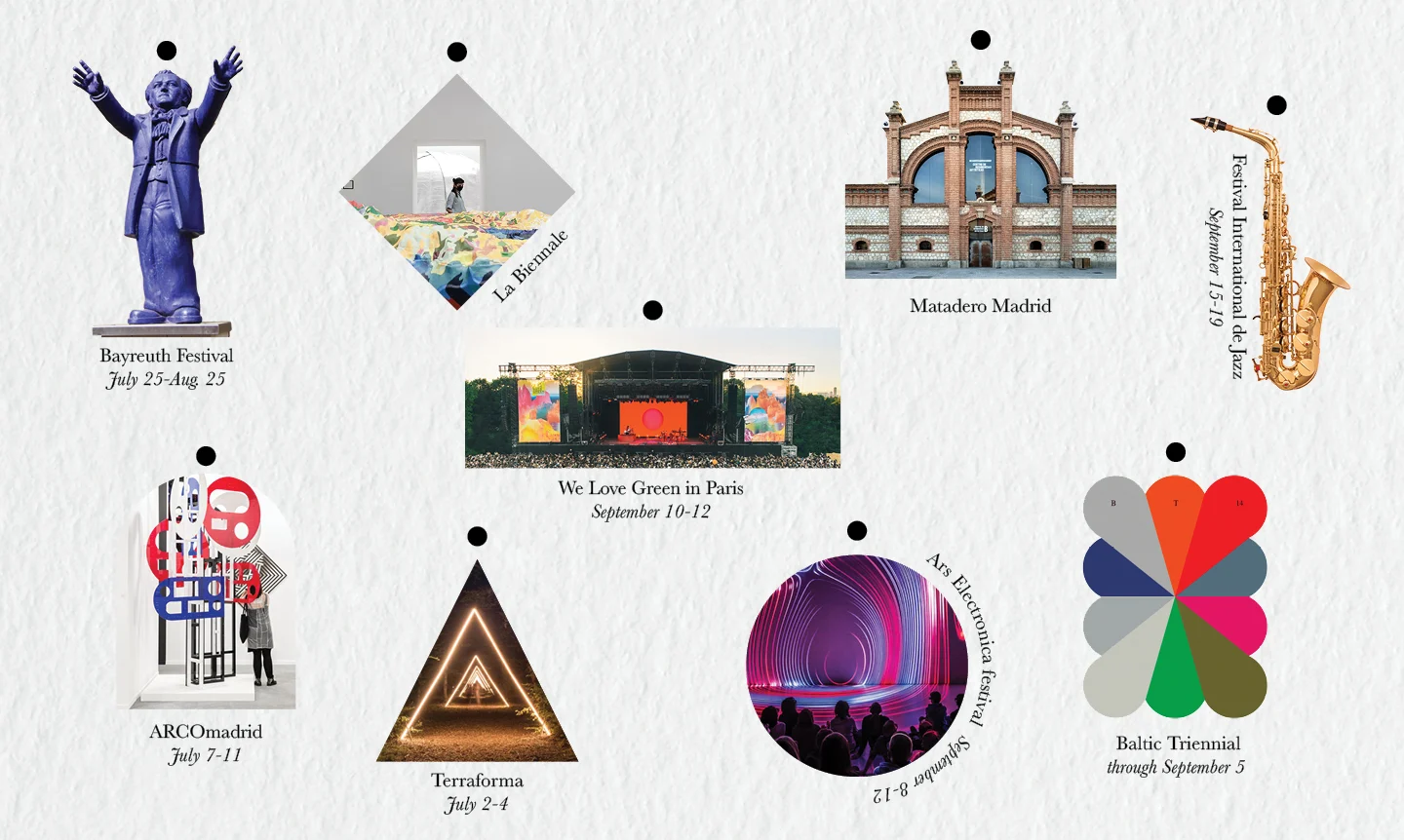
While it was possible to snag time-ticketed entry to museums last year, the return of buzzy international art events like Frieze in New York this spring was one of the surest signs of normality returning. While the biggest fairs like Art Basel were still able to turn sales during the pandemic, from both an art viewing and social perspective, digital art fairs and exhibitions just don’t cut it. That’s the reason to head to Madrid next month for one of the best fairs in Southern Europe, ARCOmadrid, that was luckily rescheduled from February for this summer (July 7-11). With its strong focus on Latin American artists and collateral events scheduled around the city, it’s a perfect excuse to catch up on the incredible contemporary scene unfolding at places like La Matadero, a former abattoir turned public art complex.
Another promising art outing this summer on the other corner of Europe is the 14th edition of the Baltic Triennial (through Sept. 5), unfolding across venues in Latvia, Lithuania and Estonia. Perched on the edge of the E.U., these three small countries—with their Scandinavian flair, Russian Empire architecture and cheaper prices—seem very much at the center of the future of Europe, as evidenced by the topics explored in the triennial’s mixed programming of performance, debate, and visual art.
For those interested in architecture and design, there is nowhere more compelling to visit this year than the pinnacle of all art destinations: Venice. While normally thronged with selfie-stick tourists and price gouging, this year the city’s narrow streets and bridges will be luxuriously maneuverable. The theme of this year’s Architecture Biennale, How will we live together?, feels especially apt after a year of social distancing, with the climbable, smell-able, and scan-able mix of interactive national pavilions spread across the Arsenale and Giardini, making this edition a must-see. Best times to visit for special programming are around the awards ceremony in late August and the finissage in mid-November. Lastly, if technology is a calling card, the Ars Electronica festival (September 8-12) draws together leading media artists and technologists for four days of speculative world-making at the interdisciplinary foundation’s Museum of the Future in stunning Linz, Austria.
A Performative Embrace
The largest and perhaps best jazz festival in the world takes place just north of the U.S. border in Montreal—which is expected to finally open to international travelers soon. What it lacks in pristine views, the Festival International de Jazz (Sept. 15-19) makes up in pure energy: public squares, parks and small clubs around Canada’s alternative cultural capital come alive for extra long evenings of fun and francophone flair. Another less-expected performing arts destination—St. Petersburg, Russia—also embraces its northern latitude for White Nights (through August). Take advantage of Russia’s easy new e-visa system and near midnight sun for this two-month-long showcase of some of the world’s best ballet, opera and classical music. For the band experience, look to the well-executed gem Austin City Limits (Oct. 1-10)—this year featuring Erykah Badu and St. Vincent, a more manageable alternative to the corporate-overrun SXSW.
When theater and opera companies around the world decamp to their summer homes, the off-season program can sometimes feel like an after-thought, despite the beautiful settings. That’s why it’s exciting to go see performances where the summer destination is the main act, like the picturesque Bavarian town Bayreuth. A center of opera since the 18th Century, Bayreuth is home to Wagner’s own hall, the Festspielhaus, where the composer debuted many of his iconic works that are still staged each summer during the Bayreuth Festival (July 25-Aug. 25). Another historic destination to visit for world-class performance is the Provençal city of Avignon in the South of France. For the entire month of July, a certain Parisian milieu transforms the city into a living laboratory of experimental theater and artistic revelry. Even for those who can’t speak French, there’s some infectious about weaving in and out of impromptu performances along the city’s medieval streets (July 5-25).
Where Are the Big Sound-Systems?
Most electronic music doesn’t hit the same in our living rooms, so the urge to get out and dance this summer couldn’t be higher. Depending on vaccination status and the regulations of the country, a wide menu of house- and techno-centered festivals are on offer every weekend of the summer in Europe.