American photographer Steve McCurry has devoted a lifetime to wandering city streets and remote regions with a camera virtually welded to his hands, relentlessly pursuing chance encounters and the right alchemy of light, color and composition to reveal the inner-lives of those he meets.
Most synonymous with his images from Asia and the Middle East, his “Afghan Girl” portrait of the young refugee Sharbat Gula on the cover of National Geographic in 1985 is doubtlessly one of the best-known photos of the 20th century. Framed by a torn shawl, the piercing gaze of her clear green eyes became a window into and emblem of the hardship of those displaced by a hopeless conflict.
It is one of some 350 images in the newly released visual biography of his career, A Life in Pictures. Compiled and written by his sister, Bonnie McCurry, it casts new light on the forces that shaped him early on and showcases his most memorable pictures and an assortment of unpublished works.
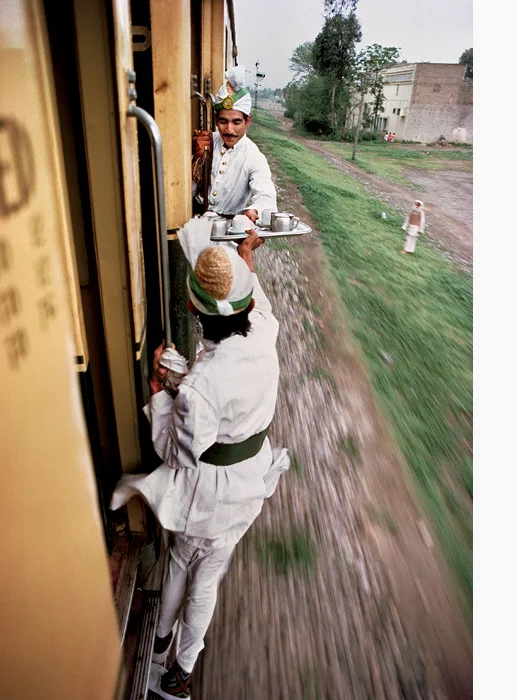
The sheer scope of humanity on display is testament to McCurry’s dedication to get beyond the easy clichés of a country or culture. Page after page is populated with ordinary people going about life in some of the most extraordinary places and situations on the planet, often with an unexpected flourish. We see a mother in Beirut casually peeling potatoes on her balcony against the backdrop of bombed-out apartment blocks; a young man in Kabul resting against his bicycle clutching a bouquet of pink carnations; and a tailor transporting his sewing machine neck-high above the floodwaters of Gujarat after monsoonal rains.
McCurry began working internationally after quitting his job as a photographer at a Philadelphia newspaper at the age of twenty-seven with a one-way ticket to India; his experiences abroad up to that time having nurtured a fascination with far-off places. “Early on I decided I really wanted travel to be part of my career,” he explains from his New York studio. “That wanderlust and urge to see the world has carried me through the next fifty years.”
He would spend some two years overseas after arriving in India, following the path of his hero Henri Cartier-Bresson, the legendary lensman and co-founder of Magnum Photos whom he would later befriend as a member of the seminal agency. It was during these early adventures that McCurry learned to stop and observe. “If you wait,” he realized, “people will forget your camera and the soul will drift up into view.”
A Life in Pictures is a tribute to a life behind the lens and a celebration of McCurry’s vision to chronicle ancient and sometimes vanishing ways of life and to capture the common thread of humanity in the people he photographs, no matter their circumstances.
You’ve returned to India countless times since your first visit. What compels you so much about that country?
One of the strengths of India for me is that it’s very different from where I grew up, so you’re continually learning about these new things and being bombarded by all the visual differences. You’re struck by how many people are there and all the different religions and cultures swirling around. There is also extreme wealth and extreme poverty. It’s an incredible place to wander and explore. With such a vast country I kept finding new places and going back for different reasons—it’s just an incredible endless fascination.