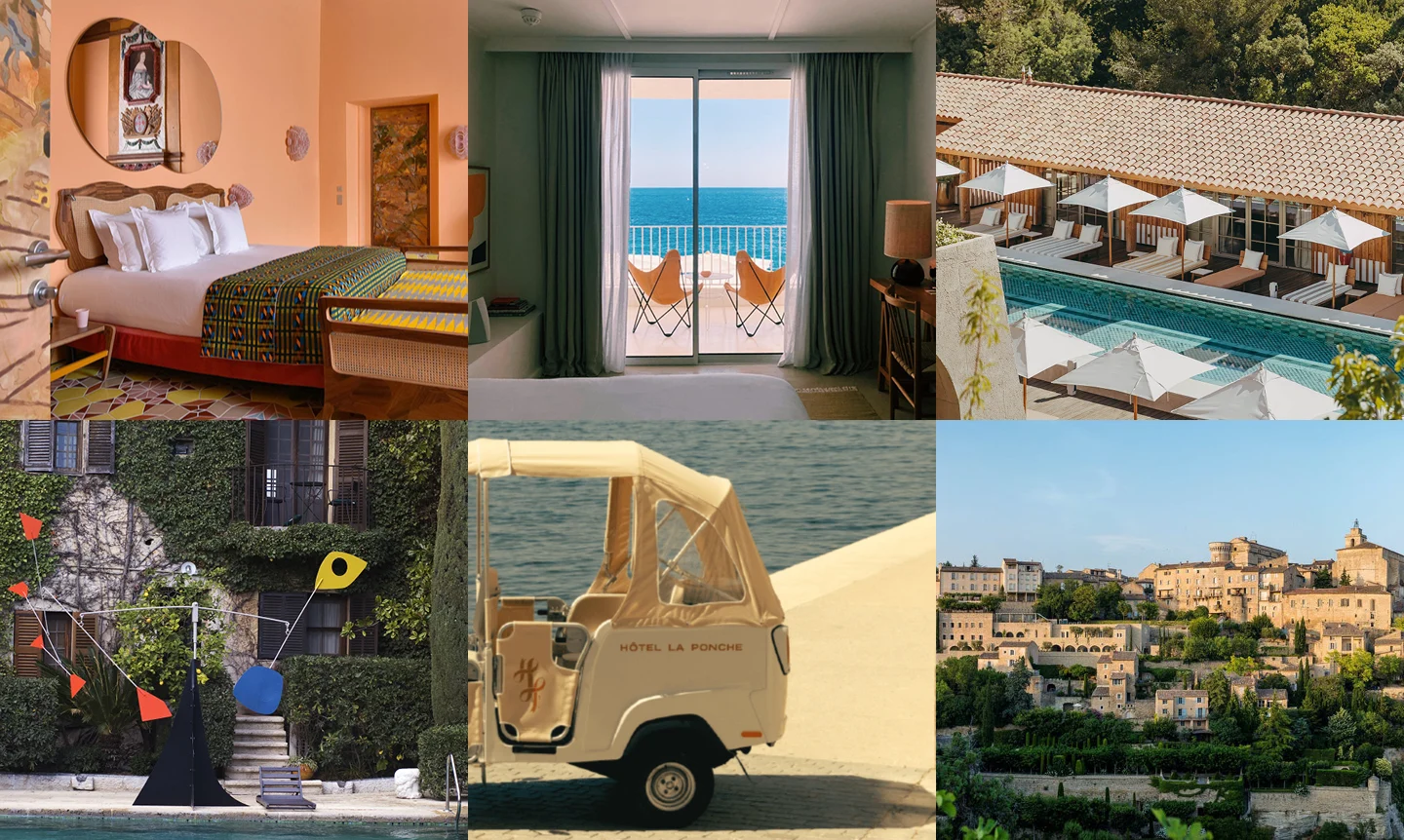
Remember when the French Riviera was the most fabulous place to go on holiday? Think back, way back, to those days when glamour was practically embedded in every grain of sand, dripping from every striped beach umbrella and built into the walls of every luxury hotel. Frank Sinatra in the‘50s, Serge Gainsbourg in the ‘70s, Cher in the ‘80s, Brigitte Bardot, well, for decades—they all did the French holiday right, long before the scene was taken over by “yobs,” as Bardot once lamented. And now we can add the ‘20s to the list of South of France heydays, as the post-pandemic yearning for classic, elegant (and, yes, a little bit excessive) holidays come back into fashion in a big way. Here, we share our pick of the hotels that (re)capture the golden age of the South of France, from the hills of Provence to the sands of Saint-Tropez.
Hotel Épi 1959, Ramatuelle
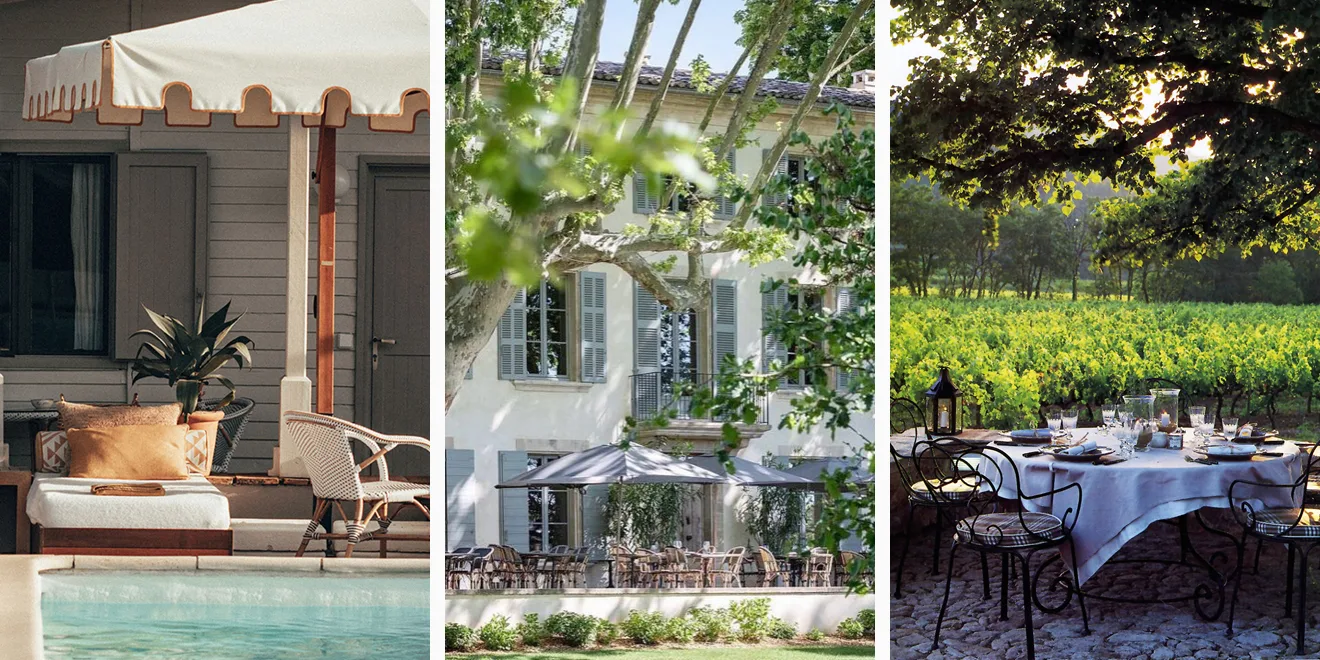
If ever there was a poster child for the glitz and glory of the classic Cote d’Azur retreat, it’s the Épi. Opened in 1959 on Pampelonne Beach, just west of Saint-Tropez, the Ramatuelle oasis remains one of the last and best secrets in town—but it’s hardly resting on its laurels. The hotel has been updated with just enough modernity: Italian designer Monica Damante redesigned the 10 original cabins with vintage furniture and black-and-white prints, and Madison Cox—who has overseen Marrakech’s Majorelle Garden for the last two decades—brought the extensive gardens back to life with blooming hydrangeas and lilies. It wouldn’t be right to update everything though. Just the right amount of retro can be found at the pool (surrounded by eggshell umbrellas and daybeds), the bar (lined with bohemian wicker stools) and a tennis club (with clay courts, of course).
Domaine de Fontenille, Lauris
Cezanne’s Provence—filled with kaleidoscopic hillsides and moody forests—is in abundance at Domaine de Fontenille, a 17th-century chateau tucked amid ancient cedars and olive trees in the Luberon. At first glance, it’s all so very rural, with hens pecking around the gardens and fat, juicy gourds littering the potager. (There’s even a donkey sanctuary.) But what was once the ruins of Fontenille’s 87 acres has become an assuredly cosmopolitan retreat, where the 19 rooms and suites are lined with photographs and paintings by local artists and the old cellar has become a contemporary exhibition space. The spa has a hammam; the bistro is endowed by the organic gardens. The vineyards, meanwhile, remain every bit the post-Impressionist paradise, where dappled sunlight flickers between the leaves of plane trees, spilling across the heritage vines that have been producing the Luberon’s native Petite Syrahs and Mourvedres for centuries.
La Bastide de Marie, Ménerbes
Jocelyne Sibuet, the founder of Sibuet Hotels, a collection of chic properties from Megève to St. Barts, has been called the French Martha Stewart more than a few times, but the comparison is perhaps a bit misleading. Whereas her American counterpart is the accessible queen bee of homemaking, Sibuet is a certified doyenne of divine design. That’s particularly evident at La Bastide de Marie, her polished 12-room retreat fashioned out of a particularly unpolished old farmhouse, some 24 miles east of Avignon amid the Luberon Mountains. A reinvention of classic French-Country, the estate sits roughly halfway on the style spectrum between Louis XVI and Pierre Deux, with crisp details and eclectic design pieces somehow fitting in just so with the original vaulted stone ceilings and beaten-earth floors. Sibuet has created a sort of gypsy, anything-goes vibe here, from the Baroque sofas upholstered in denim to the swimming pool carved into the rocks in the terraced garden. It all communes perfectly, if improbably, with the ochre valleys and vine-covered hills that tumble right up to the front door.
Hotel Lily of the Valley, La Croix Valmer
Even Philippe Starck thought the French Riviera was too done when he was initially approached by the owner of Lily of the Valley to give the hotel a facelift. But this 44-room Ramateulle retreat is no Côte d’Azur cliché: Set among the hills above unspoiled Gigaro Beach, with views over the Mediterranean—and a solid 30 minutes from the lights of Saint-Tropez—the retreat is more high-up-in-the-trees than high-fashion froideur. Starck has made a decidedly warm, even rustic, departure from his typical modernist style, leaning heavily on natural materials like wicker, rattan, wood, and marble. Thankfully, there’s nary a Ghost Chair in sight. Make no mistake, there’s still a sense of French Riviera joie de vivre here: in the spa, offering retreats for those who want to look and feel (but mostly look) better; at the beach club, with robin-egg-blue-and-black umbrellas lining the sand; and at the pool, where the rosé is as endless as the sea views.
Hotel La Ponche, Saint-Tropez
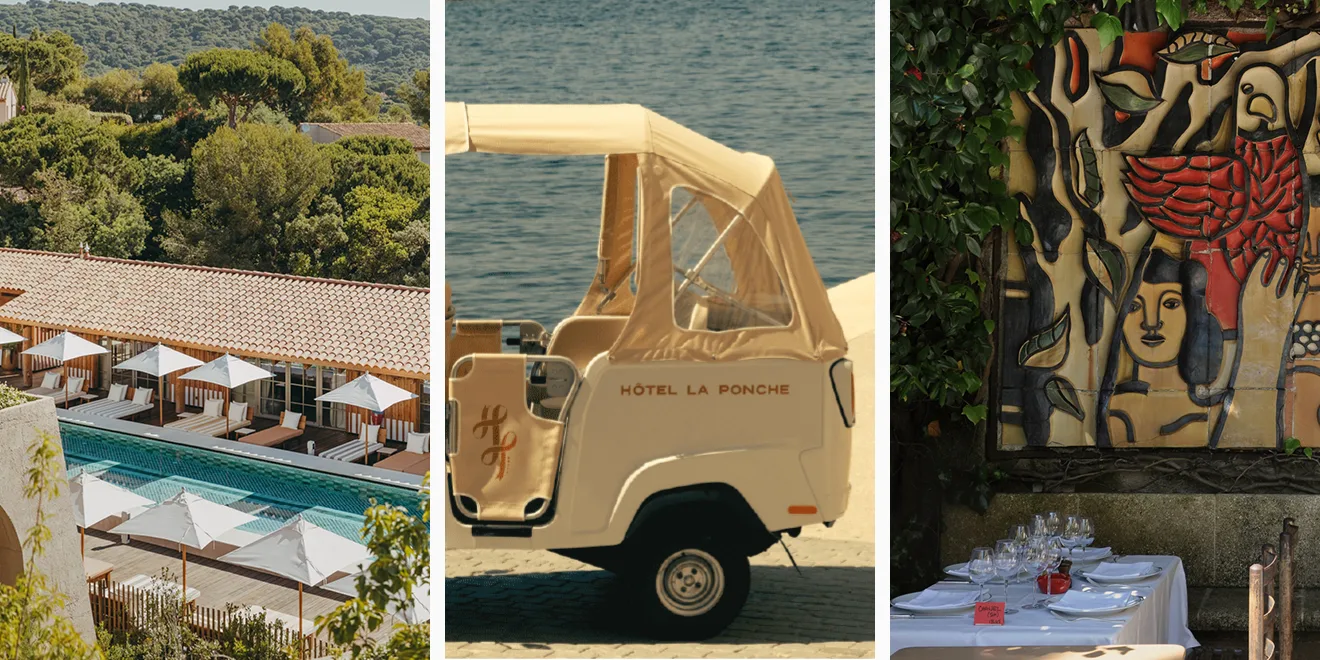
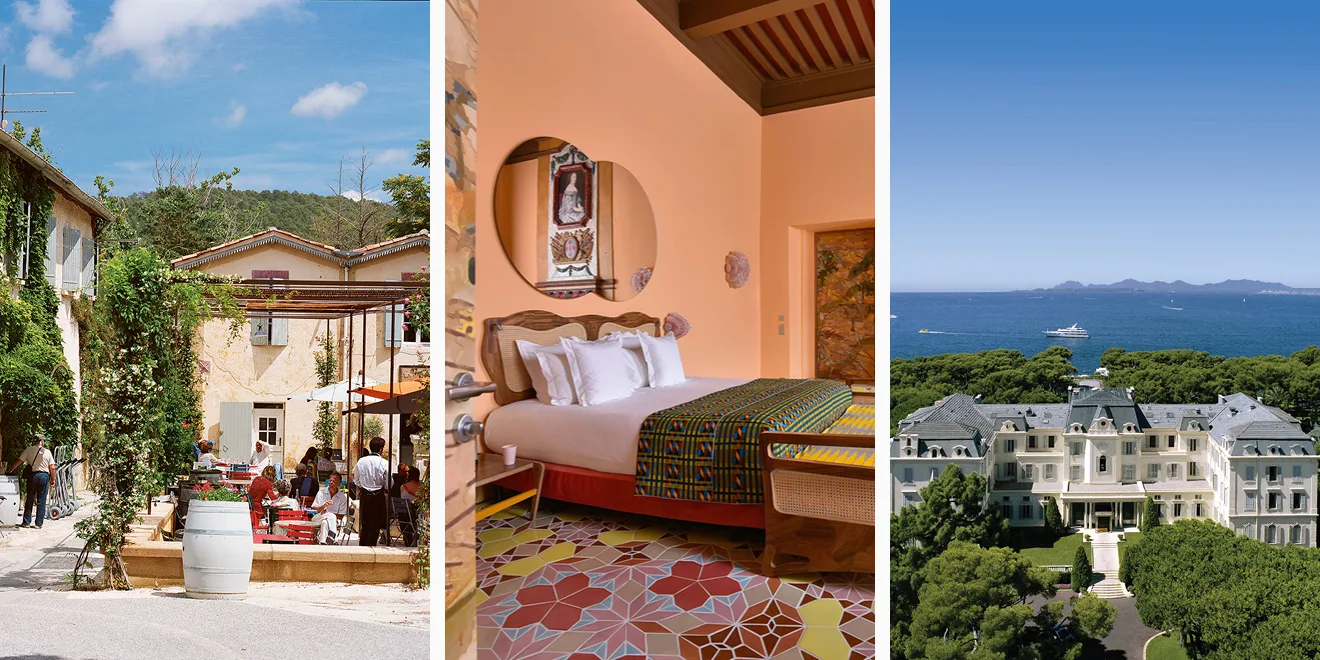
Truth be told, La Ponche was coasting on its reputation for quite some time. The storied pink hotel located in the middle of Saint-Tropez had welcomed enough important names—including Brigitte Bardot for the filming of 1956’s And God Created Woman—that it had the luxury of legacy to keep it afloat. But a renovation last year has made this iconic address great once again. In updating the 21 rooms and other spaces, Parisian designer Fabrizio Casiraghi left the inspiration firmly planted in the ‘60s—only now with a modern attitude (plus a little bit of accidental Wes Anderson). New frescoes, Deco checkered marble floors, original artworks—including a sketch by Picasso, another past guest—bring the motif up to date, just enough to feel fresh, but not so much you’ll forget why you’re here in the first place.
La Colombe d’Or, Saint-Paul-de-Vence
There was a time when sufficient funds weren’t always necessary to secure a night at La Colombe d’Or—that is, assuming the guest in question was Marc Chagall or Henri Matisse. The once-modest inn tucked between Nice and the Alpes-Maritimes was known for taking in a number of 20th-century masters in exchange for a piece of artwork, many of which today still hang on the walls of what has become a discreetly private 25-room hotel. There’s a Calder mobile above the swimming pool, a Léger mosaic mural by the terrace, a Matisse line drawing in the dining room. But the world-class eye candy belies a rather pared-down stay that remains true to Provence’s simplistic style. When guests aren’t in their suites, draped in lace duvets in their four-poster beds, or dining on Chicken Fricassee in the restaurant, they’re no doubt engaging in the old-fashioned pastime that kept Picasso, Braque and César Baldaccini coming back again and again: gazing over the lush gardens and, beyond, the hills of medieval Saint-Paul-de-Vence (and maybe even making a sketch of it).
Villa La Coste, Le Puy-Sainte-Réparade
Villa La Coste is the rare contrarian out to prove that not everything in Provence is steeped in history. The 28-villa retreat set on the 600-acre Château La Coste wine estate is decidedly untraditional, yet it’s a natural progression of classic Provençal style, with its whitewashed interiors and rolling Luberon Valley views. The design may verge on modern to a fault (though, honestly, a high-tech Toto is a welcome addition to any bathroom), but a close-to-nature ethos ensures an infallible sense of place, whether dining in the restaurants fueled by organic produce—one helmed by the renowned chef Hélène Darroze, the other from Argentine grill master Francis Mallmann—or sipping Coteaux d’Aix-en-Provence reds among Louise Bourgeois sculptures at Château La Coste, which, though more than 300 years old, is a pioneer for its biodynamic wines today.