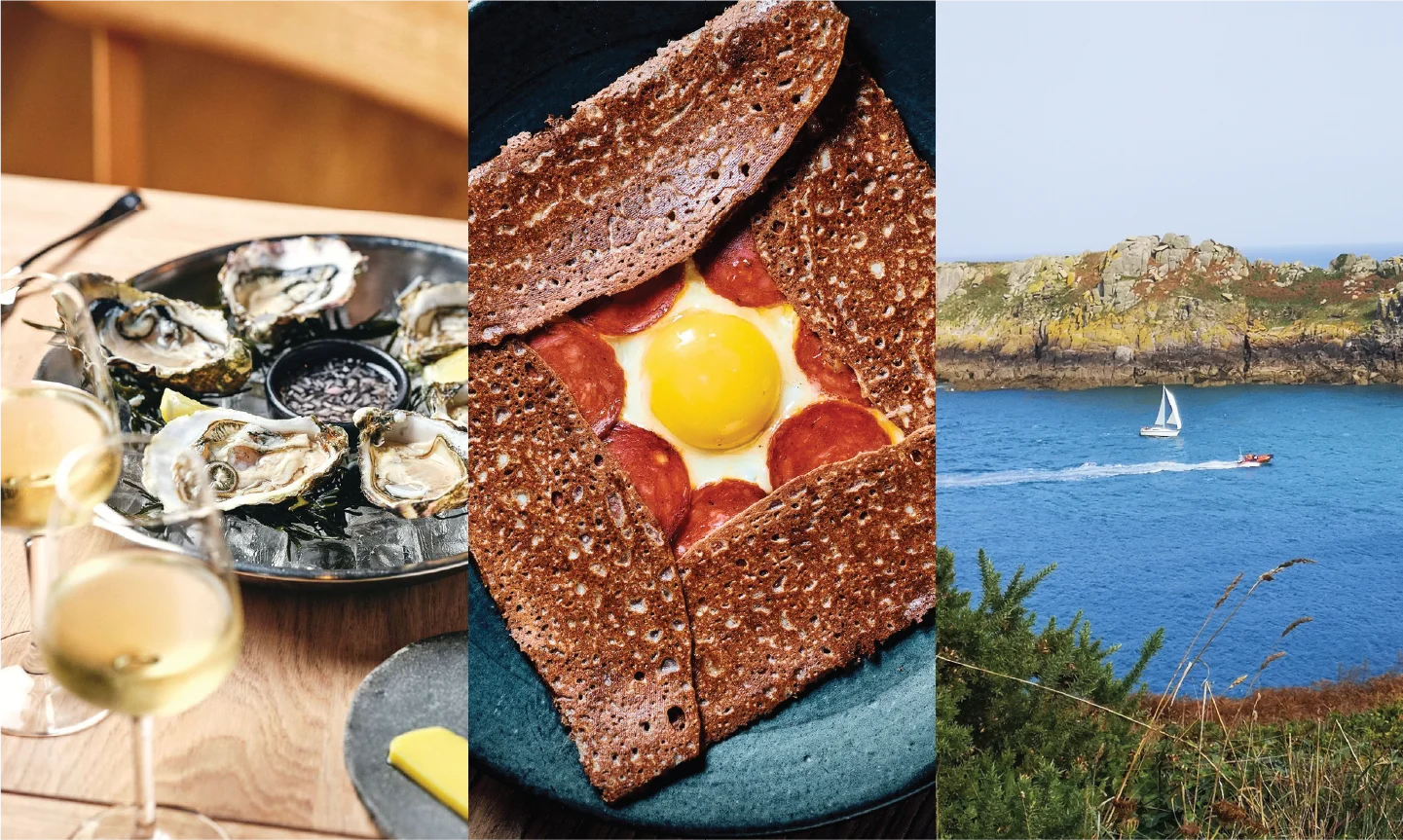
The Breton port of Cancale has long reigned as the oyster capital of France, its briny, pearlescent mollusks so prized that Louis XIV had them shipped daily to Versailles. Their subtle nuttiness and clean, salty finish reflect the unique terroir of the Bay of Mont Saint-Michel, where nutrient-rich waters and dramatic tides — rising and falling up to 43 feet — create ideal growing conditions. In 1994, the French government named Cancale a Site Remarquable du Goût (Remarkable Site of Taste), cementing its place as a gastronomic destination alongside places such as the Châteauneuf-du-Pape wine region and the cheese-making town of Roquefort-sur-Soulzon.
These days, well-heeled gourmands and vacationing Parisians flock to the town to slurp oysters and roam along the Breton Coast, where a wave of new creative businesses (see: Deus Ex Machina’s new surf-centric outpost in Saint Malo) and glossy new accommodations like the Japanese-style Otonali Hôtel and the soon-to-open Les Bassans, from the LVMH-backed Fontenille Collection, are luring tastemakers. Among them: hotshot chef Jean Imbert, who is preparing to open a restaurant at the summit of Mont-Saint-Michel.
But at the center of the buzz is Cancale, where one local family has been shifting the spotlight to another ingredient rooted in the region’s rich maritime history: spice. Chef Olivier Roellinger — whose now-closed Le Bricourt once held three Michelin stars — has spent decades uncovering and reanimating Brittany’s ties to the spice trade. Two centuries ago, pirates from nearby Saint-Malo raided merchant vessels carrying pepper, ginger, cinnamon, and clove — prized cargo bound for the royal court. “In these warehouses,” Roellinger writes in his 2020 book Pour une Révolution Délicieuse (For a Delicious Revolution), “the flavors of the world were gathered in Europe for the first time.” Today, the Roellinger family (known in the area for their boutique hotel collection and acclaimed eateries) sources more than 250 spices from small-scale growers around the world. Their spice blends, some co-created with creatives such as Indian chef Beena Paradin and Japanese poet Ryoko Sekiguchi, appear in many of the region’s best-known restaurants, including Bertrand Larcher’s beloved Breton-Japanese Breizh crêperie.
Viewed through the prism of spice and scent, the region’s perfumeries, tea salons, and exotic seaside gardens tell a more layered story of exploration and exchange. Cancale still smells like salt and sea — but now, too, of sweet vanilla from Réunion, white pepper from Cameroon, and Criollo cacao from Mexico. With the Cancalais hospitality family leading the way, here’s how to get a taste.
Stays
From the waterfront to windswept cliffs.
The port of Cancale is lined with tidy rows of two- and three-story granite houses, their steep slate roofs featuring dormer windows designed to draw in light and sea breeze. In a pitched-roof building near the oyster market are Breizh Cafe’s five minimalist guest rooms, situated above Bertrand Larcher's Breton-Japanese crêperie and the Michelin-starred restaurant, La Table Breizh Café. The simple, unfussy rooms take their cues from Japanese ryokans, with sparse decoration that never competes with the views of the port and bay. Daily breakfast includes fresh crêpes and local goodies like Maison Bordier yogurt perfumed with Madagascar vanilla and artisanal teas from Brittany’s Brûlerie d'Alré.
For a different vantage on the Emerald Coast, Les Rimains, near Cancale’s Upper Tour (Le Bourg), was the Roellingers’ first foray into hospitality. Opened in 1998 inside a composer’s cliffside stone home overlooking the bay, the four rooms feel like quaint maritime cottages, with wide plank flooring, porthole-style windows, clawfoot tubs, and views of the property’s manicured garden, planted with whimsical hedges, bushels of hydrangeas, and exotic proteas (native to South Africa and characterized by their crown-like head and colorful tubular flowers). Just beyond the property’s white gates lies the GR34 (the Sentier des Douaniers footpath), stretching thousands of kilometers along the coast, connecting Cancale to the wild Pointe Du Groin headland.
“These are simple, beautiful places imagined as family homes,” says general manager Marine Roellinger about the four properties that make up the Les Maisons de Bricourt collection. “We try to bring the best of this region to life through these guesthouses.”