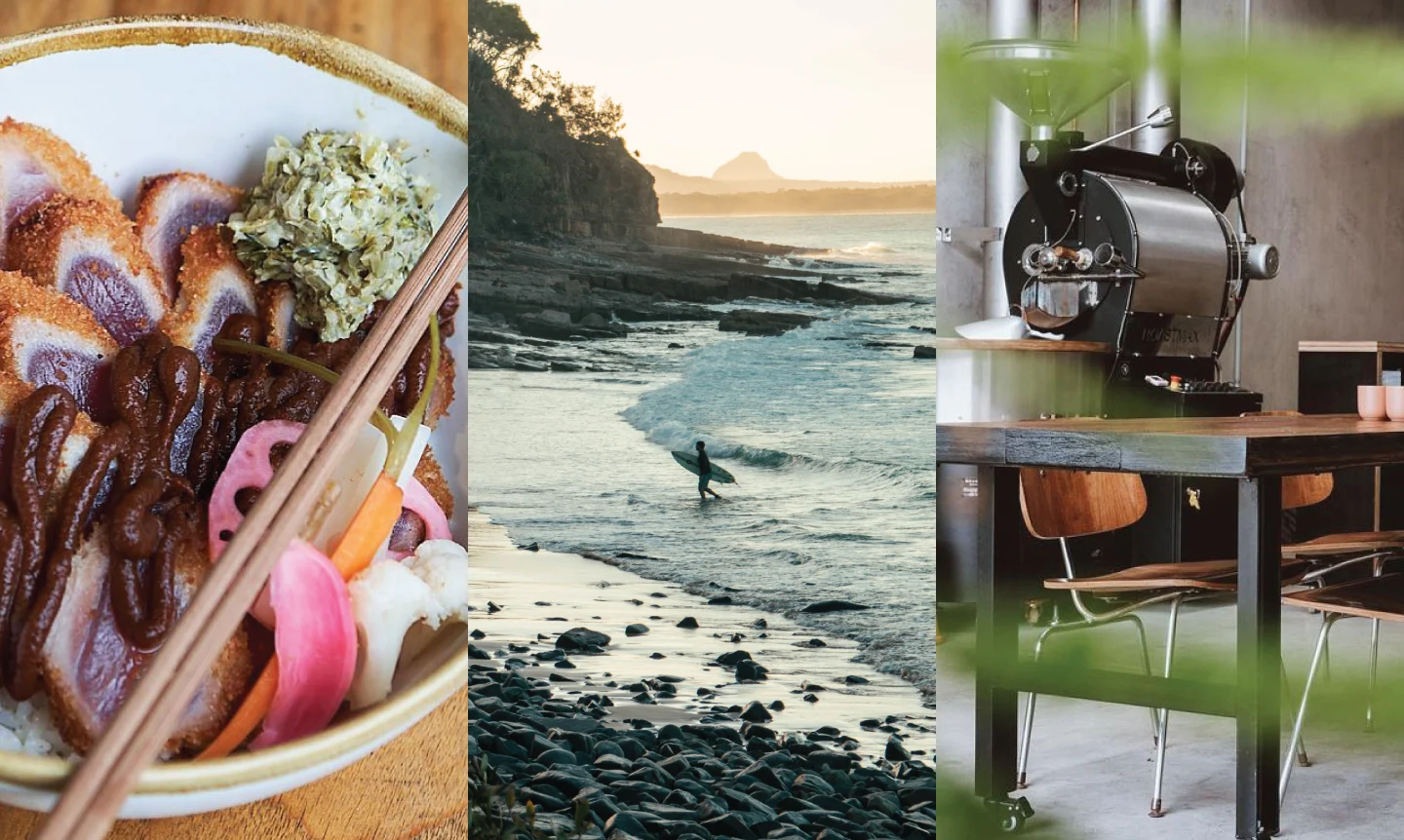
With a rugged coastline, lush farmland, and a glorious 7,500-acre national park, the Queensland town of Noosa has held a near-mythical appeal for generations of Australians. The understated cousin of the flashy Gold Coast, Noosa has long been heralded for its natural beauty, with most visitors flocking to Noosa Heads for white-sand beaches and, as the late Nancy Cato described in her seminal book The Noosa Story, “a necklace of small coves – Little Cove, Tea Tree Bay, Granite Bay.” “Here,” she writes, “legend says the rainbow serpent died and gave his colors and his shape to the earth. On a clear day you can see the end of his broken tail at Double Island Point, sixty kilometres away to the north-west.”
But beneath the Noosa that Australians know and love, there’s something special stirring, a new sensibility for the Sunshine Coast town. Beyond Noosa Heads— and its well-trafficked Hastings Street— satellite pockets of creative energy are emerging in a renaissance for Noosa that hasn’t been seen since the 1970s, and it’s happening in the most unexpected of places: on Noosa’s outskirts, in its industrial zone— commonly referred to as “Noosaville”— where coffee roasters, breweries, artisanal wares shops, and designer surfboard shapers sit alongside panel beaters, warehouses, and big-box stores; and in “Noosa junction,” previously home to some supermarkets, banks, takeaway food outlets and not much else. Here, multiple new restaurants have formed nightly “eat streets,” with tables spilling onto the sidewalk for alfresco dining, while a crop of tucked-away bars have sprouted in unassuming side streets. Meanwhile, in the lush, mountainous Noosa farming hinterland, sleepy villages straddling railway lines have become home to distilleries, artisanal cheese shops, and design-forward homewares stores.
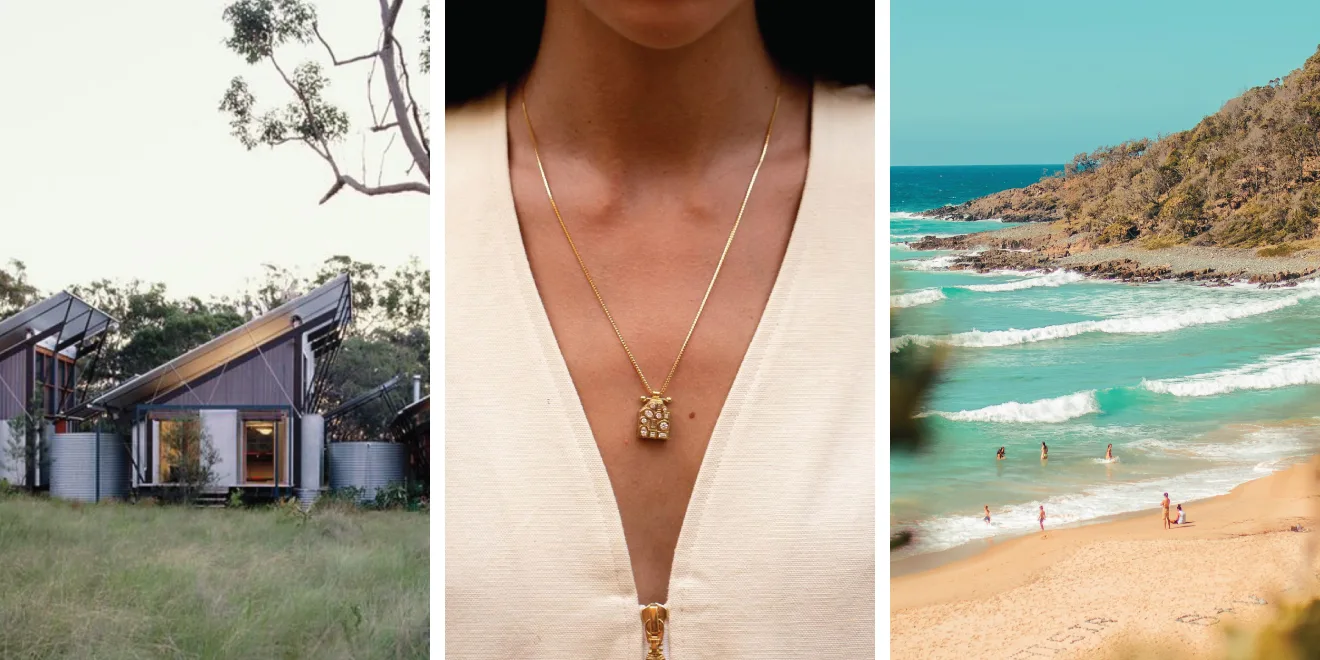
For tens of thousands of years, the Kabi Kabi Aboriginal people (pronounced Gubbi Gubbi) owned this lush region of south-east Queensland. White colonists arrived in the mid-19th century, eager to profit from the area’s giant kauri and hoop pine, red cedar and rosewood. About a century later, in the 1960s, the area drew the interest of pioneering surfers who flocked to the swell along tree-covered headlands. With them came flocks of free-spirited nudists who claimed the beautiful beaches of Granite and Alexandria Bay, nested within the national park, as their own. They were followed by bohemian Europeans, like the legendary Swiss-French chef Pierre Otth, who arrived in a Kombi van in the ‘70s to open a slate of high-quality restaurants, the likes of which many Queenslanders had never seen. Architects including Gabriel Poole and Maurice Hurst created a low-impact, lightweight “Noosa style” of architecture to sit symbiotically within the environment and its native vegetation of casuarina, banksia, pandanus, and tuckeroo. But Noosa’s growing popularity also brought with it a sort of new colonist takeover: property developers. Behind Hastings Street in an area of mangroves, they built “Noosa Sound”, a set of high-end housing blocks; to protect it from tropical cyclones, they built a “spit” at the end of Hastings Street, forever altering the mouth of the Noosa River and its greater environment. Through the 1980s, Hastings Street saw the continual development of generic condos and expensive rentals; while much was lost, what remained was the magic of Noosa National Park, with its spectacular coastal tract of towering cliffs, turquoise “fairy pools,” and boulder-strewn bays— and with it, a lingering freewheeling, nature-loving spirit. It was only a matter of time before a new creative class continued the legacy established by those shaggy-haired surfers and van-camping dreamers. Today, there’s renewed focus in Noosa on treading lightly and sustainable creativity.
The creative renewal was spurred, in large part, by Covid-19 and the ensuing lockdowns; Australians forbidden from travelling internationally arrived in Noosa en masse, developing a fresh appreciation for its charms, with many deciding to relocate and open new businesses. One of them was one of Australia’s most of-the-moment tastemakers, clothing and jewelry designer Lucy Folk. With her French-born partner, the nomadic Folk bought and renovated a dilapidated vintage guest-house in Boreen Point, a small hamlet 10 minutes’ drive north of Noosa. Though the couple lives in Europe most of the year, when in town they make sure to frequent Nineteen Twenty Four US, an antique general store that sells American paraphernalia, vintage cameras, and miscellaneous obscurities, and the by-appointment-only showroom of the furniture and jewellery designer Lee Brennan. For food and drink, she loves simple Japanese at Blue Plum (hand rolls, gyoza, sashimi), Somedays for wood-fired pizza, or the “iconic” Boreen Point pub. (Locals tend to steer clear of two of the most popular, established restaurants – Ricky’s, on the river, and the nearby Asian-fusion Sum Yung Guys – which are invariably booked out.)
“It’s the Byron-ification of Noosa,” says one local referring to Byron Bay, the increasingly crowded coastal town in the state of New South Wales, a longtime Australian creative hub that is now buckling under the weight of money, attention, and influencers.
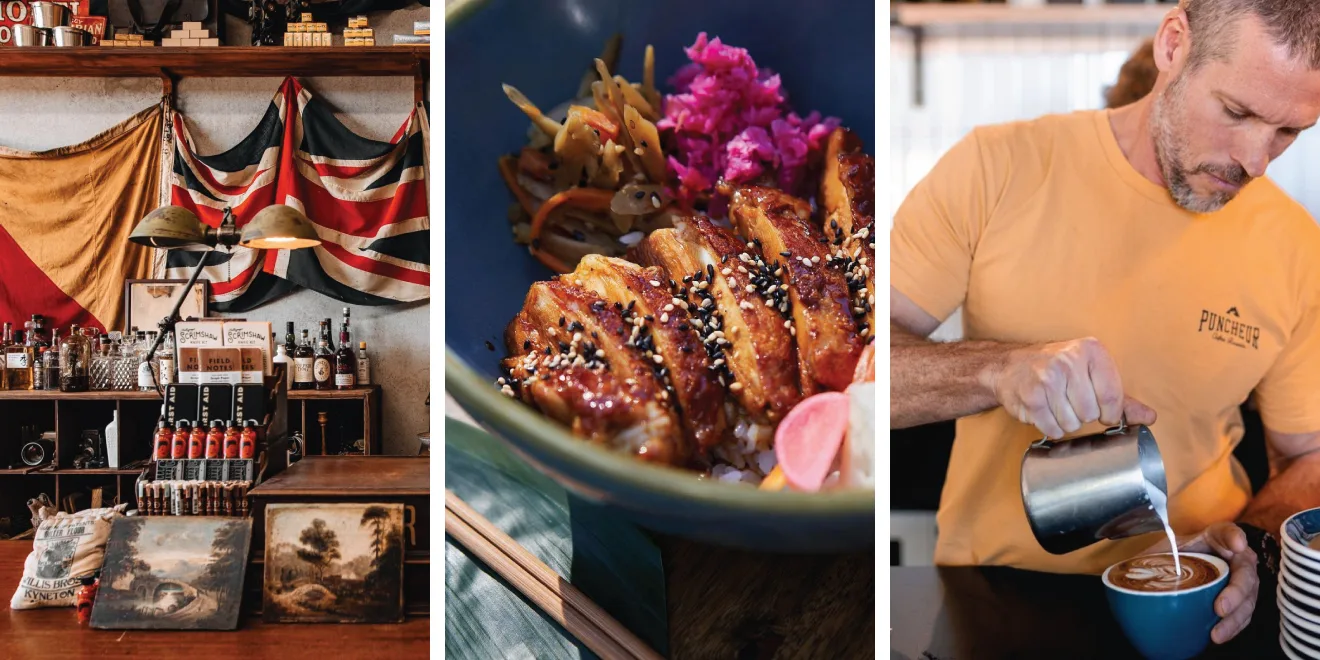
Creative director and stylist Bettina McILwraith, who spends months each year in Africa working with the artisanal basket weavers of Bolgatanga in Ghana, was also grounded during Covid and decided to set up a home base in Noosa where she spent childhood holidays. Through her company, Appetite for Decoration, she offers design consultancy and has a “high-vibrational” showroom of wares in the changing Noosa industrial zone. “It’s exciting because a lot of independent small businesses that came here because of Covid have kept their businesses running in these out-of-the-way locations and they’ve become almost like secret destinations.” Another notable Noosa newcomer is the Sydney-born chef Justin North, who since late 2022 has been the fly-in, fly-out proprietor of two hospitality businesses on Gympie Terrace, Apéro, a European-style wine bar and the adjacent JD’s Chicken Co. “Everything’s always been focused around Hastings Street, but it’s very touristy, and very overpriced,” North says. The result, he notes, is a growth in alternative hubs of interest. “In years gone by, Noosa Junction was just backpackers and cheap bars. But now there has been an evolution of amazing spots – restaurants, cool quirky little bars, nice little eateries – and it’s starting to get a bit more of a Melbourne-Sydney sort of vibe.” North identifies Theo’s Social Club, a favourite with locals which sources interesting, low-intervention wines and offers food for “grazing” (perhaps fresh house cheese, radicchio, pickled grapes and fermented honey); Nudge Nudge Wink Wink bar, an unlikely Melbourne-vibed, disco-balled, wallpapered cocktail bar; and the minimalist wine hub Atelier. In Gympie Terrace, he likes Bandita, a Mexican cantina and bar with a wood-fired oven, and the bars Whisky Boy and Baxter’s.
For some, the new Noosa optimism is buoyed by the announcement of a new luxury hotel that is set to be built in a bushland setting on “Serenity Close,” nestled beside the Noosa River and within walking distance of the junction. The group behind Brisbane’s acclaimed The Calile Hotel are developing the project, hoping to open in 2026 with 178 rooms, 12 suites and 15 villas.
“Noosa has incredibly strong environmental values, which align with our sustainability ambitions,” says Michael Malouf, one of the partners of Calile Malouf Investments, the company behind the new hotel. Malouf notes that Noosa Shire and its waterways hold UNESCO Biosphere Reserve status—which aims to foster the harmonious integration of people and the environment. Discussions are underway between the Calile and Noosa Council to establish a solar-powered ferry to shuttle guests between the hotel and Hastings Street.