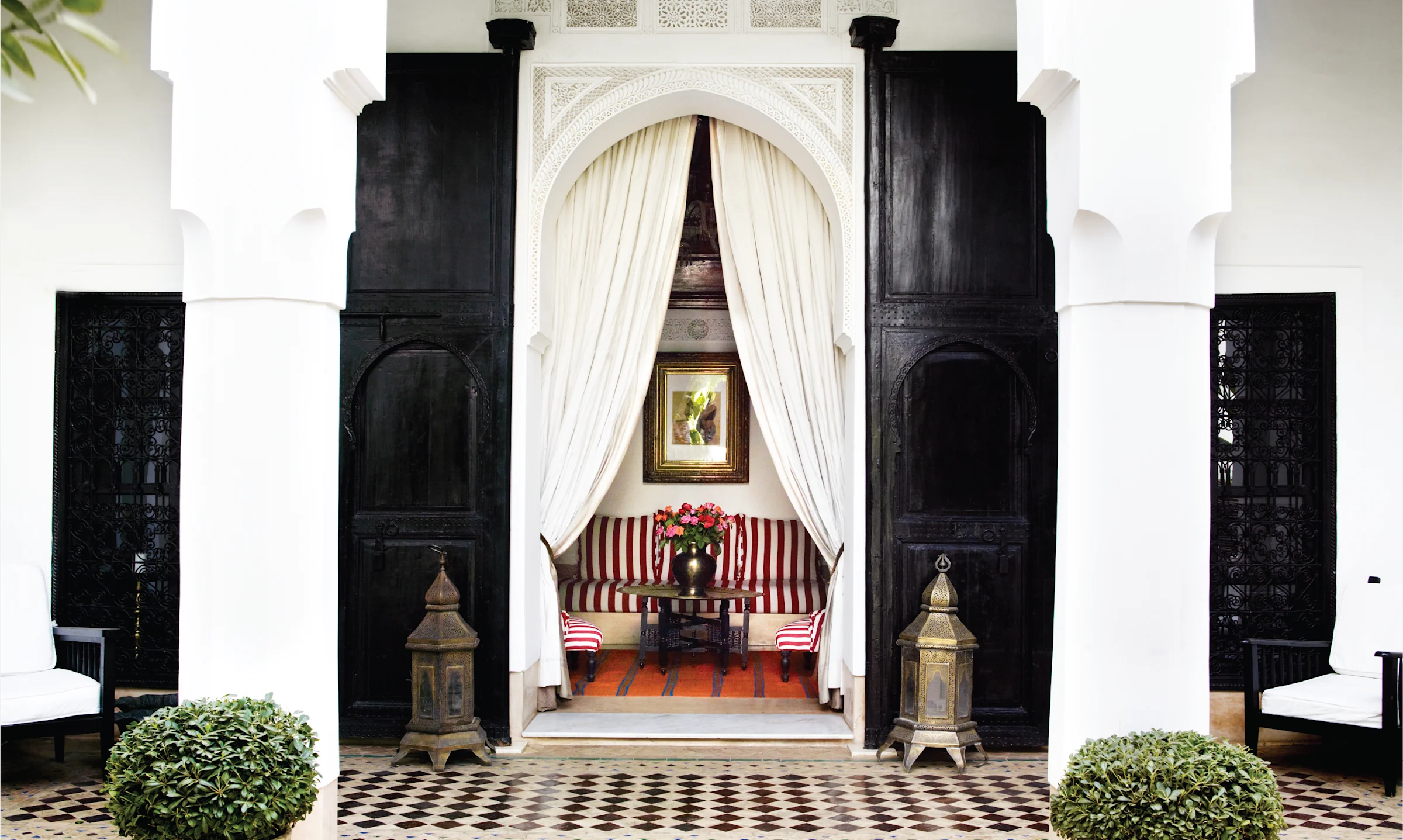
There is nothing, and nowhere, quite like a Moroccan riad. From the street, you'd likely walk right past one: Behind an unassuming wooden door, the noise of the medina falls away, replaced by the sound of trickling fountains, the scent of orange blossom, and the cool shade of a courtyard hidden from the outside world.
Meaning “garden” in Arabic, a true riad is organized around a central open-air courtyard, often planted with citrus trees arranged around a pool or fountain. Unlike the sprawling resorts and international hotels beyond the medina, these traditional homes turn inward, creating private sanctuaries within the city's labyrinthine streets. Smaller versions, known as dars, may forgo formal gardens but often feature a bhou (recessed sitting area) for escaping the heat of a Marrakech afternoon. Nearly all are tucked within the medina's dusky pink walls and adorned with filigreed plaster, smooth tadelakt walls, carved cedar beams, and handwoven Moroccan rugs.
Today, many of Marrakech's most captivating riads have evolved beyond places to sleep. Their courtyards, salons, and roof terraces host long lunches, artist residencies, intimate concerts, and gatherings that blur the line between hotel and cultural salon. Yet as riads have multiplied, the truly special ones have become harder to distinguish from the merely fashionable. The best still offer an unmistakable sense of discovery: the feeling that, with the turn of a key, you've entered a private world hidden in plain sight.
El Fenn
Few hotels have shaped Marrakech’s visual identity quite like El Fenn. What began as an intimate five-room riad has gradually expanded into one of the Red City’s most talked-about hotels, now encompassing multiple courtyards, pools, restaurants, a spa, boutique, and one of the medina’s most sought-after rooftops. Celebrated globally for a design language where jewel-bright tadelakt walls and hand-stitched camel leather floors meet mid-century modern furniture and a museum-worthy art collection, these are the rooms that launched a thousand photo shoots. Recent updates have refined rather than reinvented the property, from the marble-tiled rooftop terraces and colonnaded gardens to a cocktail program built around seasonal ingredients and a plant-forward menu infused with rose water, argan oil, and preserved lemons. Even after two decades, El Fenn remains the riad against which nearly every design-forward opening in Marrakech is measured.
Riad Sakkan
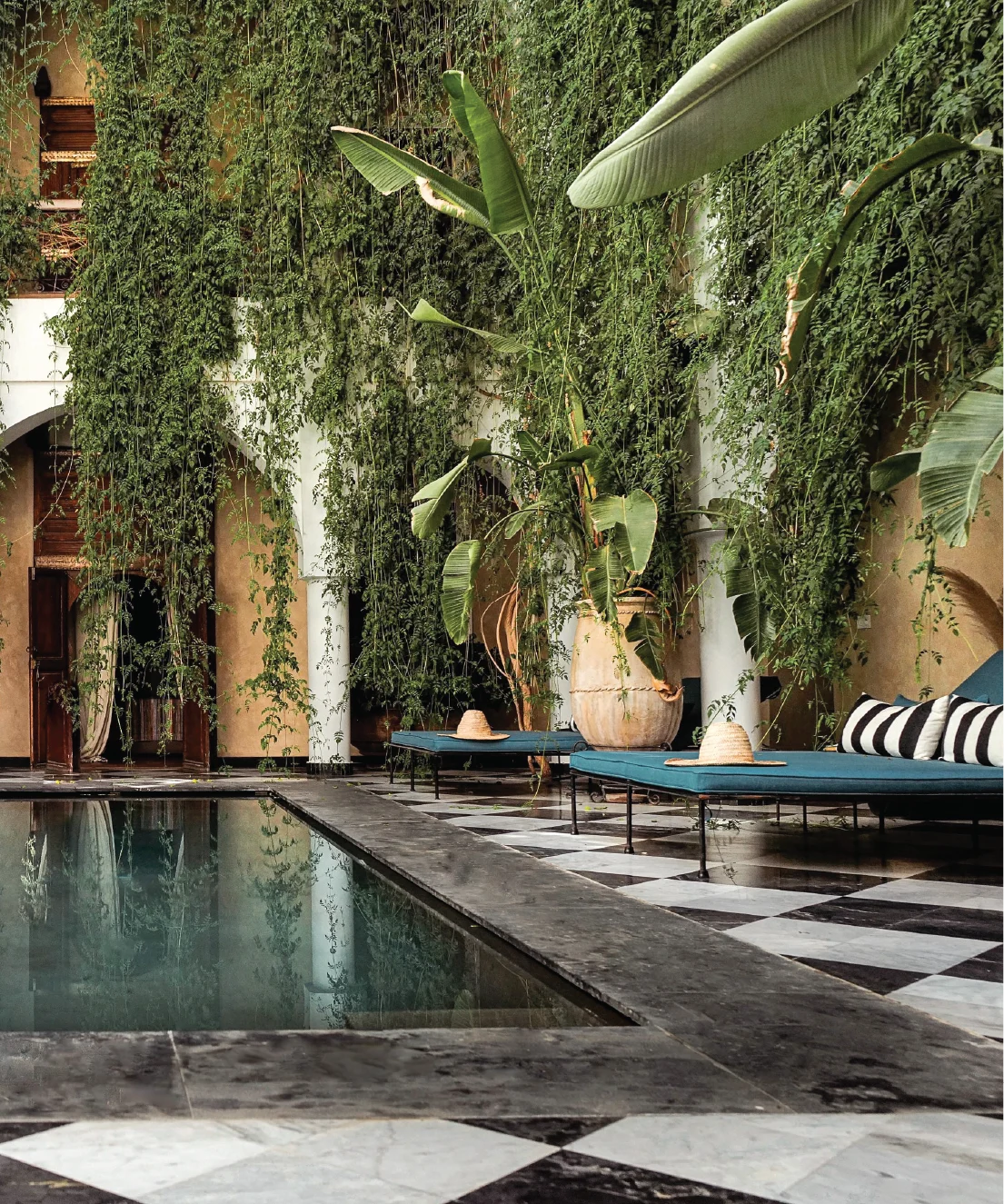
Riad Sakkan arrived at a moment when Marrakech’s riad scene was becoming increasingly crowded, yet the 12-room property still manages to feel distinct. It is reassuringly true to place, though not necessarily in expected ways. Rather than leaning heavily on nostalgia, the riad functions as a showcase for a younger generation of Moroccan makers and contemporary craftsmanship: spice-hued striped blankets woven from Atlas wool by Anajam Home, hydraulic concrete tiles by Popham Design, organic toiletries by Botanika, and ceramics, textiles, and homewares sourced from across the country. Staff are more than happy to share shopping recommendations. Between the inky blue plunge pool, candlelit dinners beneath the stars, and interiors that balance clean lines with traditional craft techniques, Riad Sakkan captures a more modern vision of Marrakech.
Izza
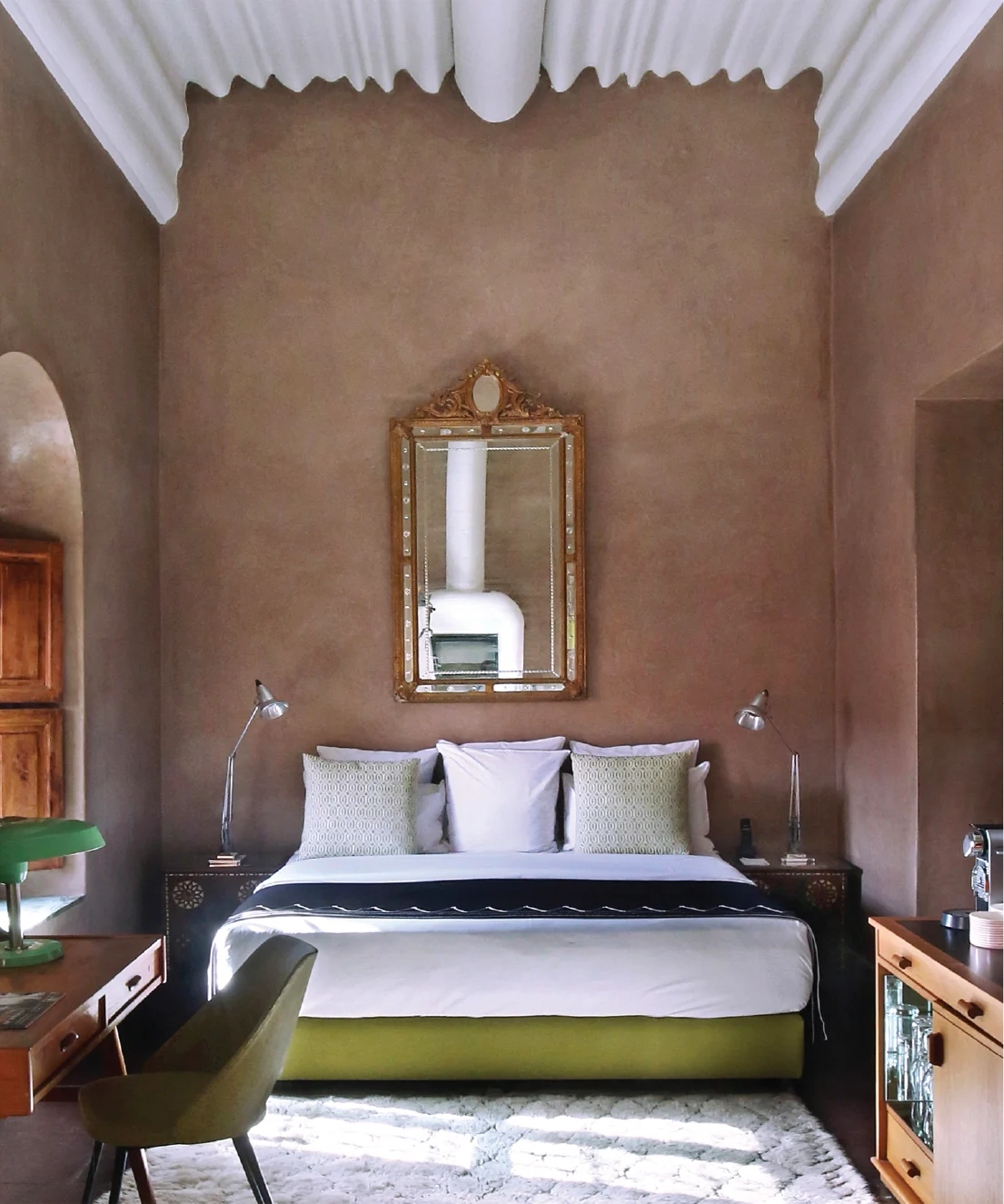
Part contemporary art museum, part members’ club, part riad, Izza is unlike anywhere else in Marrakech. Comprising seven interconnected houses tucked within the medina, the 14-room property is a treasure chest of more than 300 artworks, ranging from contemporary Moroccan photography and painting to one of the world’s largest physical displays of digital and generative art. Inspired by the legendary expatriate designer Bill Willis, the interiors pair traditional craftsmanship—think zellige, carved cedar, and hand-finished plaster—with a distinctly cosmopolitan sensibility. Bathrooms are outfitted with Egyptian cotton robes and babouche slippers and stocked with amenities made with botanicals from Ourika Valley. Artists’ residencies, exhibitions, talks, and rooftop dinners bring a steady pulse of creative energy, making Izza a kind of cultural salon for the modern city.
Riad Kniza Marrakech
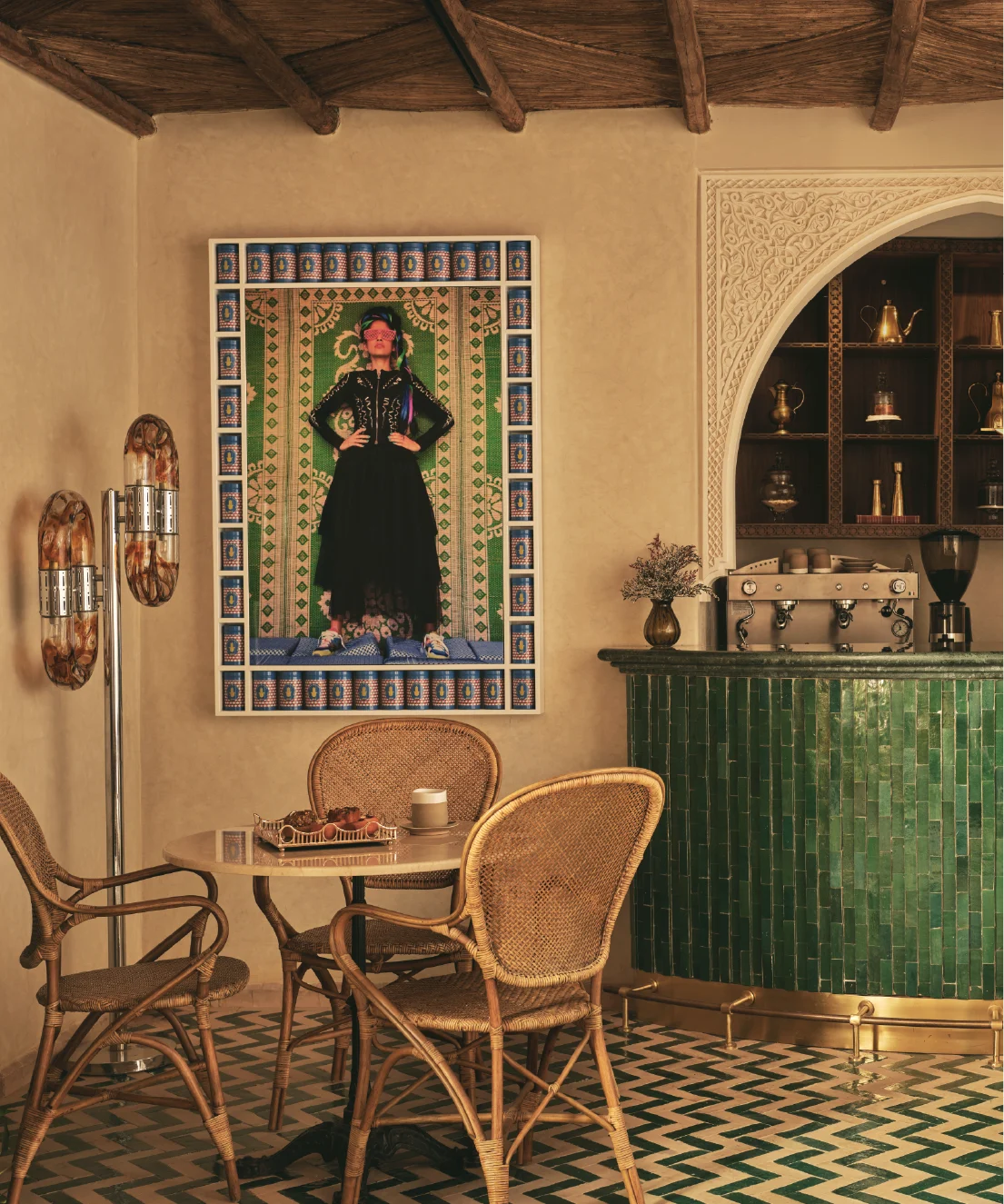
Long before design-forward riads and art-world hangouts arrived on the scene, there was Riad Kniza. Restored by Haj Mohamed Bouskri—a renowned antiques dealer, licensed guide, and lifelong collector—the 18th-century house is essentially a living museum of Moroccan craftsmanship. Hand-knotted carpets, carved cedar panels, Berber jewelry, painted pottery, and family antiques fill the salons and suites. Yet for all its decorative richness, what guests tend to remember most is Bouskri himself, whose encyclopedic knowledge of the city has made him as much an attraction as the riad.
When Claudia Amadeo and Mauro Violini began renovating their six-room riad, they set out to bring a touch of Milanese restraint to the medina. Claudia, who previously worked in fashion PR and first came to Marrakech as a buyer, introduced a more streamlined geometric sensibility to the interiors: terrazzo floors, a brass-inlaid plunge pool, sleek built-in seating, and a fireside courtyard lounge that deliberately sidesteps the ornate aesthetic typical of many traditional riads. The quarters feel unusually bright and airy for the medina while remaining unmistakably part of it.