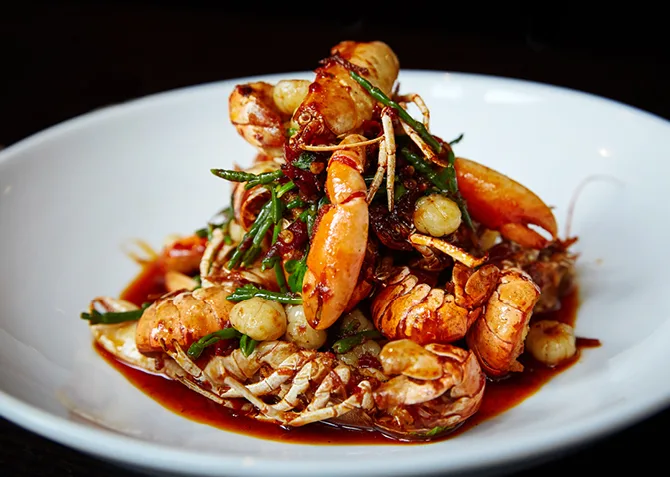
In the heart of Sydney’s Potts Point, Kylie Kwong plates up Cantonese-Australian fare that’s entirely her own. If she isn’t traveling, without fail she can be seen on the pass of her restaurant, Billy Kwong, an establishment that is as close to a modern Australian institution that can be.
Yet the title “institution” implies a place that has seen its moment of innovation pass—somewhere looked upon with respect and affection but not necessarily excitement nor for the thrill of the new. At Billy Kwong this is not the case, and nor is it why it deserves the designation. Here, between the rust-red walls that seem to simultaneously evoke Australia’s Red Center and the inside of a Cantonese eating house, Kwong continues to crystallize the modern Australian identity on a plate.
While the restaurant is the wellspring of her success, the third-generation Chinese-Australian chef is familiar to many from having fronted television series, cookbook jackets and even postage stamps. Her popularity reflects the broadening palate of a country that, within the space of a few generations, has outgrown meat-and-two-veg-style British cooking thanks to waves of post-war immigration from the Mediterranean and, subsequently, Asia.
“Growing up my mum would cook really beautiful homestyle Cantonese cuisine,” Kwong recalls. “We were the only Asian children in our Sydney neighborhood, but we were very popular at school because the kids all wanted to come to our house to have Mrs Kwong’s cooking.”
Inheriting her mother’s prowess in the kitchen (Pauline is as handy with a pavlova as she is a pork bun) and benefiting from the tutelage of seminal Australian chef Neil Perry, she began reinventing Cantonese tradition early in her career. Gone were the gelatinous morsels popular in mainland China, so too the heavy-sauced dishes. Instead, the young Kwong favored a light, bright and punchy cuisine that embodied the rapidly evolving Australian palate and saw lines down the street clamoring to have a stool in her little “Chinese Eating House.” From that modest platform she sparked her first revolution, a style that made her a household name and further integrated East and West into the everyday. Yet her most important chapter was yet to come.
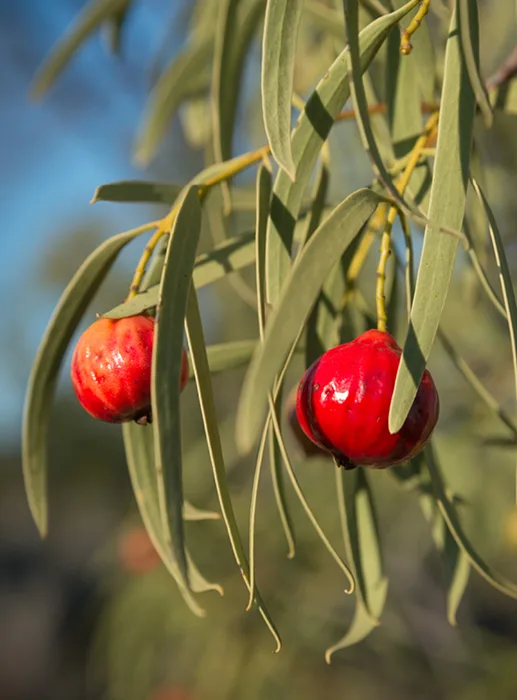
During a speech by Noma’s René Redzepi at the Sydney Opera House in 2010, Kwong experienced what she calls a “lightbulb moment.” “He started speaking about his philosophy of using native ingredients from the country in which you cook in order to express a certain time, place, history, flavor, culture and tradition. I sat there and thought, 'Kylie, why aren’t you using Australian native ingredients?'”
From here she began connecting with Indigenous communities in earnest to unlock the long-held secrets of Australia’s natural abundance and its breathtaking array of beautiful, often bizarre ingredients. She began to incorporate flavors that the country's cooks had turned a blind eye to, preferring instead to be masters of mimicry of the foods of elsewhere. Reading the current menu of Billy Kwong even ten years ago would have had the average Australian believe that Kwong was intent on poisoning them. Yet now, depending on the season, guests may be served sweet-and-sour pork belly with “bush tucker” like fresh muntries and pickled quandongs, or her signature crispy-skin duck with native Davidson’s plum and wild Rosella flowers.
Just don’t mention the f-word when it comes to her culinary style. Her food is not fusion. It is much less earnest and contrived than that. What Kwong and her cuisine do instead are hold a mirror up to the best aspects of modern Australia. One that is reconciled with its past, confident in its identity and excited about its future.