It’s interesting how what we read about a place before we go impacts our experience. For example, many of those who took the long journey north to eat at Fäviken Magasinet were, when they finally reached the remote restaurant in central Sweden, often a little surprised. Mainly because the now-closed restaurant was by no means as remote as numerous media reports claimed. But also because the ingredients used by the extremely talented chef Magnus Nilsson did not come exclusively from the “barren landscape” and the “immediate surroundings of the estate,” as the same media liked to emphasize.
In fact, Åre, Sweden's most famous ski resort, could be reached by car in less than 30 minutes. And while a mighty roast elk filet may indeed have come from the surrounding forests, it didn’t have much to say about “barrenness” or “austerity.” Neither did the two-kilo lobsters or the impressive scallops that gastronaut icon Nilsson imported from the Norwegian coast, a hundred miles away.

You won't find lobster and elk fillet at Klösterle in the mountains of western Austria. But there are other similarities to the legendary Swedish restaurant. There is the restaurant’s location, embedded in nature in the middle of a picturesque landscape — in this case the end of the Zug Valley in the Vorarlberg region. And there is the proximity to a famous ski resort, namely the fashionable Lech. But the most essential similarity is that Ethel Hoon and Jakob Zeller, the two young chefs of Klösterle, met at Fäviken, where they both cooked for three years.
“People keep telling us that Klösterle is a kind of second Fäviken, when in fact there are significant differences,” says Hoon with amusement. “For example. Fäviken was a destination to which many guests came specifically, while Klösterle is more about surprising already-present vacationers with a very special cuisine. Also, in the Alps, the transitions between the seasons are much more pronounced than in central Sweden,” says Hoon, who herself comes from the season-free city-state of Singapore.

In the nature-oriented cuisine of Hoon and her husband Jakob, seasons and growing periods do of course play an important role. Most of the food they serve for lunch and dinner indeed comes from nearby forests and surrounding pastures, as well as from local producers. Or at least from the Alpine region, such as South Tyrol, where Zeller grew up and to this day maintains contacts with many farmers. “We are not dogmatic at all and make a lot of exceptions,” notes Zeller, who brings in fantastic citrus from the Amalfi Coast, which he, as an Italian, would not want to do without.
Exceptions aside, most of the food is locally picked, collected or harvested in summer, and preserved, fermented and boiled down for winter – just as the couple did at Fäviken. And just as all young cooks are expected to do these days, especially if they come from the Scandinavian school.

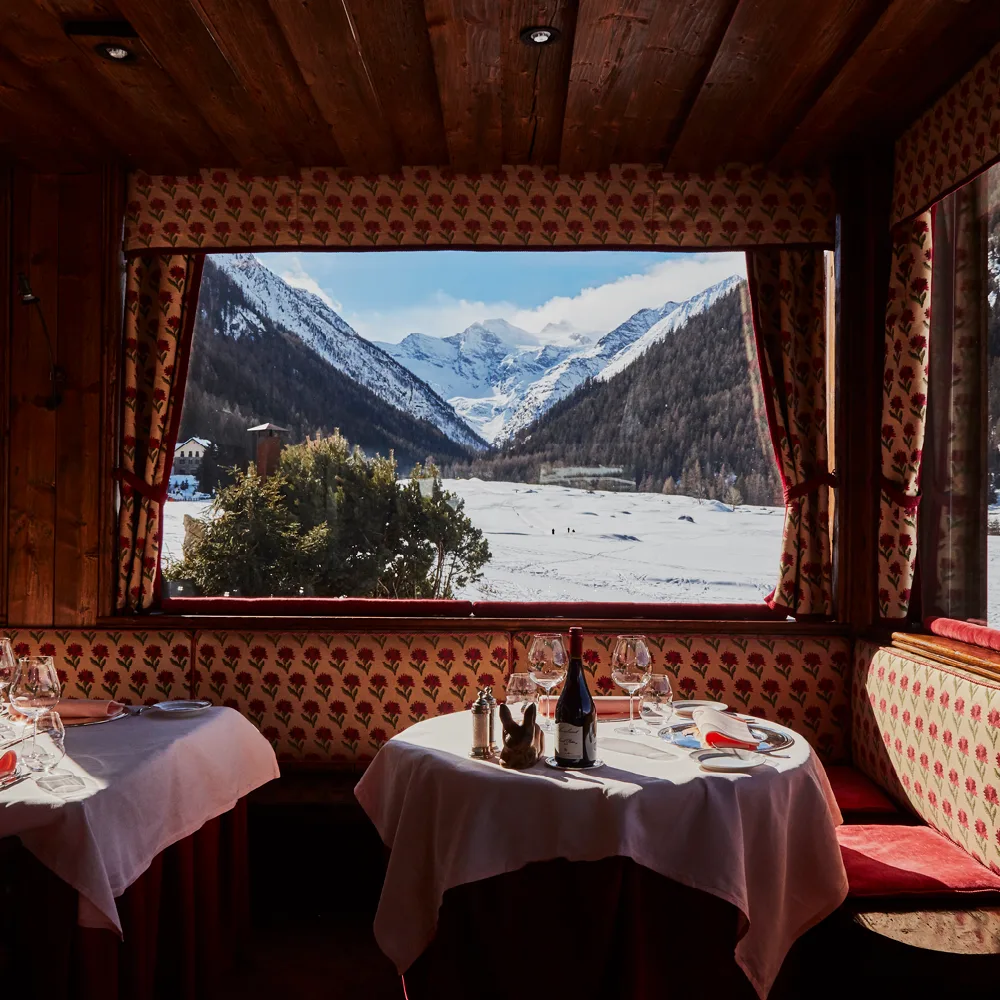
Nevertheless, the experience at Klösterle is completely unique. There is the couple's distinctive cuisine, of course. Add to that the sensational setting, which seems to be straight from a picture book: a centuries-old chalet, surrounded by mighty mountains, lush meadows and grazing cattle. In summer, the mountainous hiking trails begin and end here, as do the ski slopes and cross-country tracks come winter. When snow falls, guests like to access the restaurant on skis during the day and via horse-drawn sleigh in the evening.
The building itself is nothing less than dazzling: a magnificently preserved and lovingly maintained Alpine chalet from the 16th century. In earlier times, during summers it served the shepherds and dairymen who tended the cattle and produced cheese. Today, the wood-paneled parlors and low ceilings are brought to life with carefully selected furniture and kitsch-free decor.