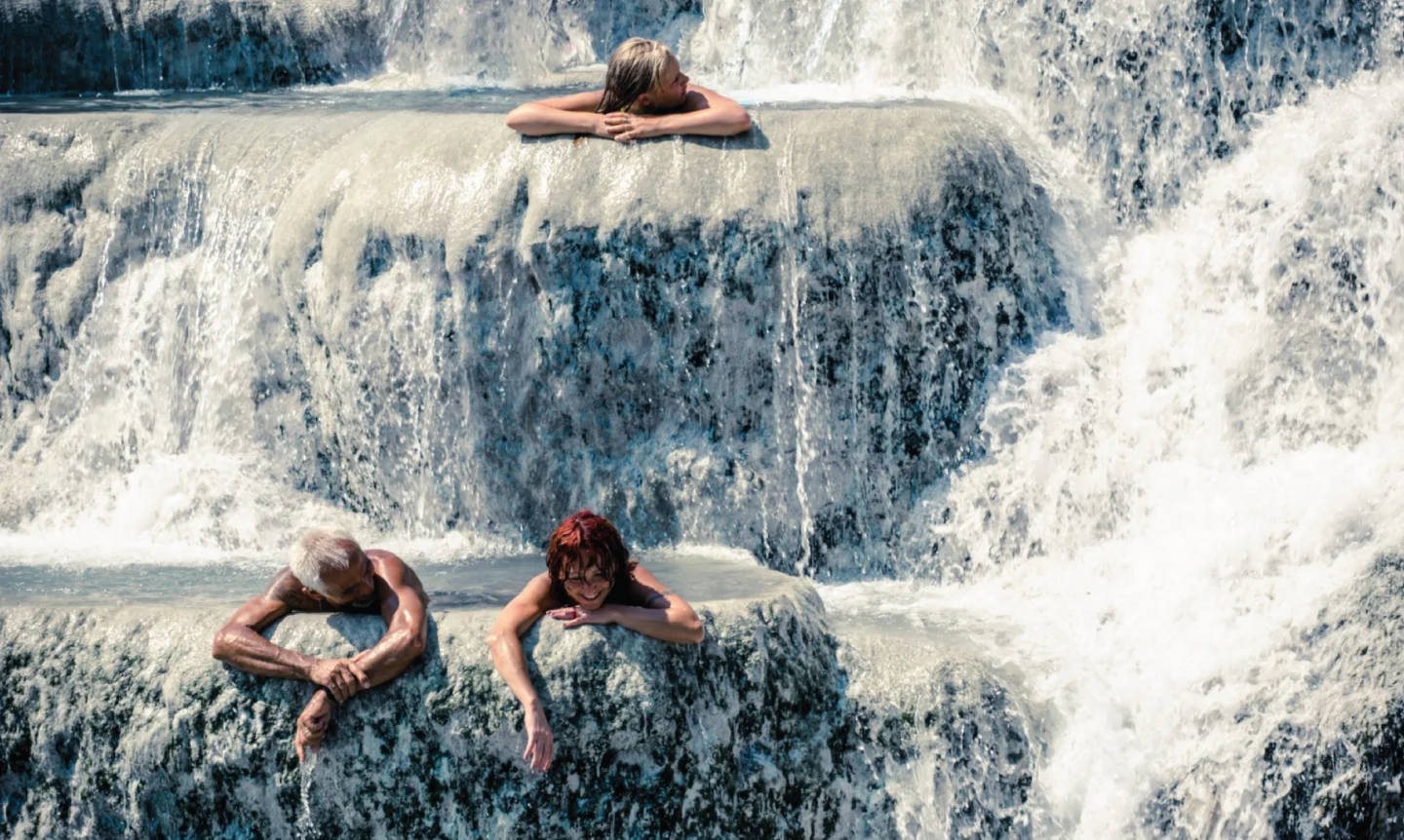
The ancient Romans, who established elaborate bath complexes throughout their empire, called it salus per aqua, health through water. Moneyed wellness-seekers flocked to spa towns that evolved around natural hot springs in Europe and the United States to “take the waters” in the 1800s, and throughout Central and South America, aquas calientes have long been considered to possess a primal power that connects humans and gods. Thermal waters, which began as rain that fell thousands of years ago, bring therapeutic elements such as lithium, magnesium, and calcium from deep within the earth—and though their mineral content (and purported healing properties) may vary, their allure is universal. Whether it’s to calm the mind, mollify aching muscles, cleanse the skin, or soothe the soul, there’s nothing so restorative as being up to your neck in steaming water. Here are some of the world’s most scenic spots to soak.

Pamukkale Thermal Pools, Turkey
One of the world’s most picturesque places to soak, Pamukkale (“cotton castle” in Turkish) is a UNESCO World Heritage site featuring terraces of stunning white travertine pools shaped over eons by cascading calcium-rich water. Though many of the pools are now dry, bathers can still access the 96-degree, softly effervescent water, which was believed in antiquity to cure digestive and circulatory issues, as well as diseases of the eyes and skin. A visit to the adjacent ruins of Hieropolis, a town founded by the Greeks in the 2nd century BC as a healing center, is essential—as is a dip in Cleopatra’s Pool, which was constructed during the Roman era. Said to have been favored by the Egyptian queen herself, it still contains submerged Doric columns from a temple to Apollo that once surrounded it.
Vals, Switzerland
Though the mineralized water here has an ancient source — the nearby St. Peter spring has been visited since the Bronze Age — the remote Alpine village of Vals’ distinctive spa complex dates only to 1996, when renowned architect Peter Zumthor completed a minimalist masterpiece constructed from 60,000 slabs of local quartzite. Stay at one of the two onsite hotels—the luxe Hotel 7132 or House of Architects, which features rooms designed my Zumthor, Tadao Ando, Kengo Kuma, and Thom Mayne—and spend your days marinating in the meditative austerity of Vals’ steaming thermal pools. From the outdoor baths, monolithic walls frame vistas of evergreen forests and snow-capped mountain peaks; inside, the cave-like bathing rooms flicker with light and shadow, their simplicity monastically serene. If you can force yourself to leave the spa, be sure to hike to a vantage point where you can see the extraordinary way that Zumthor’s ultra-modern structure, half built into the hillside, disappears into the landscape.
The Retreat at Blue Lagoon, Iceland
Detractors say that the Blue Lagoon, unquestionably Iceland’s most-famous geothermic pool, is overcrowded and over-hyped—and may even point out that it was only created when drilling from a nearby power plant tapped into a wellspring of subterranean H2O in 1976. All true. But it is still unique: High levels of silica and algae give the Blue Lagoon’s water an otherworldly milky-blue hue and render it supremely healing for those who suffer from skin disorders such as eczema and psoriasis. The Retreat, a boutique hotel that opened in 2019, offers an ultra-private vantage point, with its own secluded stretch of lagoon, a luxurious spa, and glass-walled guest rooms that look out onto a lunar landscape of volcanic rock and green moss. Even in a country where one can build an entire itinerary around jumping in and out of hot water—try Sky Lagoon in Reykyavik, which features an infinity pool overlooking Skerjafjordur Bay, Vok Baths in east Iceland, where geothermal pools float atop a freshwater lake, and the new Forest Lagoon, nestled among the fjords of the north—a night at The Retreat can’t be beat.
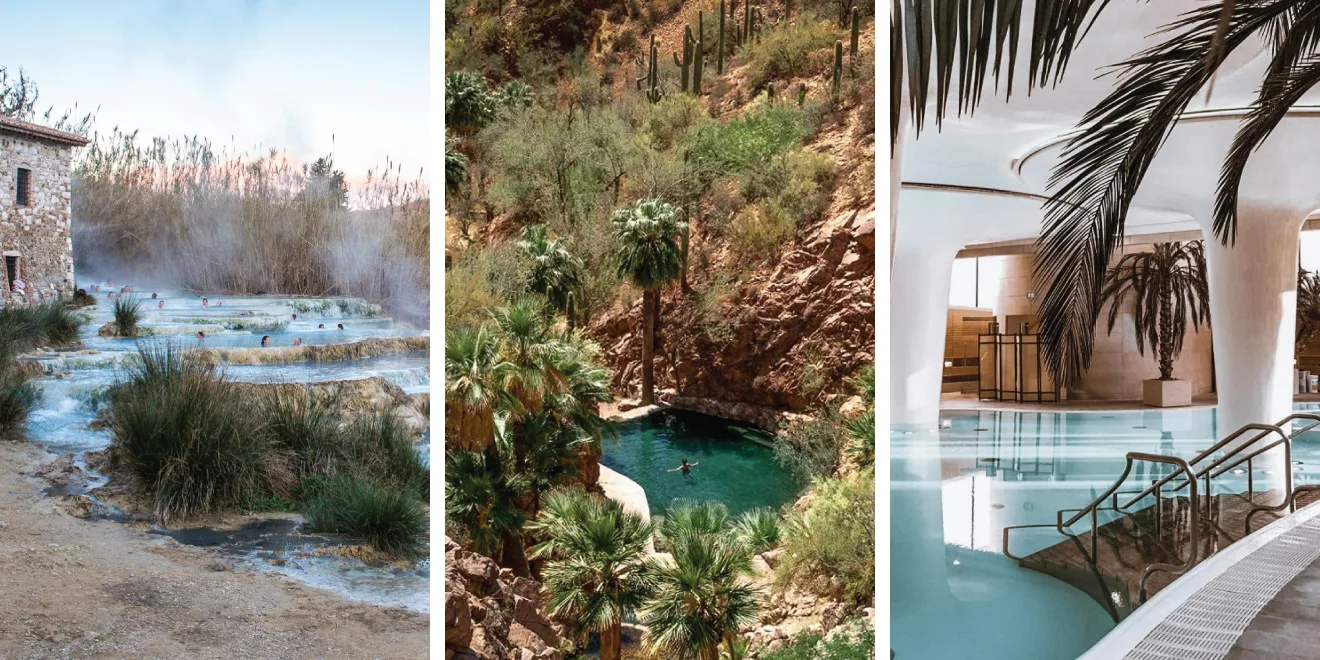
Cascate del Mulino, Saturnia, Italy