
On any menu in any restaurant in Greece, no matter the season or the location, there’s one item you’re almost certain to find: horiatiki, or “Greek salad,” an emblem of the Greek table since tomatoes arrived on its culinary scene in the beginning of the 20th century. And there's a good reason for this: horiatiki features many of the vegetables Greece grows best—cucumbers, tomatoes, olives, onions and herbs—along with its famed briny feta cheese and rich, aromatic olive oil. It’s hard to imagine a better choice for a meal after a day spent sunbathing and swimming in the endlessly blue Mediterranean.
But to forgo other vegetable offerings in favor of horiatiki every time, is to miss out on the wealth of fruits, vegetables and grains that the Greek land provides. Vegetables have long been center stage in Greek cuisine, rendering meat almost unnecessary, an expensive luxury that yields fewer health benefits than what can be pulled from a garden.
As you island hop—or even mainland hop—you are sure to encounter local produce that can’t be found elsewhere, like askordoulakous, a garlic bulb “salad” that accompanies the local spirit, raki, at tavernas in Crete. Then there are the best-ofs: the best sweet tomatoes in Santorini and across the Cyclades, the perfect pistachios in Aegina, the mouthwatering red peppers of Florina in northern Greece. And of course, each region has its own special way to make cheese. All of these ingredients could find their way into your salad bowl, which you’ll miss if you’re only ordering horiatiki.
One note: the salad category in Greece can be a bit misleading. At some point, and for reasons that are entirely unclear, “salata” became a suffix that denoted certain spreads and meze dishes. For instance, melitzanosalata, reads as though it’s a salad of roasted eggplant. But in reality, this is a dip, similar to baba ganoush. They’re part of a group that can incorporate just about anything: taramosalata blends salty fish roe with potatoes, bread, and sometimes nuts; the caper-heavy dip kaparosalata; and pantzarosalata, a yogurt spread that incorporates vivid purple beets.
Here, a short list of classic Greek vegetable dishes and the restaurants throughout the country that make outstanding examples.
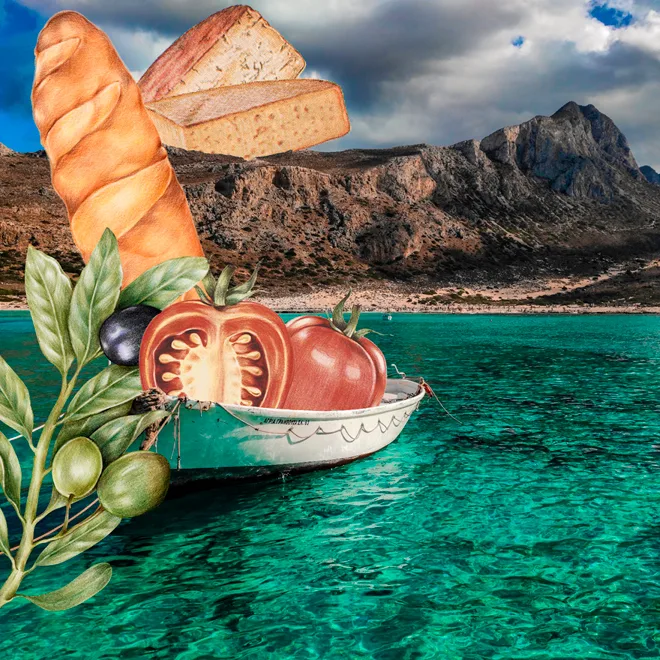
Dakos
This layered tomato-and-cheese salad is built on a little platform of paximadia, a hard rusk bread with roots that can be traced back to antiquity in Crete. This very hard bread is nearly indestructible, impervious to mold and easy to transport, which makes it a great pantry staple. The key to including paximadia in dakos is to sprinkle it with a little water first, to soften it. Then, pile on juicy in-season tomatoes, a soft cheese like myzithra that melts into the other layers as you dig your fork in, capers, and plenty of olive oil. You’ll find these salads everywhere, especially in the summer, but the best are in Crete.
Where to eat dakos: Xerokamares and Dixalo in Crete
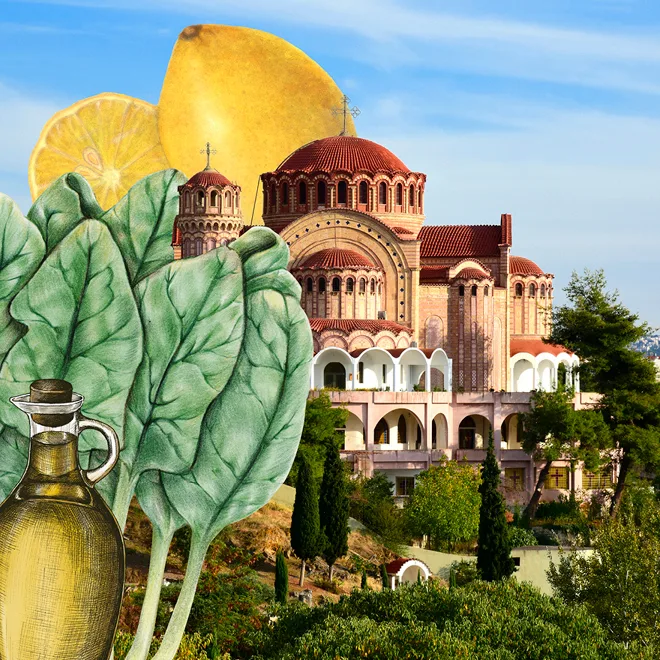
Horta
The word horta encompasses an entire category of greens, of which there are many in Greece. Wild greens, like stamnagathi, vlita (amaranth), and askolymbrus (golden thistle), grow everywhere, across the mainland and the islands, and a horta salad can feature a single variety or a mix of several. Harvesting these leafy greens is thought to be a key component of longevity on many of the islands (like Ikaria, sometimes referred to as “the island where people forget to die”), as foraging is an activity that requires movement and agility, and a social activity, too. It’s a practice that is quickly going by the wayside as gardens shrink and younger generations leave their villages for the cities. Usually, horta is served simply: the greens are boiled and served warm with olive oil and a lemon wedge.
Where to eat horta: Yperokeaneion in Piraeus (Marias Chatzikiriakou 48, +30 21 0418 0030) and Sempriko in Thessaloniki (Fragkon 2, +30 231 055 7513)
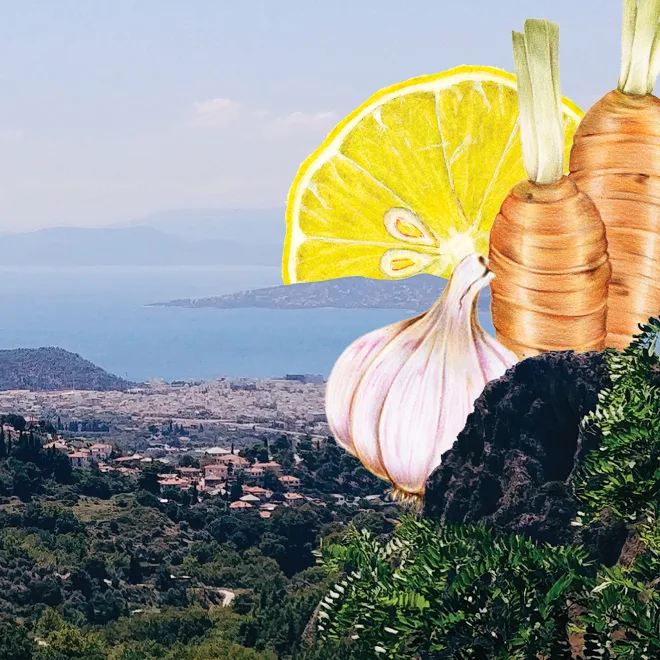
Politiki
In the fall or winter, when its requisite vegetables are in season, politiki is the salad to order. Made from freshly-sliced cabbage, carrots, celery and garlic, with vinegar and lemon juice, this has an acidic zing and almost pickled flavor. The name politiki demonstrates the influence the Greeks of Constantinopoli (modern-day Istanbul) had on Greek cuisine; “poli,” the Greek word for city, was the nickname for the city. This salad is a testament to the enduring impact the various conflicts between Turkey and Greece have had on the food. Politiki is on offer at almost any taverna in Greece, but if you go to a tsipouradiko, an establishment where the food centers around the strong local spirit tsipouro, it will be a likely component of your table full of meze.
Where to eat politiki: Aivali Paradosiako Tsipouradiko in Volos