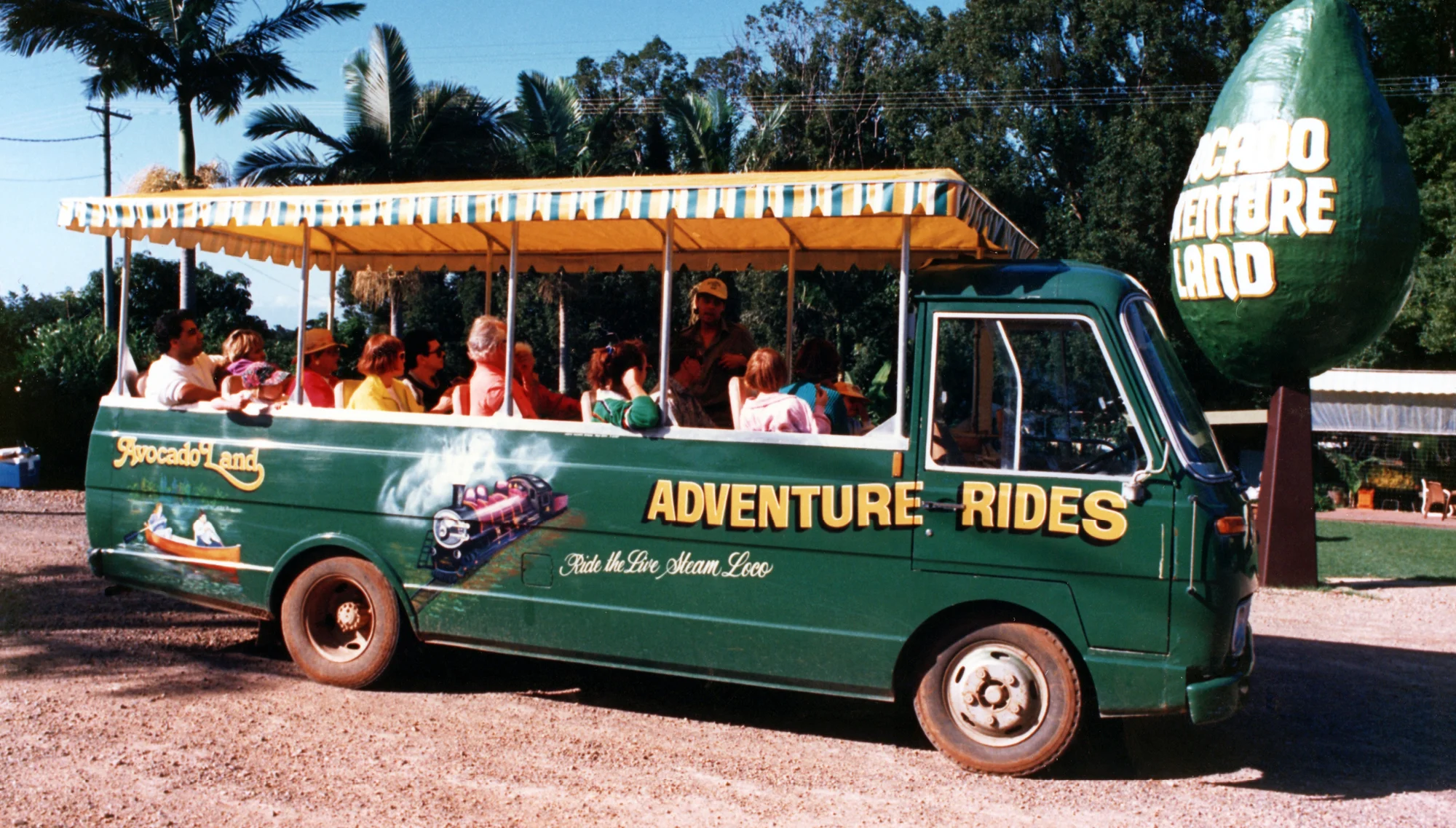
It’s looking very likely that this coming summer for many of us is going to be the season of the road trip; we'll be rediscovering our own country, wherever we live.
This, for me—an Australian, born and raised in Queensland—is funny and nostalgic and poignant in all sorts of ways. In the ‘80s, when I was a kid, road trips were what Australian families did. It was the quintessential middle-class vacation. Jaunts to Europe, beaches in Southeast Asia, skiing in Japan: all these trips that Australians now go on so conspicuously, were then the preserve of only the wealthiest. Most of us piled into our cars a couple of times a year and went.
And actually, I hated road trips. It was my worst nightmare, to be in a car for hours and hours. Travelling what I then often thought of as dry nothingness, so far away was it from the landscapes of Narnia or some other foreign book or film that had captured my young imagination. We need to remember here that Australia is gigantic, bigger than the continental US; and everywhere was hours upon hours away by car. And air travel was absurdly expensive, especially for a family of six. We often drove the half-day to the deeply un-cool beach town where we had a flat for three weeks every summer. We regularly drove the 13 hours to Sydney—that impossibly faraway Emerald city, so it seemed to the mini-Dorothy that was me. And we’d drive the even longer route to Melbourne (which was really far, and the city of intimidating culture: Cafes. Galleries. Museums!)
I was the youngest of four and so was relegated to the very back seat, where I watched the vast countryside go interminably by. I didn’t have a mature enough understanding of distance calculations to say to myself, “We must be about a third of the way to Sydney by now.” What I did have, though, was The Big Banana.
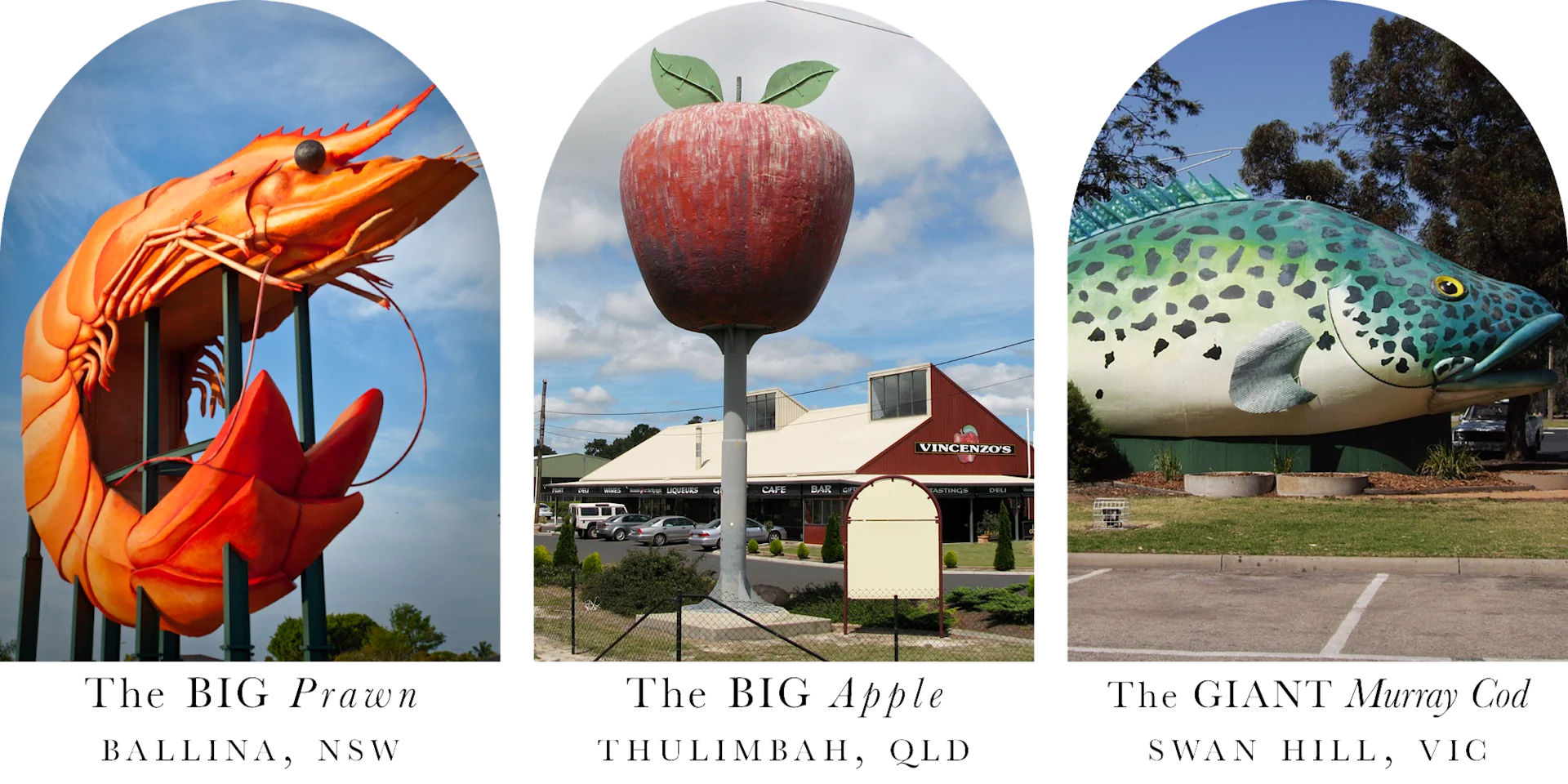
The Big Banana is said to be the oldest, and is definitely one of the most famous, of what are known as The Big Things of Australia. Wikipedia defines them as “a loosely related set of large structures, some of which are novelty architecture and some are sculptures.” It’s estimated there are about 150, scattered across every state and region of the country, most of them along or close to major highways. They’re usually made of fiberglass, and they are always massive. They’re a weird, singular and quintessentially Australian phenomenon, whose existence no one can definitively explain or justify: kitschy-hilarious-charming symbols of a town’s signal farming or agricultural industry, the pride of its enterprise.
You find quite a few of the better-known Big Things along the Bruce Highway—a kind of uber-Australian hybrid of California’s Highway 1 and Route 66, that runs along the coast of Queensland. There’s The Big Pineapple, another of the markers of my childhood (I couldn’t have told you how many miles it was from our house to the town where we rented a place each summer; but I knew that when we spotted The Big Pineapple, signalling our exit, my summer got started in earnest). There’s The Big Orange, and The Big Mango, and The Big Barramundi, and the Big Macadamia. In New South Wales, besides the beloved Big Banana (constructed in Coffs Harbour in 1964), there are the Big Avocado, The Big Wine Cask, The Big Oyster. And, in Ballina, near Byron Bay, the iconic Big Prawn.
When I was a kid, The Big Banana was more than just a huge fibreglass fruit sitting incongruously by the highway: it was an attraction. There was a small banana plantation which you could tour, and a banana-themed gift shop, and a café where my mother would buy us banana smoothies (not today’s acai-protein supplement-green variety: this was vanilla ice cream with a candy-stripe straw all the way).