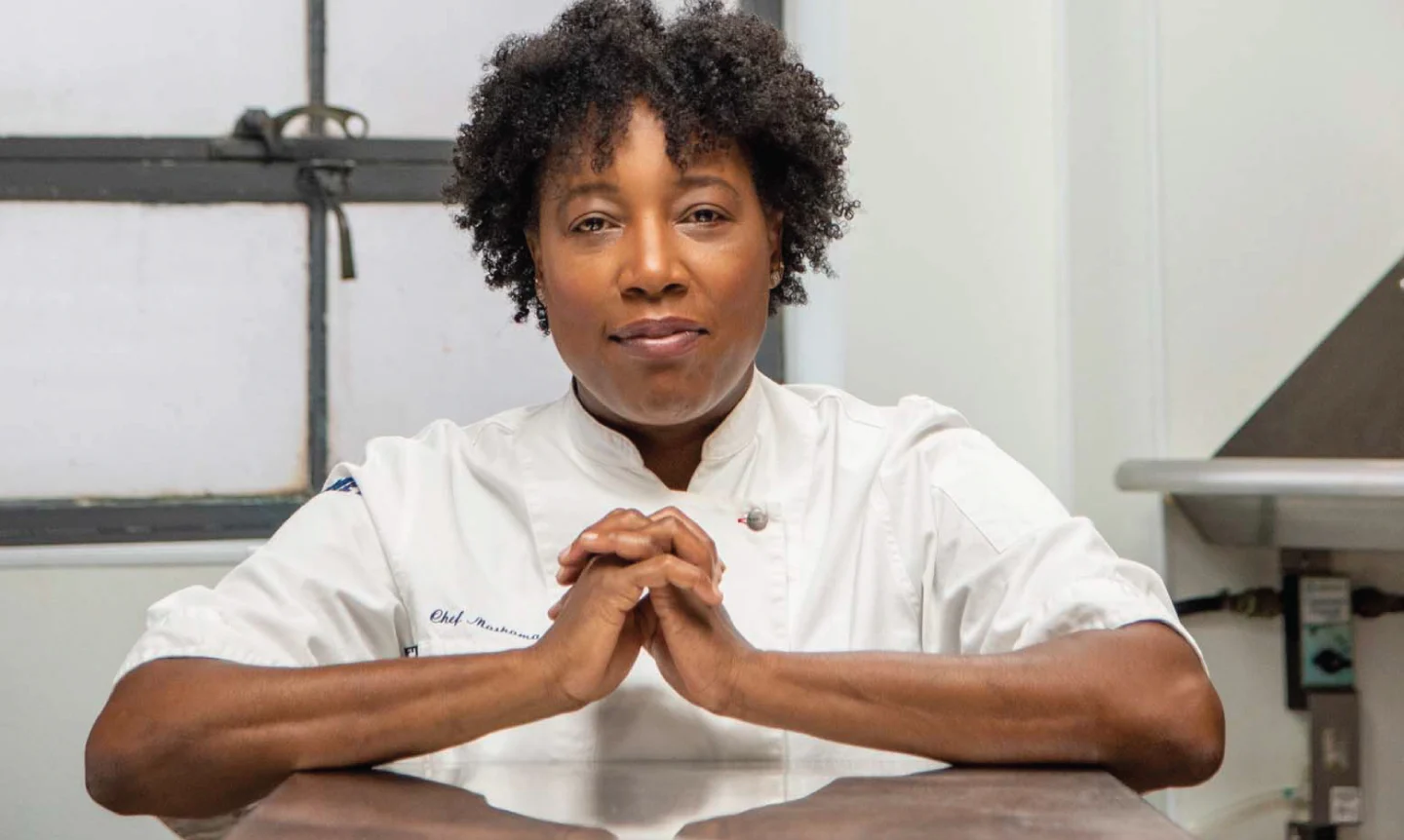
When people talk about Southern dining today, what they’re really talking about is Mashama Bailey. The chef behind The Grey, located in a former Greyhound bus station in Savannah, Georgia, is the undisputed champion of New Southern cuisine— a food movement that celebrates the heritage crops and diverse ancestral roots of the American South. The restaurant is so widely beloved that some people probably became aware of The Grey without being able to point to Savannah on a map. (This was in no small part thanks to a 2019 episode of Netflix’s Chef’s Table, but those in the know have been following the restaurant since its opening in 2014.) But two James Beard Awards, rave reviews, and seemingly endless accolades in the press haven’t torn Bailey from her focus on community. She continues to invest in both the wellbeing of her restaurant staff and the future of Black food at large.
“Living in the South and owning a business in a post-George Floyd world, one can’t help but to be aware of the constant injustices embedded in our society,” she says. “We are trying to provide an inclusive and diverse working environment where people feel safe and seen. The challenge in the South is that the visuals of black folks in menial jobs has been normalized. Our focus is constantly searching for talented people of color.”

That focus extends to her work with the Edna Lewis Foundation, named for the pioneer of Southern cooking who made a name mentoring generations of chefs and food enthusiasts. With the foundation, where she currently serves as Chairperson, Bailey has led the way in creating opportunities for “young, talented, up-and-coming Black food-focused people by way of storytelling, cooking, and agriculture,” as she puts it.
The Grey has also collaborated with local artists like Marcus Kenney, a graduate of the Savannah College of Art and Design, whose painting of a Greyhound bus with Black passengers seated at the front and whites in the back hangs prominently above the tables. Kenney’s recent installation involved fluorescent overhead lights blasting on in the restaurant, interrupting the dining experience with a harsh reminder of the space’s fraught history, and the ways racism persists in America. The lights turned on every hour for two minutes, 23 seconds, marking the date of the murder of Ahmaud Arbery— who was shot while jogging by three white men less than an hour’s drive from Savannah, a city where Civil Rights were rigorously fought for.

For Bailey, these reminders are as crucial to the experience as the reliably great food; her menu is steeped in her familial roots. Born in the Bronx, Bailey moved to Georgia at age two, then to Savannah at five, and spent her childhood learning Southern cooking from her mother and grandmother. She returned to New York six years later and stayed there through adulthood, when, after working at a homeless shelter, she found her way to culinary school and several kitchens including Prune, where she was promoted to sous-chef. A work-study program brought Bailey to Château du Fey in Burgundy, but it was only a matter of time before she found her way back to Georgia; an invitation to take over the abandoned Jim Crow-era Greyhound station brought Bailey right across the street from the courthouse where her parents got married in the 1980s. It wasn’t long before The Grey saw lines out the door, and Bailey became the most important working chef in America. Bailey spearheaded a movement of reinvigorating Southern cuisine and restoring it to its Black roots. She looked at the South’s lost foodways and reintroduced locally-sourced ingredients that have always played a central role in Black cooking: okra, benne, and Sea Island red peas among them.

With that keen eye toward history and culture, she took Southern classics and updated them with her French techniques— think deviled eggs with foie gras, quail stuffed with sweetbreads and tossed in Madeira wine, or black bass with ruby red shrimp and bouillabaisse broth. Bailey’s book, Black, White, and The Grey — a hybrid cookbook-memoir that she co-wrote with her business partner John O. Morisano— tells the story of how she brought issues of race in America to the forefront of her cooking, and got the whole country talking as they ate.
In the spring of 2022, The Grey empire landed in Austin, a city that resonated with her in its similarities to Savannah (“a cool town with a great music and food scene centered around a college.”) Taking inspiration from Southern lunch counters and New York City bodegas, the Grey Market Austin— the cousin of Savannah’s Grey Market, Bailey’s unfussy luncherie— serves a “hearty breakfast, fast lunch, and afternoon libations,” as well as a variety of provisions. From free-range fried chicken to French dip, the menu has all the Southern fare you could crave. But being a Mashama Bailey operation, there’s also “the NYC” — a bacon, egg, and cheese breakfast sandwich on a Kaiser roll— and it’s available all day long.