“The glory of New York is the Central Park. It does not do to say that it is fine, grand, beautiful, and miraculous. You must swear that it is more fine, more grand, more beautiful, more miraculous than anything else of the kind anywhere." - Anthony Trollope
On August 21, many thousands of people, most likely tens of thousands of them, will gather on Central Park’s Great Lawn, breathe on each other, touch, dance, sing and celebrate New York City’s emergence from the pandemic on the grasses of its most sacred, perverse and celebrated metonymy. The mayor has asked Clive Davis and Live Nation to organize a “mega-concert” to celebrate New York’s emergence from the pandemic, which will take place, of course, in Central Park.
Probably — definitely — the most famous park in the world (honorable mentions to Hyde Park, Gorky, and Chapultepec), Central Park is more to New York City than other parks are to other cities. It’s too big for a metaphor. Since its inception—from a desire by wealthy merchants and landowners to have a pleasant place to ride in carriages—it is more of this city than the Empire State Building, than nightlife, than almost anything but the people. It is the exception within the city, and yet, the city. So prominent, like the pyramids, one has to ask: why bother? One reason: there’s so much more than we thought we knew.
Fun fact: Central Park is a stroke of luck. Forget, for a second, that it was unprecedented—the first landscaped park in America. Forget that it was ambitious; its 778 acres (eventually 843 acres) would be five times larger than all of New York’s other parks combined. Forget that, while the merchants and landowners who argued for the park wanted something that would compete with the grand parks of Paris and London, the commissioners had the sense to choose Frederick Law Olmsted and Calvert Vaux’s “Greensward Plan,” in 1857—a much less rigid, expansive, pastoral park with meadows, hills and paths for a plurality, not rows of gardens for a few. Know that Olmsted wasn’t supposed to win. The landscape designer expected to design the park was Andrew Jackson Downing, who was much better known. But he died in a boat fire in 1852. Back luck for him; good luck for us. And now we get to see Jay-Z (Davis hasn’t announced which acts will be performing, but maybe we’ll get lucky).
What other secrets, nuances, little twists of fate, is Central Park hiding from us? As many as it has branches. Here, we share a few.
Bethesda’s Progress
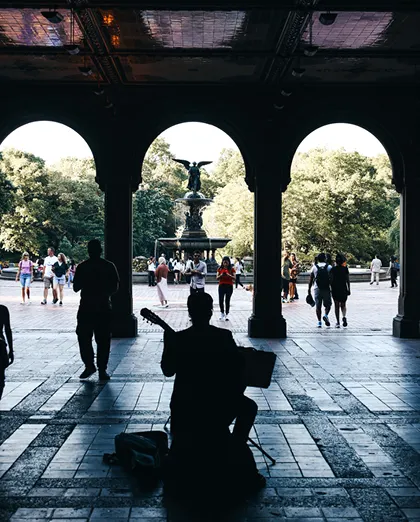
There may be no more iconic figure in Central Park than the Bethesda Fountain—built to commemorate the opening of the Croton Aqueduct—within the Bethesda Terrace at the North end of the Mall. “It is unique because it was the only statue that was commissioned as part of the park’s design,” says Central Park Conservatory historian Marie Warsh. Angel of the Waters, the angelic statue that adorns the fountain (in the Gospel of John, Bethesda was a pool, or pools, where the sick of Jerusalem were healed), was modeled on sculptor Emma Stebbins’ partner, the actress Charlotte Cushman. “Stebbins was gay at a time when very few people in the city identified as such,” says Warsh, who also points out that Angel of the Waters is among the first public works commissioned to a woman artist in any American city.
“Vagabonds and scoundrels of every description.”
Walk between 82nd and 86th streets in the vicinity of Central Park West to visit the former grounds of Seneca Village, a unique African American community, which, in 1857, boasted 250 residents, 52 houses and 3 churches. It also was the location of Summit Rock—the park’s highest point—and Tanner Spring, both of which can still be visited. The park wasn’t always a park; until the mid-19th century, the area was a medley of suburban estates, asylums and the homes of poorer families. This last category comprised around 1600 Germans, Irish and African Americans, who mostly leased their plots from the landowners.
The park’s inhabitants were portrayed as indigent squatters by local media, “Vagabonds and scoundrels of every description,” in the words of The Evening Post. In reality, they were “Grocers, founders, milkmen, gardeners, rope makers, bone boilers, leather dressers, and hog keepers,” according to Elizabeth Blackmar in her book, The Park and the People. Go to the park’s very Southeast corner to find yourself in “Pig Town,” where Irish pig farmers once plied their trade, until the mid-1850s, when they were effectively evicted (the owners of the land, including many residents of Seneca, were compensated under the eminent domain issue that permitted the park’s creation).