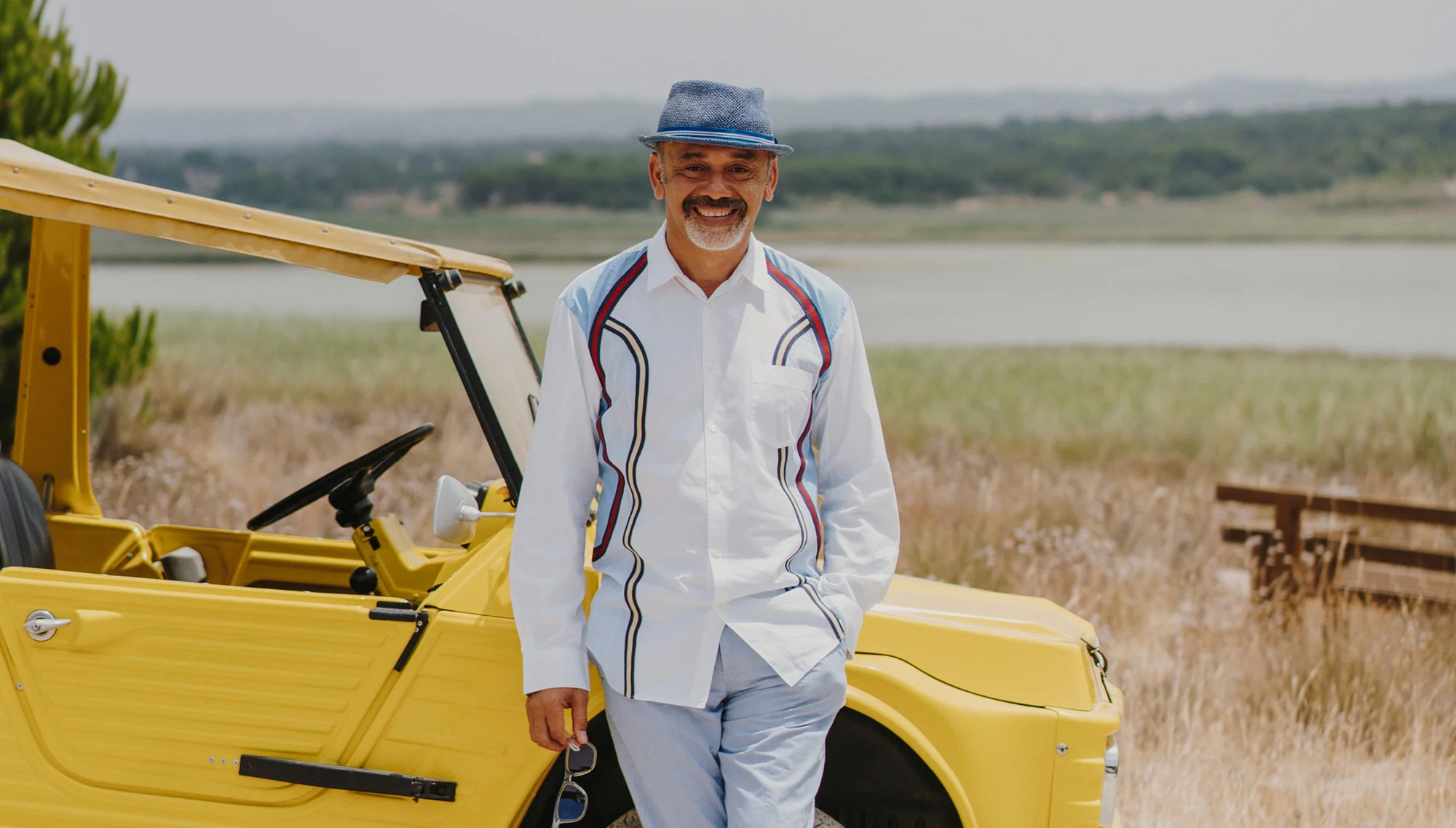
Some travelers have an innate ability to arrive in a place and truly understand its magic, even when most people can’t quite see it yet. It’s a rare and instinctual quality held by Paris-based designer, Christian Louboutin. He may have built an empire on his red-soled shoes, but it’s the way he connects to the world as a traveler that has enriched him in, perhaps, more important ways.
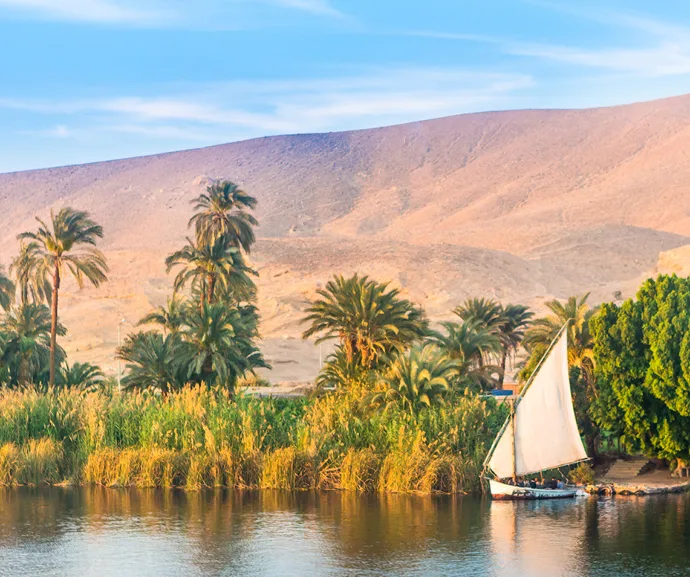
The son of a stay-at-home mother and carpenter father, Louboutin dropped out of school as a teenager and fled France for extended stays in India and Egypt. Egypt, in particular, instantly captured his heart and has remained a beloved getaway, despite the recent years of conflict. Louboutin owns a country house near Luxor (as well as a traditional dahabeah boat made for cruising the Nile), which he has filled with antiques and finds from across the globe: a tiled Moroccan dining table, furniture hand-beaded in Cameroon, and piles of vintage Egyptian fashion magazines.
Many years after his first visit to Egypt—but before he became a household name—Louboutin was introduced to another country by his then-partner, the landscape architect Louis Benech, that continues to play a prominent role in his life: Portugal. Many travelers, especially the French, had not even considered visiting the country. “After the revolution in 1974, people would not go there. For Europeans, it was considered the younger, poorer brother of Spain,” he says. “And because a lot of Portuguese migrated north, including to France, there was a form of racism against Portugal. People wouldn’t go, so it was a gem for the longest time.”
Louboutin recognized the country’s charms from the start. His visits became more frequent, leading him to purchase an apartment in Lisbon and a home in the then-empty, now-overrun beach town of Comporta. Once other travelers began descending on the formerly desolate stretch of coast, he decamped further south, to the village of Melides, where he now owns a compound of bungalows reachable by an unpaved road.
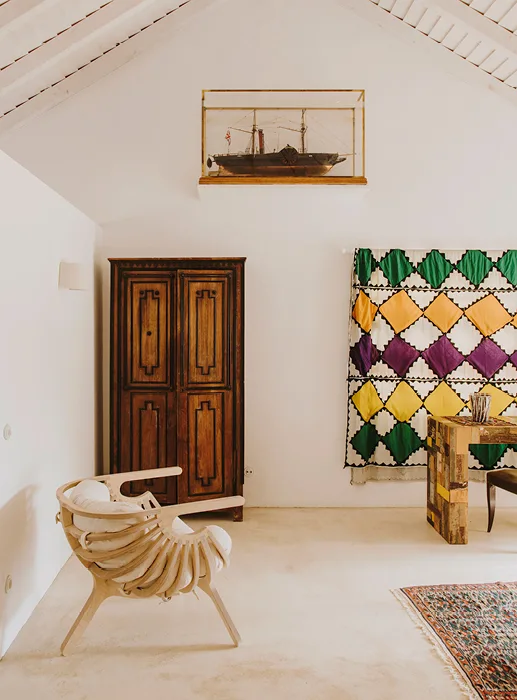
To understand Louboutin’s affection for Portugal, one only needs to look at his recent Portugaba collection, which honors various traditional artisan techniques used in villages across the country. While his global adventures have informed his designs, the inspiration is often unintentional. “I travel because I’m curious,” Louboutin says. “I never go to a place intending to do a collection inspired by it. When I see things, I’m not thinking about them in terms of work. It’s only after when I can reflect back.”
Tell us about your connection with Portugal. When did you begin traveling there?
It all started with my friend Louis about 25 years ago. He lived in New York but would visit Comporta with his mother for the holidays, so I would go with them. At the time there was nothing there—it was really, really pretty. About 15 years ago, Louis moved to Portugal so I continued to visit him, and then I would go for two weeks every summer, and eventually bought a house there. But Comporta became this really busy, va-va-voom place, and I started to hate it. So five years ago I moved down south to Melides. It’s the same coast, but much slower—there’s nothing there.
Four years ago, you launched a handbag line called Africaba, a collaboration with artisans in Senegal, and followed it up with similar projects in Mexico, the Philippines, and most recently Portugal. What was the impetus for these destination-inspired designs?
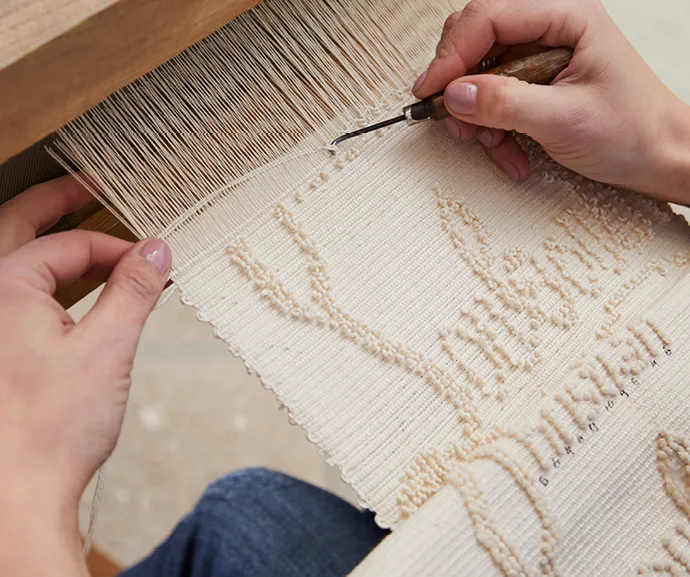
It began quite naturally. My friend Valérie Schlumberger was working with female embroiderers in Senegal who had been expelled from their families for various reasons and I thought, ‘I should do something with those women.’ The second year I thought of Mexico because I’ve always loved it. And there was no way I could not do something with Portugal—artisans there often only sell in their own villages; they really don’t bring their designs into the capital. I began to discover that there were many different types of artisanship that were very, very nice.
To whom or what do you attribute this strong love and appreciation for artisan-made designers?
I started traveling when I was pretty young. I moved away from home at 12, and went to live with my first boyfriend at 13, and we started to travel. I was always bringing back things. I remember visiting Morocco when I was 16 and having shoes made. I always love the idea of having things made.
My father was also an influence. He was a cabinetmaker, and from an early age I saw him working on objects. He would show me the vein of the wood and all these things. He was very sweet, somber, and quite shy, and for the longest time I thought I was the product of my mother, who had a very strong personality. But she had no patience; she couldn’t look at an object for more than five minutes. I realized much later that I’m much more like my father. His influence has always been there—I just never gave him any credit for it.