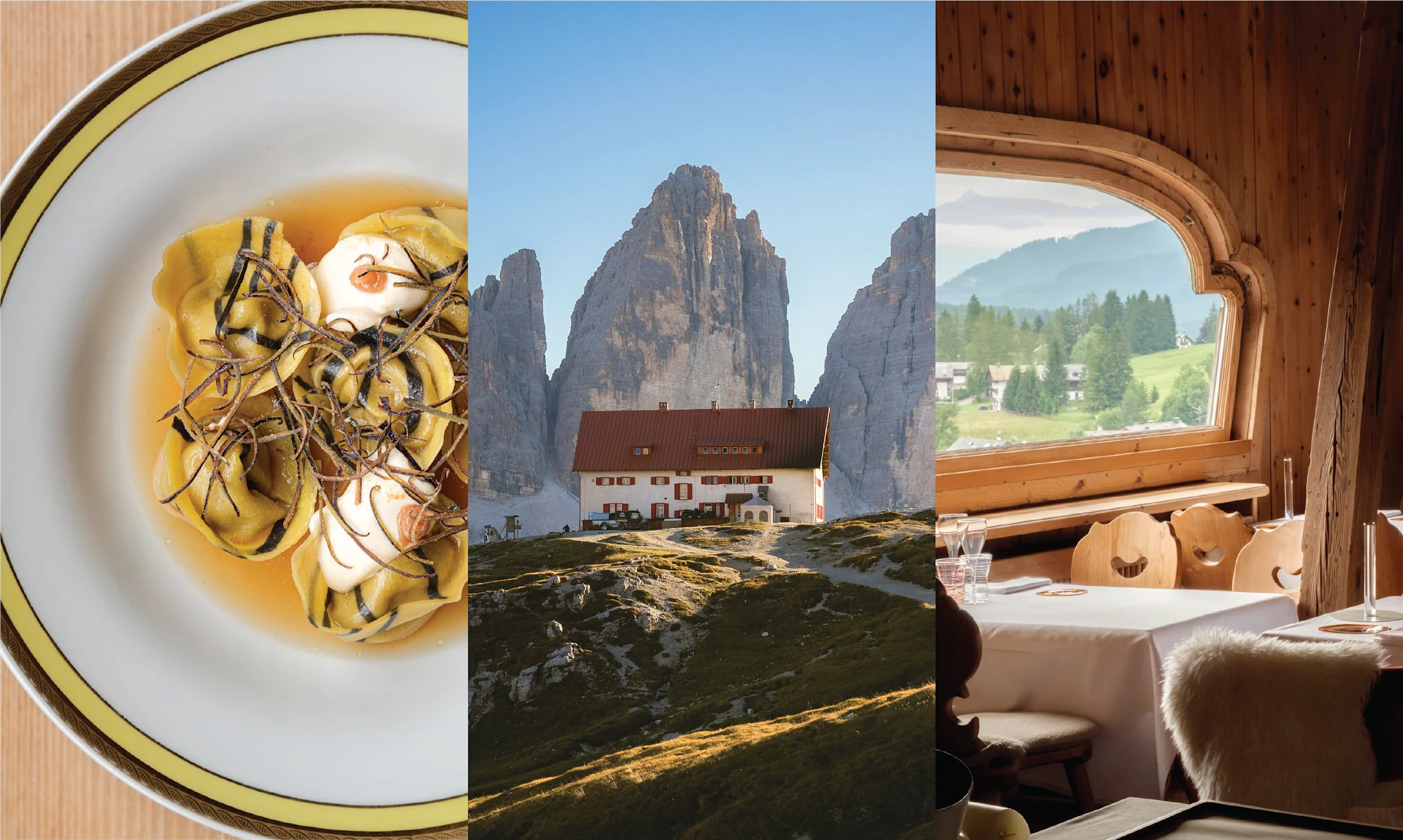
Rising like pale cathedrals from the heart of northern Italy, the Dolomites are without question the eternal favorite among Alpine destinations. As early as the mid-1860s, two Britons, Josiah Gilbert and George C. Churchill, sparked a veritable rush of visitors with their book, The Dolomite Mountains. The range, often hailed as the most beautiful and dramatic in all the Alps, has captivated travelers ever since. Three language groups – German, Italian, and Ladin – share this territory, which spans the three Italian regions of Alto Adige–Trentino, Veneto, and Friuli Venezia Giulia.
This makes it a true meeting place of cultures, reflected not only in its languages but also, quite naturally, in its cuisine. Central European specialties such as Knödel (dumplings), strudel, and smoked pork belong as much to the region as Mediterranean classics like pasta, tomatoes, and olive oil.
From lush green Alpine meadows come the herbs and rich milk used for butter and cheese; from dense forests, the mushrooms and the meat of wild game such as deer and roe. And from the nearby Adriatic Sea (just a two-hour drive away) arrive fresh fish and seafood. The region also produces excellent red and white wines, some from vineyards that thrive at over 3,280 feet above sea level.
The region’s most emblematic dish is undoubtedly filled pasta – delicate, half-moon-shaped ravioli known in German as Schlutzkrapfen, in Ladin as casonzei, and in Italian as casoncelli or mezzelune (“half-moons”). A special variety of this pasta is casunziei all’ampezzana: half-moon ravioli filled with red beets and ricotta, lavishly coated with poppy seeds, Parmesan, and melted butter – plenty of butter. This is the signature dish of Cortina d’Ampezzo, regarded as the most famous town in the region. The “Pearl of the Dolomites,” as Cortina is often called, is Italy’s most exclusive ski resort – and, come February, once again the host of the Winter Olympic Games, for the second time since 1956.

This fall, the picturesque town is especially bustling. Construction cranes rise everywhere; the sounds of hammering, drilling, and building fill the air. Even the old Olympic ski jump from the 1950s is wrapped in scaffolding – though the ski jumping events for the 2026 Winter Games will actually take place in Predazzo, in the Val di Fiemme valley.
Construction work is still ongoing along Corso Italia, Cortina’s main shopping street, sometimes behind screens adorned with glamorous logos – Prada, Louis Vuitton, or Dior. Where usually well-heeled shoppers in chic fur coats or Moncler jackets would stroll, men in yellow hard hats and safety vests are now bustling about.
The local restaurant scene is also gearing up for the grand spectacle that will once again place the Dolomite region under the global spotlight, seventy years after the 1956 Games. Some have only just opened or changed ownership, others are undergoing renovations, and a few are long-established classics. All of them are eager to showcase to the world the cuisine of this unique region, where the Mediterranean climate meets the Alps and Latin and Central European cultures intertwine.
Alajmo Cortina
Two years ago, brothers Max and Raffa Alajmo – known for running the Michelin-starred Le Calandre in Padua and the historic Caffè Quadri in Venice – took over this charming chalet just outside the town center, offering spectacular views of Cortina and the surrounding mountains. The atmosphere is warm and inviting, with plenty of wood, furs, and comfortable chairs. Yet, after all, this is Cortina: there’s also a caviar and champagne fridge, along with pictures and models of sleek boats and fast cars. Chef Max Alajmo aims to “build a culinary bridge between the Venetian lagoon and the Dolomites”. The result is dishes such as bone marrow with caviar on champagne risotto or fried scampi with thyme powder, celery juice, wild fennel, and spruce shoots.
Località Ronco 123, 32043 Cortina d’Ampezzo BL, Italy