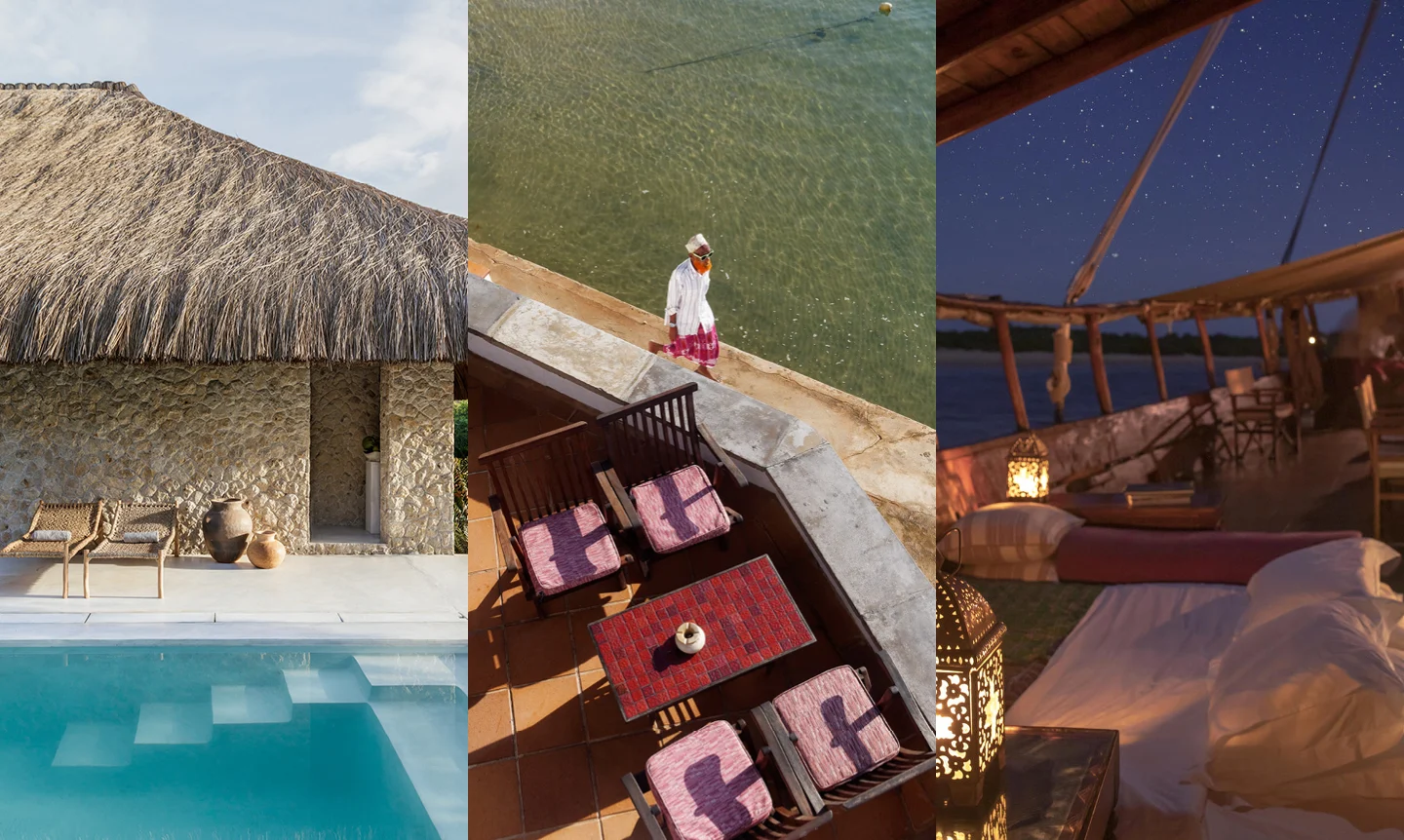
My fixation with Africa’s expansive coastline isn’t mysterious. Ever since I first set foot on the shores of Lamu in 2016, it has become my favorite place in Kenya, whether shucking wild oysters off the rocks at Manda Toto, marveling at old homes with their zidaka niches dressed in antiques and porcelain plates, even doing headstands on the beach during the annual yoga festival. I’ve returned at least twice each year to watch sea turtles hatch on the beach and wander Lamu Town’s art galleries, snacking on sickly sweet labaneer. Walking through Zanzibar’s Stone Town, I am always transported to the past, imagining merchants haggling over the price of a kilo of cloves, and adventurers from across the seas setting foot on “zinj-bar” soil for the first time. Cruising down to Mozambique, South Africa and the islands in between, I’m similarly drawn to the allure of the rich history of small fishing towns and ancient ports, overlaid with unique local dialects, food and culture, and lulled by a pole pole (that’s “slowly, slowly” in Swahili) way of life. Here, then, are some favorite castaway hotels that might require venturing further to reach, but their locations are wild and beautiful—and entirely worth it.
LAMU ISLAND, KENYA
The surrounds
The unique swirl of cultures in the Lamu Archipelago off Kenyan’s northern coast—Swahili, Indian, Arabic, Persian, and European—reveals itself in every aspect of local life, from the architecture to the food. Once Africa’s most important trade port, Lamu has for decades lured a global mix of hippies, rockstars and royalty—not just for the sparkling blue waters and white-sand beaches, but also for Lamu Old Town’s animated markets and centuries-old labyrinthine alleyways, where no cars are allowed (get around on foot or on the back of a donkey) and where whitewashed coral buildings are offset by intricately carved mahogany doors.
Pair it with
Kenya’s Maasai Mara Game Reserve, renowned for its seasonal wildebeest migration from June to October, or farther north in Laikipia’s Borana Conservancy, home of the real-life Pride Rock and an ideal spot for galloping across the plains on horseback. Don’t miss the bustling capital, Nairobi, for the best sangria in town at Tapas Bar, colourful kiondo baskets sold in stalls along Red Hill Road, a plate of nyama choma (grilled meat) with locals at the Carnivore Restaurant, and the national park, the only one within the boudaries of a world capital city.
The stays
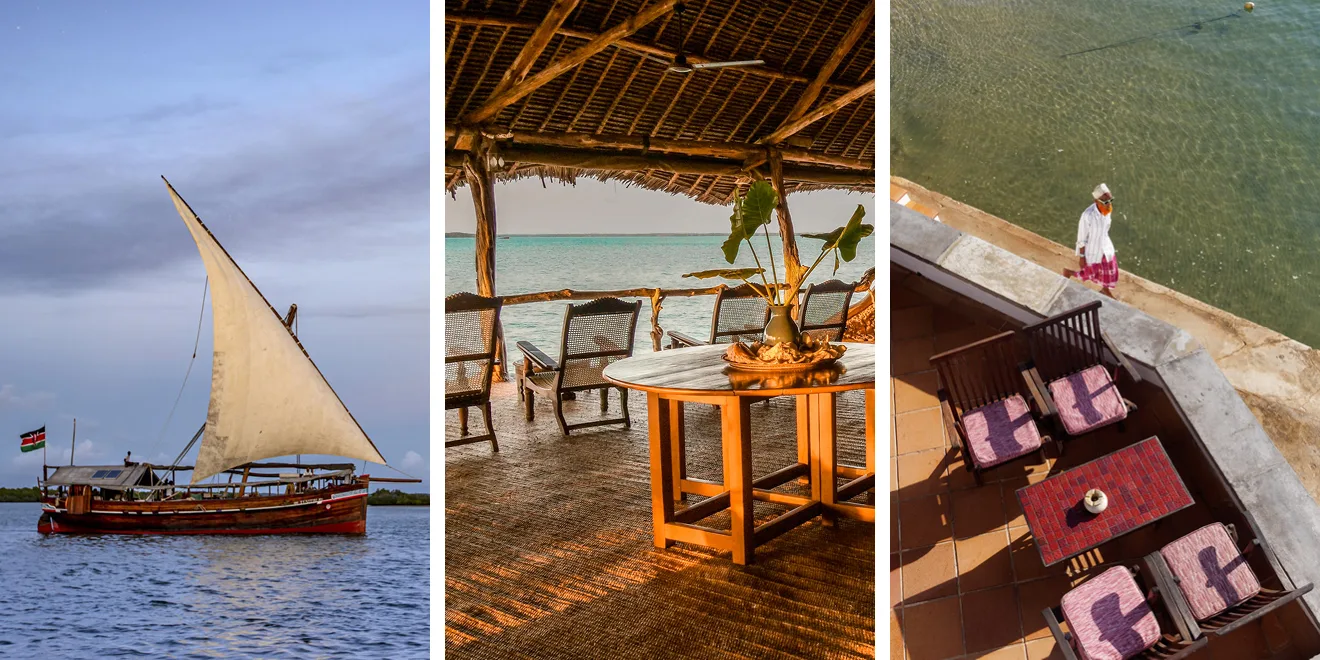
A century ago, the wooden dhow sailboats that dot Lamu’s horizon traded everything from coffee to spices across the Indian Ocean. Some of them have been given a second life, including the 50-foot Tusitiri Dhow. The once-shipwrecked vessel was transformed into a sumptuous private charter by its Norwegian owners with Zanzibari chests, kikoi textiles and polished brass lanterns; guests sleep under the stars on beds rolled out onto the massive deck. Back ashore on Manda Island, 20 minutes by speedboat from Lamu Island, the 22 stylishly rustic cottages at Manda Bay—acquired in 2003 by Kenyans Fuzz Dyer and Andy Roberts who raised their kids there, Robinson Crusoe-style—are now clad in makuti thatch and mangrove poles, and cooled by glassless windows that let in abundant ocean breezes. (A mile off camp, a herd of resident buffaloes, which crossed through a shallow canal a decade ago, can be seen grazing.) And, of course, there’s the legendary Peponi Hotel, which sits on a pristine stretch of sand on Lamu Island’s coveted Shela Beach. The whitewashed, colonnaded retreat, where 28 ocean-facing rooms and a few new villas are individually designed with multicolored Swahili textiles, sits on the outskirts of Lamu’s atmospheric Old Town.
ZANZIBAR, TANZANIA
The surrounds
The pristine beaches that rim the coast of Zanzibar, 20 miles off the coast of Tanzania, are a main draw, but just as intoxicating is the multicultural mix of daily life on this four-island archipelago, which include African, Arabic, Indian, Persian, and European influences. Women wearing colorful cotton khanga cloths explore the curio shops along the narrow streets of Stone Town, while men play a complex game of bao in the busy town square. At the night market, the air fills with the aroma of “Zanzibar pizzas,” crispy, spice-filled pancakes made with everything from lobster to avocado.
Pair it with
A safari in Tanzania’s Serengeti National Park, where the vast savanna is a stage for a herd of elephants cooling off with a dust bath, giraffes browsing tall acacia trees, or baboons calling out warnings at the sight of stealthy lions.
The stays
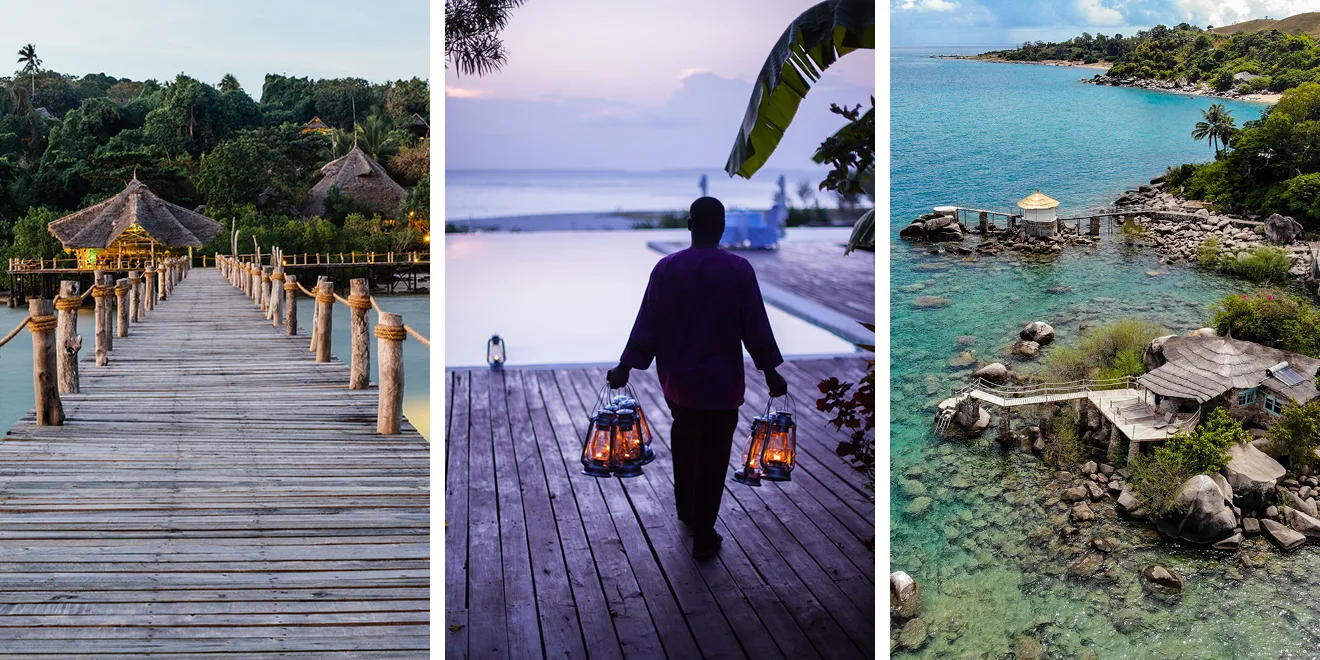
Set on the secluded southwestern corner of Zanzibar’s Pemba Island, Fundu Lagoon was constructed in the coast’s ubiquitous Swahili style with wood and thatch. In the 18 canvas-walled rooms on raised platforms, interiors are a mix of wicker, Tanzanian artifacts and local textiles; some are positioned right on the sand, while others (with the best views) sit along the hillside. On Zanzibar Island’s northwest coast in the fishing village of Nungwi, Kilindi Zanzibar, originally built for musician Benny Andersson of the Swedish band ABBA, sits on 50 garden-filled acres and takes its inspiration from Scandinavian minimalism. Each of the 15 villas, sheltered under chalk-white mushroom-shaped pavilions, has a slatted door that opens onto a plunge pool facing an indigenous forest and shore lined with double-outrigger canoes. There are no tides here, so take a dip in the sea at any time and gather for drinks around a nightly beach bonfire.
LIKOMA ISLAND, MALAWI
The surrounds
The larger of two islands within Lake Malawi, Africa’s third-largest body of water, Likoma sits off the lake’s southern coast bordering Mozambique. Here, village life is on full display on the baobab and mango-tree lined shores, where locals gather for everything from laundry to bathing. The island’s villages exude a small-town vibe, and visitors are often warmly greeted.