The precious connection to Country that the world’s oldest continuous living Culture, Aboriginal and Torres Strait Island people, have goes beyond language. Australia’s First Nations have been communicating visually for over 60,000 years and their magnificent contributions are a portal for understanding and change. It’s impossible to make a list that encapsulates Australia’s history, but this small list shines a light on both established and emerging artists who are currently creating using a mix of mediums—their work speaking to colonialism, genocide, identity, Culture and their deep connection to Country.
This tapestry of talent are just some of the many prolific and exceptional artists whose talents span photography, sculpture, fibre, textile art, and painting.
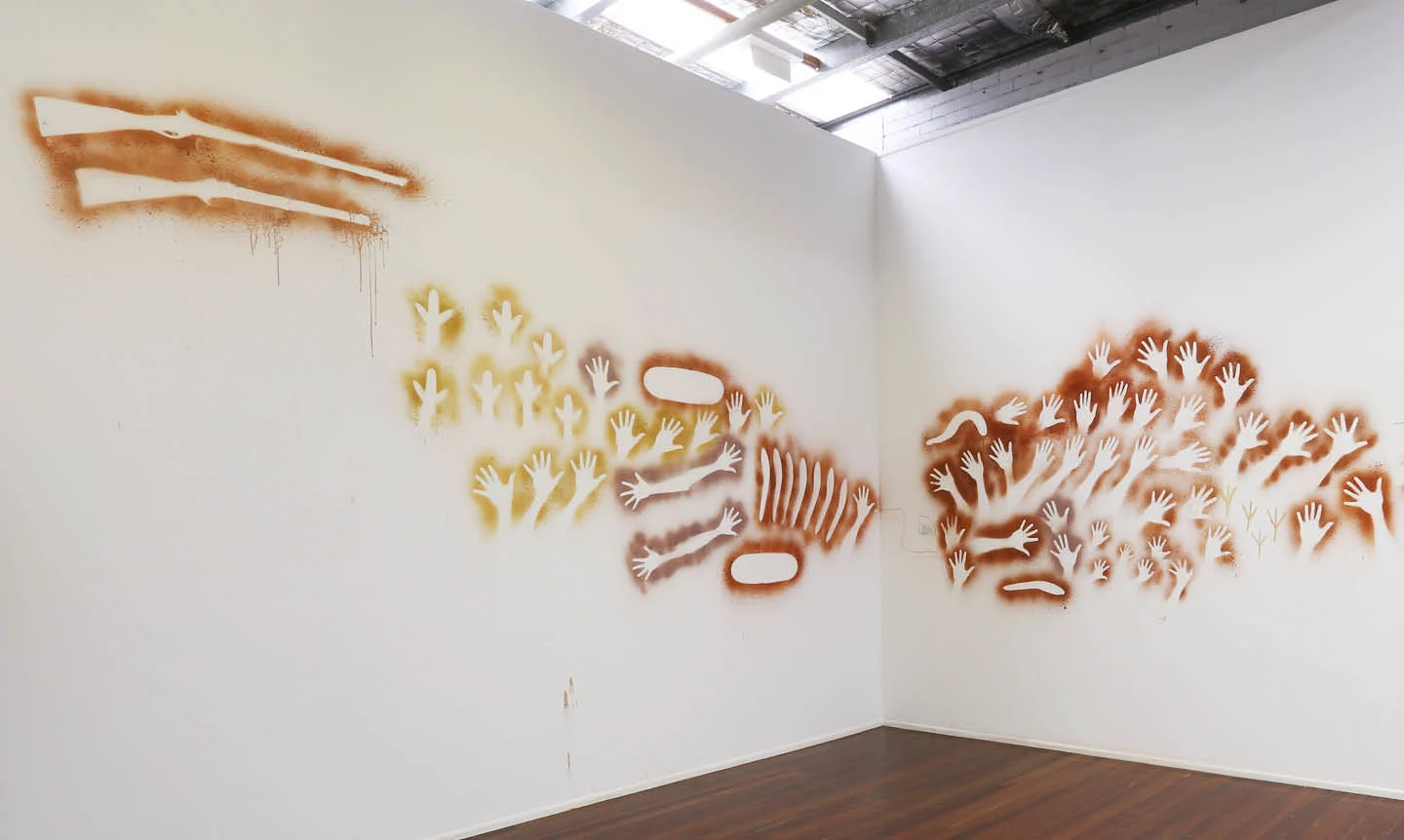
Dale Harding - Bidjara, Garingbal, and Ghungla man - Painting and Stitching
The subject of cultural lineage is what steers Harding’s typically large-scale work. (If you do see something of Dale’s that is not imposing in size, you can bet it’ll be packed and fully-loaded with meaning). Folding European and American art traditions deliberately into his commentary on ancestry, he most recently exhibited with his mother, renowned textile artist, Kate Harding—whose works are also large, made up of hundreds of thousands of minute stitches—in Through A Lens of Visitation. Both speak to Australia’s colonial intervention and, together, they are a greater sum than their part—two independant, outstanding talents who have both chosen to master contemporary versions of the oldest storytelling methods around: stitching and painting.
Penny Evans - Gomeroi woman - Sculpting and Ceramics
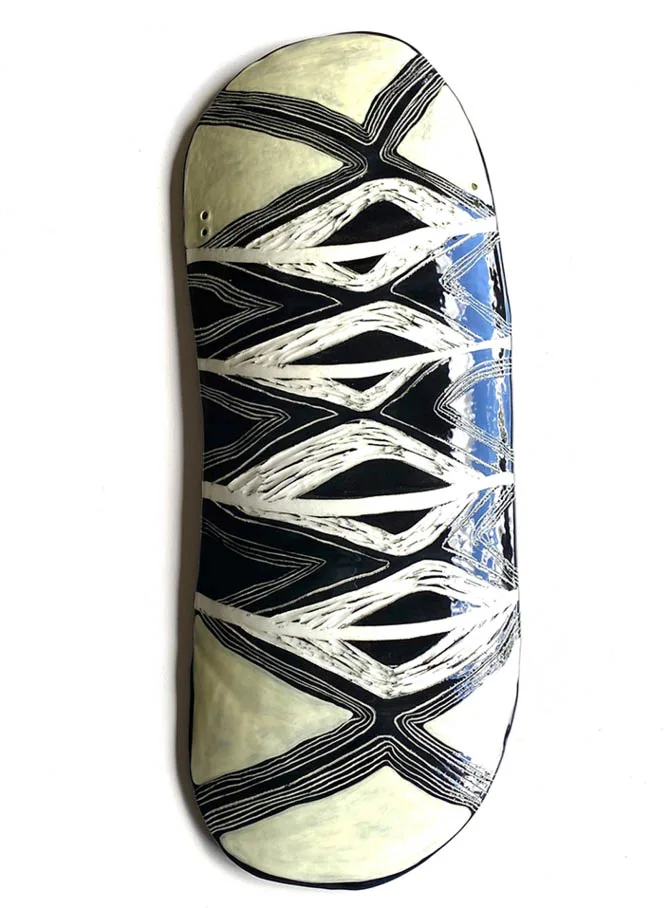
Of Evans’ genuine polymath—her talent not exclusive to ceramics, sculpture, and weaving—she describes it as “different parts of me going to different places.” She explains her works over 35 years and across mediums as her way of processing colonisation and climate change, from chronic water mismanagement, to environmental flows due to floodplain harvesting, disconnection from natural ecology, and beyond. “We embody our history and if we don’t understand where we come from, we are doomed to repeat it in the future,” she says. Penny’s large scale works are huge undertakings, and while Covid has pushed the 4th Indigenous Art Triennial exhibition dates out to March 2022, she remains deep in progress with many installation works that will be part of major exhibitions once rescheduled. At the same time, she offers small scale items off her website, making sure there is access to her art at all times.
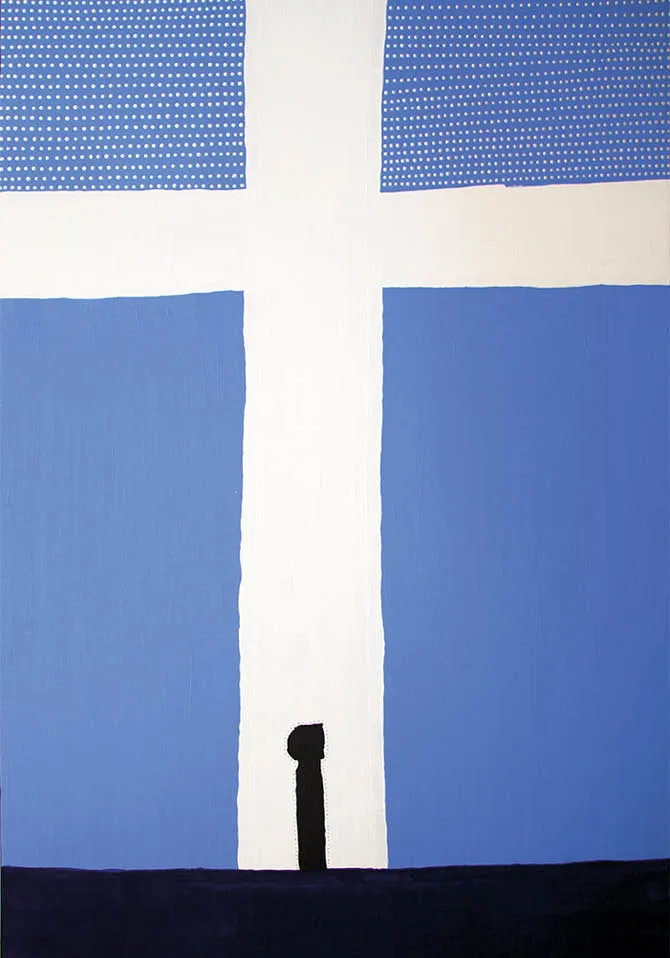
Michael Philp - Bungjalung man - Painting
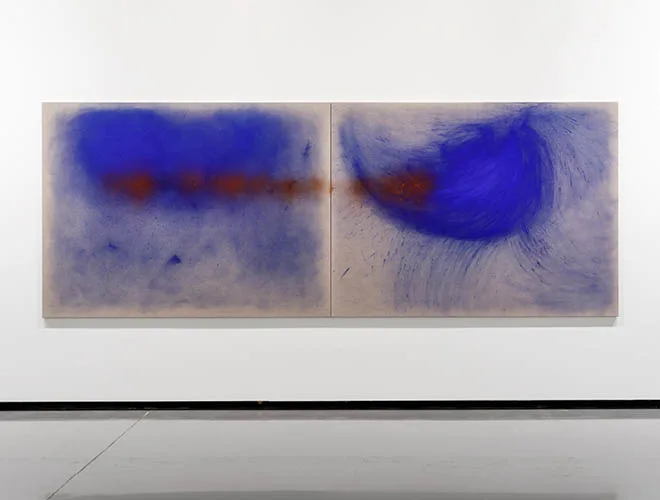
It might have taken this former Teachers Aid over 40 years to accept his calling as an artist, but it’s in part his late start that makes his simplistic storytelling of such raw issues so heartfelt and striking. After a change of life, well into his midlife, he recorded his memories both sweet and sour onto canvas. Motivated to paint partly as a way to heal, as well as to express his consciousness both as a son, a father, and an Aboriginal man, he says of his journey, “All of these stories that came up needed to be told.” His work speaks to universal human fears about safety, love, loss, family, and Country, with friends depicted as totems of support. In one work, an umbrella covers his late father, a fisherman, his painting a form of prayer for his safe return. Another depicts his mother as an anchor. His work usually uses two or three colours, a means of focusing attention so viewers can consider life’s simple truths. Proof that change can happen personally, he wants to do the same for others. “My work honours family, friends and Country,” Philp says. “These seem like simple things at first, but they are often complex for a lot of people.”
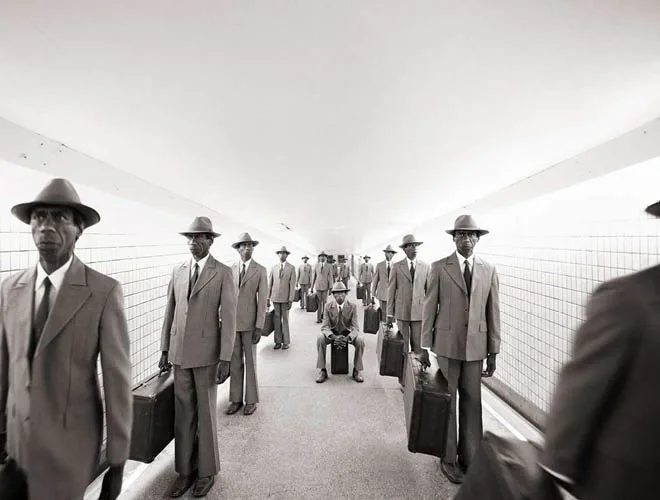
Michael Cook - Bidjara man - Photography
Subbing in the World Continuous Living Culture with it’s invaders gives power to photography as a medium that shapes cultural memory and goes straight through the heart. One look at any of Cook’s masterfully choreographed, technically perfect images registers deeply in what feels like in the left heart ventricle. His recurring question as to what makes a person ‘civilised’ has always been painful and relevant, but his impeccably set European scenes, cast with Indigenous Australians playing to the white norm, in his remarkable Invasion series makes the point louder and clearer than ever. Cinematic, brutal, and technically exceptional, his work has been selling out for 11 years, spanning recent Australian Prime Ministers through an indigenous gaze as well as topics of motherhood, environmental degradation, invasion, and displacement, to name a few. “Asking questions within my projects creates empathy which allows the viewer to explore my work in their own time and at depth they feel comfortable with,” he says. It’s hard not to stop looking at his layered work, if not for just trying to detect where the superimposition begins and ends.
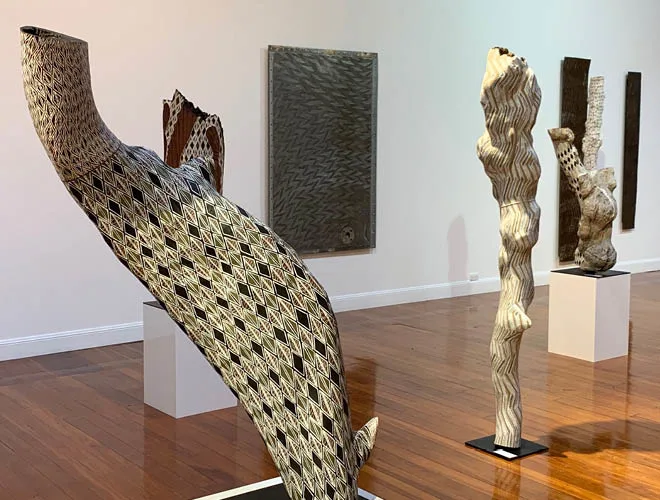
Gunybi Ganamarr - Gängan man - Sculpture and Carving
Gunybi’s work serves the eyes, the ears, the heart and the hands and somehow the spirit in all of us. Heroic and all-knowing forms push innovative materials like incised metal, ironwood sculpture, double-sided barks, and remnants to elevated limits in sell-out shows. What makes his work so otherworldly is how he manages somehow to embed the energy of ceremonial life into the work. As a revered Yidaki/didgeridoo player, all his worlds mesh together in pieces like his “Milnurr Naymil Font on Found Washing Machine 2020,” in which he uses intricate and demanding traditions of Yolngu carving with discarded materials from miners' waste (rubber belts and insulation). It is impossible to separate the art from the artist with the viewer sensing both his sheer joy and the weight of responsibility as a position of Authority in his community.
Kylie Caldwell - Bundjalung woman - Fibre Arts
“Ancestral bags act as a record of my people and a store of Culture,” says Caldwell, “but they are more than keepsakes. In museums, these ancient artefacts become comatose if the community doesn’t have access to them.” Her deep connection to Country and Culture are her motivators, but you can also see inseparable links and references to water, her Tidda’s (sisters, but not necessarily by blood), family, and domesticity. “A basket is the carrier, but still the process of its life starts from the earth's gifts,” she says, “a ribbon sedge that needs air, water and soil, that provided for many and needs time to settle before it’s woven with another thread that loops in, over and under pulling all together so it can hold what it needs to hold.” Her recently exhibited “Wise One,” depicting faces from native bush plants, is particularly poignant, and you can almost smell the riverbanks in her “Jullum Nyabay Gilamahla” work, constructed of twine, inflorescences, and ribbon, which celebrates the role of female fisherwomen in the community. “Im Still Standing” is one of many works that depicts her ongoing celebration of womanhood: “In weaving we have rediscovered the value of matriarchal bonding, its healing and its power.”