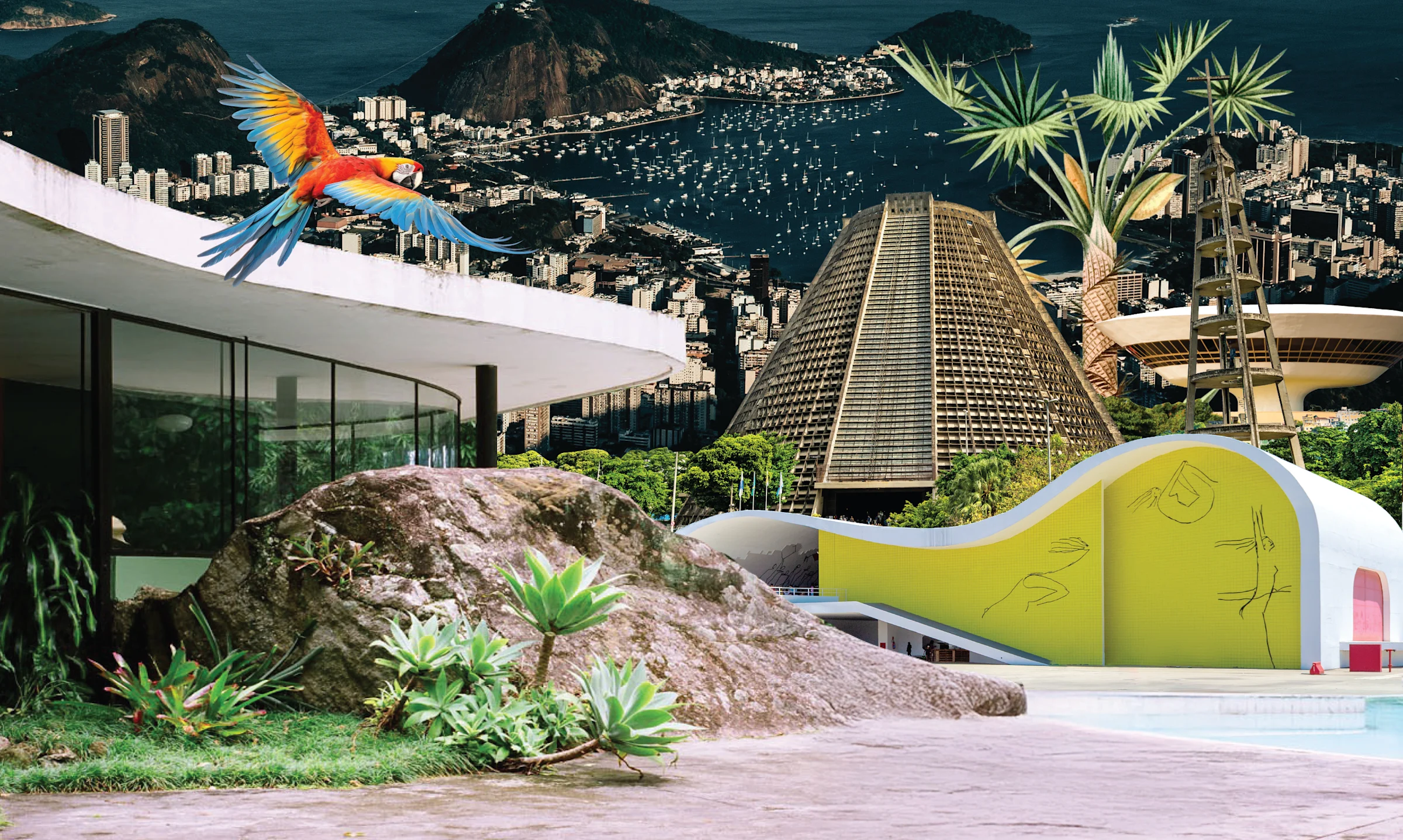
Rio de Janeiro functions as an open-air museum of modernist architecture. While the city is famous for its beaches, Carnival, and vibrant cultural personality, its architectural legacy is equally significant. Between the 1940s and 1980s, architects Oscar Niemeyer, landscape designer Roberto Burle Marx, and contemporaries like Affonso Eduardo Reidy and Edgar de Oliveira da Fonseca created a distinctly Brazilian modernism that integrated concrete structures with lush tropical landscapes. Their work ranges from major cultural institutions to public spaces used daily by millions of Cariocas (Rio residents).
This modernist movement emerged from a century of failed urban planning attempts. Portuguese colonial planning had given way to 19th-century efforts to recreate European models—most notably the demolition of entire neighborhoods to build Haussmanian boulevards like Avenida Central (now Rio Branco). These top-down impositions ignored Rio's topography, climate, and social realities, contributing to housing shortages that pushed working populations into informal settlements. The modernist architects of the mid-20th century took a different approach: working with the landscape rather than against it, using materials suited to the tropics, and creating public architecture accessible to all social classes.
What makes Rio's modernist architecture unique is how it became integral to the city's daily experience rather than remaining confined to elite cultural circles. School children play in buildings designed according to the same principles as major museums. Residents walk daily on sidewalks that follow the same design logic as significant landscape installations. Burle Marx's tropical landscape design became inseparable from this architectural movement, proving that modernism could embrace local flora and climate and seamlessly coexist.

Niterói
Pro tip: Visit Niterói in one trip with a private car. Take the bridge from Rio, stop first at Caminho Niemeyer, then continue to MAC. Ask your driver to wait at each location—most of the experience is about the buildings' exteriors and locations rather than extended interior visits.
Niterói Contemporary Art Museum (MAC)
Described by most Cariocas as the UFO that landed on a cliff, Niemeyer’s 1996 museum is a 50-meter-wide concrete disc that appears to hover impossibly above Guanabara Bay. The architect was 89 when he designed it, and the building reads like a master's confident flourish—no right angles, just a curved ramp that spirals visitors up to the floating gallery. Like much of Niemeyer's work, the museum's flowing form draws inspiration from the female body, part of his lifelong fascination with what he called "free-flowing, sensual curves."
What makes the MAC remarkable isn't just its form but its environmental logic. The curved walls channel ocean breezes through the interior, creating natural ventilation that keeps the space comfortable even in Rio's heat. Most visitors come for the building rather than whatever temporary exhibition is inside. The real art is watching how the structure frames the entire city of Rio through its floor-to-ceiling windows. From the right vantage point near the eastern windows, the museum's curved edge aligns perfectly with Sugarloaf Mountain's distinctive slope, creating the illusion that Niemeyer's concrete flows seamlessly into the granite peak across the bay. Christ the Redeemer presides over the scene from Corcovado, while the dense urban sprawl stretches between the mountains—Rio's entire geography composed into a single, carefully orchestrated panorama.
Caminho Niemeyer
While crowds flock to the MAC, three other Niemeyer buildings sit quietly along Niterói's waterfront, largely ignored by tourists. The Roberto Silveira Memorial, Teatro Popular, and JK Memorial were completed between 2007 and 2009, representing some of the architect's final works. Here you can experience Niemeyer's late-period minimalism without entrance fees or guided tours—just white concrete forms against blue water, as pure as architectural statements get.
The complex feels like a meditation on Niemeyer's career: the same bold curves and floating volumes, but stripped to their essential elements. Locals use the spaces for jogging, wedding photos, and quiet contemplation. It's Niemeyer architecture as public furniture, which may have been the point all along.